



Kamala Jayanti 2026 is on Sunday, 8 November 2026.
| Nishita Kaal | 11:45 PM – 12:37 AM, 9 Nov |
|---|---|
| Times for | Ujjain (IST) |
On this page: significance · the story · puja at home · samagri · regional traditions · Kamala among the Dasha Mahavidyas · dates · prarthanas and mantras with audio · questions about Kamala Jayanti
Chaturdashi
Amavasya

Significance of Kamala Jayanti
Kamala Jayanti marks the appearance of Goddess Kamala, also called Kamalatmika, “she who dwells in lotuses”. She is counted as the tenth and last of the Dasha Mahavidyas, the ten great wisdom goddesses of the Shakta tradition.
Her day falls on the Diwali new moon, the same night as Lakshmi Puja. Kamala is often called the tantric form of Lakshmi. In many homes her remembrance simply joins the Lakshmi worship rather than standing apart.
Devotees pray to her for prosperity, but not money alone. Writers on the Mahavidyas see in her a meeting of material plenty and spiritual fullness, the two held in one form. Shakta tradition sees in Kamala the Goddess at her most gracious and complete.
The story of Kamala Jayanti
The best-known origin story of the Mahavidyas begins with Daksha’s yajna. Daksha held a great sacrifice and did not invite his daughter Sati or her husband Shiva. Sati resolved to go, and when Shiva would not allow it, she revealed ten cosmic forms that surrounded him on every side.
Those ten forms are the Mahavidyas, from the fierce Kali to the gentle Kamala. Through them Sati showed Shiva that the Divine Mother is the whole of reality, not a part of it. Kamala, last in the sequence, is the form in which that same power appears as grace, beauty and plenty.
How devotees honour Kamala on Diwali
- Remember her within your Lakshmi Puja Kamala Jayanti falls on Diwali night, and in many homes she is honoured as part of the Lakshmi worship rather than in a separate rite. If you keep a separate prayer, the Nishita window shown above is the late-night period of the Amavasya.
- Offer what is dear to her Offer lotus flowers if you can find them, or red flowers, with a ghee lamp, incense and sweets.
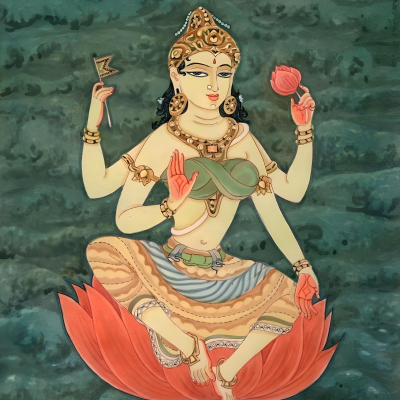
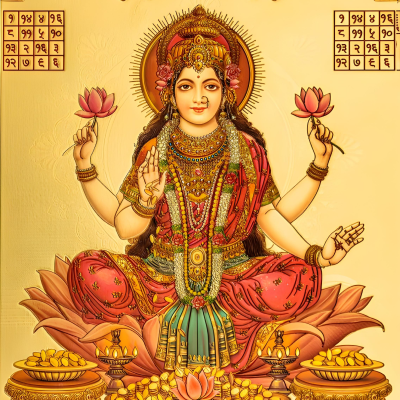
- Picture her form Hold in mind the golden goddess seated on a lotus, with elephants pouring water over her. Some devotees keep a small elephant figure near the altar.
- Pray in your own words Recite a Lakshmi or Kamala stotra you know, such as her 108 names. Or simply ask, in your own words, for prosperity honestly earned and well used.
- Leave formal sadhana to the lineage Formal Kamala sadhana, with mantra and yantra, is a tantric practice. It is done only as taught by a guru within a lineage.
Kamala Jayanti puja samagri
- Image of Kamala, or of Lakshmi seated on a lotus
- Lotus flowers or red flowers
- Ghee lamp and wicks
- Incense sticks
- Sweets for naivedya
- Small elephant figures for the altar (optional)
Regional traditions
- Tantric lineages
- On Diwali night, Kamala is honoured as the tantric Lakshmi. These rites are usually kept private or shared with a small circle, with prayers for prosperity and contentment.
- Navaratri observance
- Devotees who honour all ten Mahavidyas across Navaratri generally keep Kamala for the final day.
- Shakta schools
- Some schools see the ten Mahavidyas as forms of Mahakali, others as forms of Tripura Sundari, and this colours how Kamala is approached.
Kamala among the Dasha Mahavidyas
The ten Mahavidyas are usually listed as Kali, Tara, Tripura Sundari, Bhuvaneshvari, Bhairavi, Chhinnamasta, Dhumavati, Bagalamukhi, Matangi and Kamala. The list moves from the fierce Kali to the serene Kamala, and Kamala closes it. The Maha Bhagavata and Brihaddharma Puranas give this standard set of ten.
Other texts count differently. The Niruttara Tantra names eighteen Mahavidyas, and the Devi Bhagavata lists thirteen forms, so the familiar ten is one tradition among several. Shaktas explain the number as one truth seen through ten faces of the Divine Mother.
Her dhyana (meditation verse) describes a golden goddess on a lotus with four arms. Two arms carry lotuses; the others bless and reassure the devotee. Four elephants tip jars of nectar over her, an image tied to rain, fertile land and kingship. Another verse pictures her shining like the rising sun, a moon on her brow, holding lotuses and sheaves of young rice.
In Mahavidya art she is usually shown alone, without Vishnu at her side. Some tantras pair each Mahavidya with an avatar of Vishnu. The Todala Tantra links Kamala with the Buddha, and the Guhyatiguhya Tantra links her with Matsya. The Todala Tantra also names Sadashiva, in the form of Vishnu, as her Bhairava, to be worshipped at her right side.
Kamala Jayanti dates
| Day | Date |
|---|---|
| Sunday | 8 November 2026 |
| Friday | 29 October 2027 |
Celebrate Kamala Jayanti with Dharmayana

Festival Pooja & Pandit Booking
Want a Pandit-led pooja for this festival at home, or online if you live abroad? Dharmayana connects you with verified Pandits for all major Hindu festivals — Diwali, Navratri, Shivratri, Janmashtami, Ganesh Chaturthi and more.
You can book:
- Festival pooja at home with a verified Pandit
- Online / virtual pooja with live video and digital prasad
- Same-day sankalp for time-sensitive festivals
Bookings, samagri lists and Pandit assignment are all handled inside the Dharmayana app — choose the festival, pick a date and the rest is taken care of.

Prarthana, Mantras & Vrat Katha
Every festival has its own prarthanas, stotras and vrat kathas. Reading or listening to them on the festival day is the simplest way to observe the tradition at home.
Inside the Dharmayana app you can listen to:
- 1000+ prarthanas, mantras and stotras with clear audio
- Festival-specific kathas — Lakshmi, Durga, Shiva, Ganesha, Krishna
- Multilingual versions: Sanskrit, Hindi, Tamil, Telugu, Kannada and more
Browse the full collection of prarthanas or get the app to play them on the festival morning without ads.

Festival Date, Tithi & Muhurat
Hindu festivals are tied to a specific Tithi, not a fixed date — so the day shifts every year and even varies slightly across cities.
Open the Panchanga for the festival day to see the exact Tithi, Nakshatra, Yoga, Karana and Shubh Muhurat for pooja in your location.
The Dharmayana app keeps track of all upcoming festivals on the Hindu calendar and reminds you in advance.

Personalised Astrology Around Festivals
Festivals are also a good time to look at your kundali — many families plan sankalp, donations or new beginnings around them.
Inside the app you can:
- Generate your personal Vedic kundali
- Talk to a Jyotisha for guidance around career, relationships or health
- Run kundali matching before fixing a marriage during the festival season
All of this is available inside the Dharmayana app — no fixed schedule, use it whenever you need it.
Frequently Asked Questions
What are the Kamala Jayanti 2026 timings?
Nishita Kaal: 11:45 PM – 12:37 AM, 9 Nov. Times are in IST for Ujjain.
Is Goddess Kamala the same as Lakshmi?
Kamala is understood as the tantric form of Lakshmi. Devotees see them as closely linked, but Kamala is worshipped as one of the ten Mahavidyas, with her own iconography and practice.
Is Kamala Jayanti celebrated on Diwali?
Yes. It falls on the same new moon as Diwali, and its rituals are observed on the day of Lakshmi Puja.
Can Kamala be worshipped at home?
Yes, as simple devotion: a lamp, lotus or red flowers, sweets and a prayer, usually within the Diwali Lakshmi Puja. Her formal tantric sadhana is undertaken only under a guru in a lineage.
Why is Goddess Kamala shown with elephants?
In her image, elephants pour nectar over the goddess. They are read as signs of rain and a fertile earth, and of royal authority, which fits a goddess of abundance.
Which number Mahavidya is Kamala?
Kamala is the tenth and last of the Dasha Mahavidyas in the usual sequence, after Matangi.
What should be offered to Goddess Kamala?
Lotus flowers suit her best, since her name means lotus. Ghee lamps, incense, red flowers and sweets are also offered.
When is Kamala Jayanti in 2026?
Kamala Jayanti 2026 falls on Sunday, 8 November 2026.
What is Kamala Jayanti?
Kamala Jayanti falls on the Ashwina (Purnimanta Kartika) Amavasya — the same new moon as Diwali — marking the birth of the tenth and last Mahavidya. Though she looks like Lakshmi, Kamala is grouped with the fierce Kali Kula and worshipped through tantric sadhana, not household puja.
Why is Kamala Jayanti observed?
The Swatantra Tantra tells a story rarely heard at Diwali: Kamala took form to kill the demon Kolasura, and earlier rose during the churning of the ocean. The Varahi Tantra goes further — Brahma, Vishnu and Shiva all worship her, which is why she is also called Tripura. The Purusha Sukta names her the consort of Vishnu, and she carries the epithet Bhargavi as the daughter of sage Bhrigu. Her iconography reads the difference from ordinary Lakshmi: golden-skinned, in a red sari, seated on a lotus in the middle of the ocean while four elephants pour abhishekam (ritual bathing) over her. Sadhakas chant her bija 'Aim' and the mantra 'Om Shrim Shrim Kamalatmika Shrim Swaha' — said to soften a harsh Shukra (Venus) dasha and protect the womb.
Which prarthanas are recited on Kamala Jayanti?
Kamala Ashtottara Shatanamavali and Kamala Astakam are recited on Kamala Jayanti. You can listen to them with audio on this page.
Book Pandit & Festival Pooja
on the Dharmayana App
Book Kamala Jayanti Pooja on the Dharmayana App
Verified Pandits, prarthanas with audio and accurate Panchanga, all in one place.


