Why Vedas and Upanishads Matter to You in 2026
Ancient wisdom finds new relevance

Kushal K
20 Oct 2026 • 7min
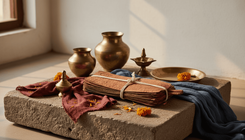
The Vedas and Upanishads are not historical curiosities. They are alive in India today, shaping how millions of people live, practice and think about themselves and the world. If you have noticed these teachings appearing more often in conversations about wellness, meaning and philosophy, you are noticing something real: Vedic knowledge is becoming visible again, not because it went anywhere, but because the questions we are asking now are the ones these texts address.
The Vedas—the Rigveda, Yajurveda, Samaveda and Atharvaveda—are the oldest layer of Hindu sacred texts, composed in an ancient form of Sanskrit and memorised and transmitted orally for thousands of years. Each Veda is traditionally made up of four layers: the Samhitas (hymns), the Brahmanas (ritual texts), the Aranyakas (forest texts) and the Upanishads. The Upanishads, the final and most philosophical layer, explore the nature of Brahman (the ultimate reality) and Atman (the self), and are therefore also called Vedanta, "the end of the Vedas." Tradition counts 108 Upanishads, of which around ten to thirteen are regarded as the principal ones. Together, the Vedic texts contain teaching on ritual, healing, ethics, metaphysics and the structure of human experience. These texts have long been studied by traditional practitioners in lineages and, since the nineteenth century, by scholars and teachers who brought them to wider audiences. Now, more people than ever are reading them, talking about them, and applying their insights.



What Is Driving Interest in Vedic Knowledge
Several things are happening at once. First, there is growing recognition that Indian knowledge systems address questions that many people feel modern frameworks leave unanswered: how to think about the mind, how to understand health as more than the absence of disease, how to live in balance with nature and time. The Upanishads ask what consciousness is and how you know yourself. Ayurveda, India's traditional system of medicine, is now studied in universities. Yoga, systematised in Patanjali's Yoga Sutras—one of the classical philosophical schools that accept the authority of the Vedas—has become mainstream. When someone finds that an idea from thousands of years ago helps them sleep better or think more clearly, they want to know where it came from.
Second, there is a tide of interest in indigenous and non-Western knowledge more broadly. People are questioning whether modernity means abandoning everything that came before, or whether some older ideas were actually onto something. That openness has made room for Vedic teachings to be studied not as exotic artefacts, but as frameworks that might be useful now.
Third, access has changed. Translations of the Upanishads have existed for around two centuries—Raja Ram Mohan Roy translated several in the early nineteenth century, and Max Müller's Sacred Books of the East made them widely available in English from 1879. Swami Vivekananda and other teachers brought Vedantic ideas to audiences around the world from the 1890s onwards. What is new is the scale and ease of access: today there are online translations, podcasts, commentary channels, and courses. An English speaker can encounter these texts without years of study or family tradition. That democratisation is real and valuable, though it also means more misreading and oversimplification.
Vedic Knowledge and Modern Wellness
The Vedic tradition addresses health, mind and how to live well, which makes it a natural point of contact for people interested in wellness. Ayurveda is traditionally regarded as an upaveda, or auxiliary branch of knowledge, connected with the Atharvaveda, which contains hymns for healing and wellbeing. Its classical texts, such as the Charaka Samhita and Sushruta Samhita, composed after the Vedas, describe health as a state of balance between vata, pitta and kapha (the three doshas), not simply as the absence of symptoms. That shift in definition changes how you approach your own care. Instead of waiting for illness to treat, you attend to balance: sleep, digestion, stress, seasonal rhythm, the food you eat.
Similarly, the Upanishads teach that lasting peace comes from understanding the nature of the self, not from controlling circumstances. Vedantic philosophy holds that much suffering arises from mistaking the temporary for the real, and that clarity comes through knowledge and direct insight. This maps onto modern interest in meditation and philosophical inquiry, without requiring you to adopt all of classical Indian belief.
The Rigveda itself contains hymns addressed to Agni (fire) and other deities. Some interpreters, such as Sri Aurobindo, have read these hymns as describing inner spiritual realities as well as outer ones—so that Agni is both the ritual fire and an inner flame of aspiration. Such readings are interpretations rather than scholarly consensus, but they show how these texts can be read on several levels at once. That density is partly why these texts are hard to read, and partly why they reward reading.
How the Upanishads Differ from the Vedas
The earlier portions of the Vedas—the Samhitas and Brahmanas—are collections of hymns, ritual instructions and cosmological teaching. They are vast, intricate, and concerned with the maintenance of order (rita) through correct action and knowledge. The Upanishads, which form the final portion of the Vedas, are more philosophical and inward-looking. Many of them are dialogues, often between a teacher and a student, exploring the nature of reality and the self.
The Upanishads ask: What is Brahman? How is Atman related to Brahman? What is the nature of consciousness? These questions are pursued through reasoning, meditation and the removal of ignorance. One of the most famous teachings in the Upanishads is Tat Tvam Asi—"That Thou Art"—from the Chandogya Upanishad, where the sage Uddalaka teaches his son Shvetaketu that his innermost self is one with the ultimate reality. It is one of the four Mahavakyas, or "great sayings," of the Upanishads. In the tradition, this is not a belief to adopt, but an insight to realise through practice and understanding.
The Vedas and Upanishads are not a unified system; they developed over centuries and contain different, sometimes contrasting, teachings. But they form a coherent tradition in that they all ask how to live rightly and understand truly. Later thinkers built six classical systems of philosophy, known as darshanas or viewpoints, that accept the authority of the Vedas: Nyaya, Vaisheshika, Samkhya, Yoga, Mimamsa and Vedanta. Vedanta, which is based on the Upanishads, the Brahma Sutras and the Bhagavad Gita, itself developed into several schools that interpret the Upanishads differently. Advaita Vedanta, associated with Adi Shankaracharya, holds that Atman and Brahman are one and the same. Vishishtadvaita, associated with Ramanuja, holds that the self is a real part of Brahman—one with it, yet distinct. Dvaita, associated with Madhvacharya, holds that the self and Brahman are eternally distinct. When you hear someone refer to Vedantic teaching, they are usually referring to one of these schools, most often Advaita, which has been the most influential globally.
Why This Matters Today
The reason Vedic and Upanishadic teaching is appearing now is not that it is fashionable, though fashionability helps spread it. It is that these texts were never obsolete. They were always being studied and lived by people within the tradition. What has changed is that more people outside the tradition are now able and willing to engage with them.
This matters because these texts offer a complete worldview: an account of how mind, body, time, and reality fit together. They were composed for people asking the questions you might be asking: How should I live? What is my purpose? What is really real? Is there a part of me that does not change? These are not questions that went out of fashion. They just went out of fashion in certain contexts and times. Now they are back.
That said, reading a translation of the Upanishads is not the same as living the tradition. You will find people offering to sell you enlightenment, or claiming that the Vedas support whatever ideology they already hold. The real value comes from taking these texts seriously as teaching, not as decoration. It means sitting with them, thinking about them, testing them against your own understanding. It means, often, finding a teacher or a tradition to learn from.
The Vedas and Upanishads are trending because they answer questions that become more urgent as you mature: What is my life actually for? What part of me is real? How do I live well? These texts do not give easy answers. But they give you the tools to work on these questions yourself, and that is worth more than any answer someone else hands you.
Common questions
What is the difference between the Vedas and the Upanishads?
The Vedas are the oldest Hindu scriptures, made up of hymns, ritual texts and teaching on how to maintain cosmic order. The Upanishads form the final, philosophical portion of the Vedas, which is why they are also called Vedanta, "the end of the Vedas." They explore the nature of Brahman (ultimate reality) and Atman (the self). The Upanishads are inward-looking and focused on knowledge of the self and reality, while the earlier portions of the Vedas address ritual and cosmic order.
Do I need to read the Vedas and Upanishads in Sanskrit?
No. Many translations into English and other languages exist, along with commentary and explanation. Reading a translation is a genuine way to encounter these texts and learn from them, though some nuance of the Sanskrit is lost in translation. Many people find that working with a teacher or tradition helps them understand what they read.
What do the Upanishads say about the self and reality?
The Upanishads explore the relationship between the individual self (Atman) and Brahman, the ultimate reality, and contain famous teachings such as Tat Tvam Asi—"That Thou Art." Different schools of Vedanta interpret these teachings differently. Advaita Vedanta holds that Atman and Brahman are identical; Vishishtadvaita holds that the self is a part of Brahman, one with it yet distinct; and Dvaita holds that they are eternally distinct. Across these schools, the Upanishads are understood as pointing to an insight to be realised through understanding, meditation and the removal of ignorance, rather than a belief to be accepted.

Related Articles