
Why Tulsi Leaves Are Offered to Vishnu but Not to Ganesha
Sacred in form, precise in ritual

Abhilash Ramakrishna
19 Nov 2026 • 6min
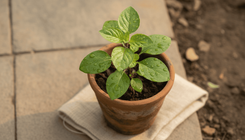
Tulsi leaves have a special place in Hindu puja, but they are not offered to every deity. You will see them placed at the feet of Vishnu and Krishna, and used to adorn their altar, yet many practitioners avoid offering tulsi to Ganesha, Durga or Shiva. This distinction comes not from arbitrary rule but from how Hindu ritual texts understand the nature of each deity and what forms of worship honour them most deeply.
The foundation of this practice lies in the Puranas and in the qualities each deity represents. Tulsi, also called Vrindavani or holy basil, is associated with purity, devotion and the divine love that Krishna and Vishnu embody. The plant itself is said to be sacred to Vishnu—some traditions hold that tulsi sprang from the tears of Lakshmi, Vishnu's consort, while others trace its origin to the devotion of the earth itself. This connection is not merely poetic; it shapes how ritual texts prescribe its use.



The Association with Vishnu and Krishna
Tulsi is most strongly linked to Vishnu through both mythology and regional practice. In many temples dedicated to Vishnu and Krishna, tulsi plants grow in the courtyard or are placed near the sanctum, and devotees offer the leaves as part of daily worship. Some Vaishnava traditions believe that offering tulsi to Vishnu is equivalent to offering oneself—the plant represents the devotee's heart laid before the deity.
The connection to Krishna runs equally deep. Krishna is said to have loved tulsi, and in Vaishnavism, offering tulsi leaves is seen as an expression of intimate devotion. Many texts suggest that tulsi sanctifies the offering itself; when the leaves are placed on Krishna's altar, they transform other gifts into prasad more readily. The practitioner who offers tulsi is, in this view, participating in the same devotion that the plant itself embodies.
This is not confined to high temple ritual. In many Indian homes, a tulsi plant is tended in a small shrine or pot, and its leaves are used daily when prayers to Krishna or Vishnu are made. Some families observe this as a seasonal practice, while others maintain it year-round. The care given to the plant—watering, tending—becomes part of the act of worship itself.
Why Tulsi Is Avoided for Other Deities
The restraint around offering tulsi to deities like Ganesha, Shiva or Durga reflects a different understanding of how each deity receives honour. Ganesha is approached with different flowers and offerings—coconut, flowers like marigold or hibiscus, sweets and fruit. These suit the nature of Ganesha as the remover of obstacles and the lord of beginnings; they are generous, abundant offerings that reflect abundance itself.
Shiva's worship, meanwhile, follows its own logic. Shiva is sometimes offered flowers, but tradition often emphasizes the offering of water, ash, bilva leaves and milk over the leaves of a plant associated so closely with Vishnu's circle. Some texts suggest that tulsi, being specifically devoted to Vishnu, is not the appropriate vehicle for addressing Shiva's transcendent, ascetic nature.
Durga and other forms of Devi are honoured through their own ritual vocabulary—red flowers, specific plants like palash or ashoka, and offerings that reflect their role as divine mother and destroyer of darkness. To offer tulsi in these contexts would be to import the language of Vaishnava devotion into a rite that has its own integrity.
None of this means that offering tulsi to other deities is forbidden or will bring harm. Rather, it reflects a principle at the heart of Hindu puja: that the form of the offering should echo and support the specific relationship between devotee and deity. Ritual precision is itself an act of respect.
Regional Variations and Household Practice
The strength of this convention varies by region and sampradaya, or lineage. In South India, particularly in Tamil Nadu and Karnataka, Vaishnava temples uphold the tulsi-Vishnu connection very strictly. In Bengal and Odisha, worship of Ganesha and Durga sometimes includes tulsi without the same stricture. Some Shaivite traditions are flexible about the rule, seeing tulsi as auspicious in any context.
For householders who tend a tulsi plant at home, the practice often becomes simpler. Many offer tulsi in their daily prayers to whichever deity they worship most, and this is accepted as genuine devotion. The rule is observed more rigorously in formal temple contexts, where ritual specialists ensure that each element of worship aligns with scriptural precedent. The difference reflects a general principle: greater precision is expected in formal ritual, while household practice can be more personal.
If you are unsure whether to offer tulsi to a particular deity, you might ask the priest at your local temple or follow the tradition of your own household. If your family has always offered tulsi to Ganesha without incident, that is a sign of your own lineage's practice. The rule is not iron-clad, but rather an expression of how different deities are honoured in the broader ecosystem of Hindu worship.
The Meaning Behind the Practice
Understanding why tulsi leaves are reserved for Vishnu helps you approach the practice with awareness rather than mere habit. When you offer tulsi, you are not simply following a rule; you are participating in a tradition that sees the plant itself as a form of devotion—one that has been tended and offered across centuries.
The principle extends more widely: Hindu puja works through correspondences and resonances. Each deity is associated with particular colours, flowers, foods, directions and times. These are not arbitrary categories imposed from outside; they emerge from how the tradition understands each deity's nature and sphere. Tulsi's sweetness and purity align with Vishnu's grace; red flowers' vibrancy suits Durga's fierce compassion. Learning these associations does not constrain worship; it deepens it.
If you maintain a tulsi plant for worship, its care itself becomes a form of practice. The daily watering, the attention to its health, the moment of picking a leaf with reverence—all of these are the ritual. When that leaf is offered to Vishnu or Krishna, it carries not just the plant's sanctity but the devotion you have given it.
Common questions
Can I offer tulsi to Shiva without breaking any rule?
Tulsi is traditionally associated with Vishnu, so most formal rituals do not include it in Shiva worship. However, there is no strict prohibition in many Shaivite traditions, and household practice may be more flexible. If you are unsure, follow the practice of your own tradition or temple.
Is it disrespectful to offer tulsi to Ganesha?
No; it is not disrespectful, but rather not the conventional choice. In some regions, particularly Bengal and Odisha, tulsi is used in Ganesha worship without issue. The principle is that each deity has offerings that align with their nature, but this is a guide rather than an absolute rule for household worship.
Why is tulsi sacred to Vishnu specifically?
Hindu tradition associates tulsi with Vishnu through mythology and the plant's qualities of purity and devotion. Some texts say tulsi originated from Lakshmi or the devotion of the earth itself, and Vaishnava theology sees the plant as embodying the intimate devotion that characterizes worship of Vishnu and Krishna.

Related Articles


