
Why Some Families Worship Their Tools and Workplace During Diwali
Honouring craft and livelihood at the season of light

Kushal K
02 Nov 2026 • 7min
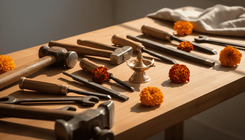
During Diwali, most attention falls on the main festival rituals: lamps lit in homes, sweets shared with family, new clothes and jewellery bought. Yet in workshops, offices, factories and small shops across India, a quieter worship happens too. Families and workers gather to honour their tools, machines and workplaces with prayers, flowers and offerings. This practice of tool and workplace puja during Diwali stems from a deeper tradition that recognises work itself as worthy of spiritual reverence—and it remains a living custom, especially among artisans, traders and those in manufacturing.
The roots of this custom run to a figure central to Indian craftsmanship: Vishwakarma, the divine architect and maker. In Hindu tradition, Vishwakarma is said to have designed the worlds and created the tools and technologies used by gods and humans alike. He is the patron of all who build, craft, shape and make—carpenters, blacksmiths, engineers, masons and every kind of artisan. While Vishwakarma is often remembered through a festival dedicated to him (usually observed in the month of Shravana or Bhadrapada, depending on the region), his presence in Diwali worship of tools reflects a broader truth: that craft and work are not separate from the spiritual life, but woven into it.
The practice reflects an understanding that your tools are not mere objects. They are the means through which you exercise your skill, earn your livelihood and contribute to the world around you. To worship them is to acknowledge that relationship—to say thank you to what serves you, and to invite blessing into the work you do. For many families, this ritual marks a moment to pause and reflect on the dignity of labour itself, whatever form it takes.



Why tools deserve worship
In the Indian understanding of dharma (righteous living), honest work carried out with skill and integrity holds spiritual weight. A carpenter's chisel, a weaver's loom, a shopkeeper's scales, a farmer's plough—each is a sacred instrument through which dharma is lived. When you use these tools well, you are not just earning; you are fulfilling a role in the larger order.
Puja of tools also acknowledges a practical reality that is also spiritual: tools require care. They must be maintained, sharpened, oiled and handled with respect. When a blacksmith honours his hammer or a farmer honours his plough, he is making a commitment to stewardship. This is not superstition but wisdom expressed in ritual form. Tools that are treated with respect tend to last longer and work better. The puja becomes a way of saying: I will care for these, and in caring for them, I care for the work they enable.
In some families and communities, particularly among those in traditional crafts, the tool itself is seen as having absorbed something of the user's knowledge and intention. A master carpenter's plane is not the same as any other plane; it has been shaped by years of use into an extension of the maker's skill. To worship it is to honour that accumulated knowledge.
How the Diwali tool puja is done
The practice varies by region, community and type of work, but the basic structure is consistent. In many households and workshops, people gather before or during Diwali to perform a simple puja of their tools and workspace.
The ritual typically begins with cleaning and arranging the tools in a visible place—a workbench, desk or corner of the shop. Some families set up a small temporary altar or area marked out for the purpose. Flowers, usually marigolds or other seasonal blooms, are gathered. Incense or diya (small oil lamps) are lit. A prayer or invocation is offered, often to Vishwakarma, asking for blessing on the tools and the work they facilitate.
In some places, the puja includes offerings of flowers, fruit or sweets at the site. A small prayer or mantra may be recited—sometimes a simple one known in the family or community, sometimes words composed for the moment. Some families perform an aarti (a ritual of waving a lit lamp) before the tools. After the puja, the blessed flowers or fruit may be distributed as prasad (blessed food or objects) among those present.
The scale of the ritual can range from very simple—a worker pausing to light a lamp by their tools and speaking a word of gratitude—to more elaborate ceremonies in larger workplaces, where many people gather. In some factories and construction sites, a designated space is set aside and a more formal puja is performed. The shared nature of the ritual also binds the community: workers, owners and family members gather together, and this itself becomes a form of communion around the shared work.
Who practices tool worship at Diwali
This custom is particularly strong among families in traditional and artisanal trades. Carpenters, metalworkers, weavers, potters and stonemasons are more likely to maintain this practice because their relationship to their tools is intimate and long-standing. A master craftsperson often spends decades learning to know their tools in a deep way, and the puja reflects that bond.
Shopkeepers and small business owners also commonly observe tool and workplace puja during Diwali. For them, the "tools" may include weighing scales, account books, the counter itself, or the vehicles used in their trade. Farmers often worship their ploughs, harrows and other implements. In recent decades, the practice has extended to offices and tech companies in cities, where workers may perform a puja of their computers, desks and workspaces—an adaptation of the old custom to modern work.
Regional variations exist. In some parts of southern India, the equivalent festival to Diwali includes strong traditions of tool worship. In western India, particularly in Gujarat and Maharashtra, the practice remains deeply embedded in trading and manufacturing communities. In North India, it is common among artisans and small businesses, though urban office workers may observe it less frequently.
The meaning beneath the ritual
At its heart, tool worship during Diwali expresses a conviction that work matters spiritually. It is a statement that earning your bread through skill and honesty is not separate from spiritual life—it is part of it. The ritual says: the work I do, the tools I use, the people I work alongside, all deserve to be blessed and remembered.
For many people, the practice also serves as a moment to step back from the rush of daily work. In the middle of a busy season, or during a year of hard labour, the Diwali puja offers a pause. It is a time to acknowledge what has been accomplished, to care for the means of your livelihood, and to ask for continued blessing and safety in the year ahead.
In this way, what might look like a small custom—flowers placed before a workbench—holds together several threads of the Indian worldview: the sanctity of honest work, the relationship between the maker and the made, the importance of gratitude and care, and the place of ritual in marking what matters most.
Common questions
What is the connection between Diwali tool puja and Vishwakarma Jayanti?
Vishwakarma Jayanti, celebrated in the month of Shravana or Bhadrapada, is a festival dedicated entirely to honouring the divine architect and patron of all craftspeople. Diwali tool worship draws from the same tradition of honouring Vishwakarma, but during the larger festival. While Vishwakarma Jayanti is the specific day for artisans to worship their tools, many families and workplaces also honour their tools during Diwali as part of the season's spiritual observances.
When during Diwali should tools be worshipped?
There is no single fixed day for tool and workplace puja during Diwali. Some families do it on the day of the main Lakshmi puja, others on the day after, and some choose another day during the Diwali season that suits their work schedule. The timing depends on local custom and when the family or workplace can gather together, so you can plan it around when it is most convenient and meaningful for your household or business.
What if I work in an office or don't have traditional tools?
The practice has adapted to modern work. Office workers may perform puja of their desks, computers, and the workspace itself. The principle remains the same: honouring the means through which you do your work and earn your livelihood. You can simplify the ritual to suit your setting—a few flowers, a moment of intention, and a prayer for blessing on the work you do.

Related Articles


