
Why Saraswati Holds a Veena and Book: The Meaning of Her Symbols
Knowledge Takes Form and Sound

Abhilash Ramakrishna
31 Oct 2026 • 6min
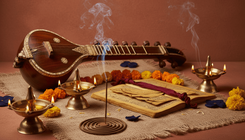
When you encounter an image of Saraswati, the goddess of learning and wisdom, she almost always holds a veena in one hand and a book or manuscript in the other. These are not random attributes. Each object carries deep meaning about the nature of knowledge itself and how it moves through the world.
The veena is a stringed instrument that requires discipline to master. When Saraswati holds it, she represents all forms of learning that call for practice and devotion—not just music, but the disciplined arts and sciences. The book or palm-leaf manuscript in her other hand speaks to knowledge as it is preserved and passed down: the wisdom in texts, the words that survive across generations. Together, the veena and the book show that wisdom is both living practice and permanent record.



The Veena and the Practice of Knowledge
The veena is one of India's oldest stringed instruments, and its music is said to be among the purest sounds that can be made. When Saraswati holds it, she is not simply blessing musicians, though she is certainly the patron of music. The veena stands for all forms of knowledge that require the hands as well as the mind: the arts, crafts, sciences and skill traditions. To play a veena, you must understand theory, yes, but your fingers must also know the instrument intimately. Your breath must be controlled. Your ear must be trained.
This is why Saraswati carries the veena. She embodies the principle that true learning is not passive. It demands practice, repetition, refinement and discipline. In the classical arts, a student of music or dance is called a sadhaka—a practitioner. The path is called sadhana. Saraswati, through her veena, presides over all such paths. She represents the active work of becoming learned, not merely storing information.
The veena also makes sound, which in the Hindu tradition is sacred in itself. The Upanishads speak of Brahman, ultimate reality, as the source of all sound. Saraswati holds the veena because she embodies that power: the creative force that brings thought into expression, silence into language, potential into actuality. When you speak, teach, write or create, you are participating in the work that Saraswati represents.
The Book and Knowledge Preserved
The palm-leaf manuscript or book in Saraswati's other hand points to a different but equally vital aspect of wisdom: preservation. A book captures knowledge and holds it still so that others can study it. It crosses time. It carries authority, because what is written down can be checked and discussed.
For thousands of years, the Vedas and the Upanishads were transmitted orally, from guru to student. Yet they were also written down and preserved in manuscripts. Saraswati blesses both forms. The book represents the textual traditions: the Vedas themselves, the commentaries and philosophical works, the technical treatises on medicine, astronomy, grammar and every other discipline. It stands for all knowledge that is systematic, recorded and available to study.
In her four arms—which appears in some representations—Saraswati may hold a prayer bead mala as well, symbolising the recitation and repetition through which knowledge becomes part of you. But the book remains constant across all her iconography. It reminds us that even in an age of digital information, knowledge that is written and preserved has power. Writing forces clarity. A text can be returned to. It can be studied closely. It can be passed to those not yet born.
Why Both Together Matter
Some people ask: why does Saraswati carry both? Why not only the veena, or only the book? The answer lies in how real knowledge actually works.
A veena without study is merely mechanical movement. Someone could produce sounds from the instrument without understanding what they mean or how they fit into a larger tradition. The book—the texts, the theory, the wisdom of those who came before—gives the practice direction and depth. It connects your work to the lineage.
Equally, a book without practice remains abstract. You can read about music theory, but if you do not sit with an instrument and work through the discipline, the knowledge remains on the page. It has not entered your hands or your ear or your understanding in a living way. Saraswati holds both because knowledge requires both: the texts that preserve and transmit, and the disciplined practice that makes wisdom real in the present moment.
Saraswati's Presence in Daily Life
In many Hindu homes and temples, people make offerings to Saraswati during Vasant Panchami, which marks the start of spring and is associated with the beginning of learning. On that day, children traditionally begin their formal education. Parents and teachers offer flowers and sweets at Saraswati's altar. Students place their books and writing materials before her, asking for the grace to study well.
The symbolism remains active. When a student sits down to study, or a musician practices, or a teacher prepares a lesson, the presence of Saraswati is understood to be there. Her veena reminds the practitioner to bring discipline and heart to the work. Her book reminds them that they are part of a tradition much larger than themselves, standing on the foundation that others have built.
A Gift for All Forms of Learning
Saraswati is not the deity of any single discipline. She presides over scholars and scientists, artists and craftspeople, teachers and students. The veena and the book together say that whatever knowledge you pursue—whether it is classical dance or quantum physics, carpentry or poetry—the same principles apply. Discipline matters. Practice matters. Studying what has come before matters. Bringing your whole self to the work matters.
When you see Saraswati with her veena and her book, you are seeing a map of how wisdom actually develops. Not in one way alone, but in the interplay of practice and study, doing and knowing, innovation and tradition. That is what makes her a goddess not just for artists or scholars, but for everyone who seeks to learn and grow.
Common questions
How many arms does Saraswati have and what does she hold in each?
Saraswati typically has four arms. She holds a veena (stringed instrument) and a book or manuscript in two hands. In the other hands, she often carries a prayer bead mala (for recitation and repetition) and holds a mudra (hand gesture). Representations vary by region and tradition.
Why is the veena specifically sacred to Saraswati?
The veena is among the purest sounds that can be made and represents all forms of disciplined learning and practice. Since Saraswati embodies knowledge that requires active work, training and mastery rather than passive absorption, the veena symbolises the pathway of sadhana—dedicated practice through which wisdom becomes real.
Is Saraswati only for students and musicians?
No. Saraswati presides over all forms of learning and skilled practice—scholars, scientists, craftspeople, teachers and artists alike. Her symbols represent the principles that apply to any discipline: that knowledge requires both disciplined practice and connection to established wisdom.

Related Articles


