
Why Rivers Are Sacred in Hinduism: The Seven Holy Rivers
Divine waters that purify soul and land

Kushal K
15 Nov 2026 • 7min
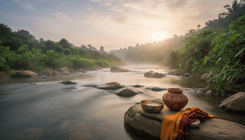
In Hinduism, rivers are not simply water that flows from mountains to sea. They are goddesses, teachers and pathways to moksha—liberation. The sacred rivers of Hindu tradition hold a place in practice and belief that runs deeper than geography. To bathe in these waters is to seek not just physical cleanliness but spiritual transformation. This understanding is woven through ritual, scripture and daily devotion across the Indian subcontinent.



Why Rivers Are Considered Divine
In the Hindu worldview, the river is a living presence. She is not a metaphor for the divine, but a manifestation of it. Rivers sustain life: they water the crops that feed millions, they are sources of fresh water in harsh landscapes, and they connect communities across vast distances. This practical reality meets spiritual truth in the heart of Hinduism. A river that gives life so abundantly is understood as a gift of divine grace made manifest.
The Rigveda, one of Hinduism's oldest texts, speaks of rivers as divine beings deserving of worship. The goddess Saraswati is invoked in the Rigveda as the river of wisdom and knowledge. Ganga, Yamuna, Sindhu and other rivers appear not as water but as mothers, as powers worthy of reverence. This is not poetry alone—it is theological. The river connects the earthly realm to the cosmic order, to the divine intelligence that sustains all of creation.
The Seven Sacred Rivers
The concept of the Saptanadi—the seven sacred rivers—forms the framework for understanding which waters hold the highest spiritual significance in Hindu practice. While commentaries vary on the exact list, the rivers most universally honoured are Ganga, Yamuna, Godavari, Saraswati, Narmada, Sindhu and Brahmaputra.
Each of these rivers has its own mythology, its own regional importance, and its own place in the spiritual life of Hindus who live along its banks or make pilgrimage to its waters. The Ganga is perhaps the most widely known outside India. She flows from the Himalayas and is believed to carry the waters of heaven to earth. To die on the banks of the Ganga or to have one's ashes immersed in her waters is considered a form of grace. Varanasi, the city on the Ganga's banks, is one of Hinduism's holiest pilgrimage sites.
The Yamuna is inseparable from the life and love stories of Krishna in Hindu devotional tradition. She flows past Mathura and Vrindavan, the landscapes of Krishna's childhood. The Godavari is sacred in South India, where she is sometimes called the Dakshina Ganga—the Ganga of the south. Each river carries the memories of the tradition: temples line their banks, pilgrims gather at their confluences, and rituals of worship continue through the year.
River Worship in Practice
River worship in Hinduism takes many forms. At its most simple, it is the act of bathing in a sacred river, understood as both physical and spiritual purification. Many Hindus begin their day by immersing themselves in flowing water while reciting mantras or the names of God. This practice is not confined to the great pilgrim sites. Even a local river or stream, treated with reverence, becomes a place of spiritual practice.
At pilgrimage sites, river worship becomes more formal. During major festivals, hundreds of thousands of pilgrims gather at the confluence points—the triveni sangam, where three rivers meet, or other significant sites—to bathe together. The maha kumbh, held once every twelve years at one of four sacred river confluences, draws millions. These are not crowd gatherings alone; they are ritual occasions. The act of bathing at an auspicious moment, guided by the lunar and astrological calendar, is understood as multiplying the spiritual benefit.
Ritual offerings to rivers form another dimension of river worship. At dawn or dusk, worshippers make offerings of flowers, ghee, milk and water itself, pouring it into the river while speaking prayers or mantras. These offerings are expressions of gratitude and invitations for blessing. They also reflect a relationship of reciprocity: as the river gives to humanity, so too do people give to the river.
The Mythology of River Descent
Central to understanding why rivers are sacred is the story of how they came to earth. According to Hindu cosmology, the Ganga exists first in the heavens, flowing as the river of stars—the Milky Way. King Bhagiratha performed intense austerities to bring the Ganga from heaven to earth, hoping to purify the ashes of his ancestors and free them. Shiva, recognizing the danger of the Ganga's celestial force hitting the earth with too much power, caught her in his matted hair and controlled her descent so that she would not destroy the land.
This story encodes several truths: that the sacred rivers connect heaven and earth, that they arrive through divine intervention and human devotion working together, and that their power is immense and requires proper reverence. Similar stories attend other rivers, each explaining how she came to flow through the land and why she is worthy of worship.
Rivers as Pilgrimage Destinations
For millions of Hindus, a pilgrimage to a sacred river is a central spiritual practice. These journeys are undertaken for many reasons: to mark a major life transition, to fulfill a vow, to seek healing, or to perform rituals for departed ancestors. The river pilgrimage is not a one-time event but often a practice repeated through a lifetime.
The most significant pilgrimage sites—Varanasi on the Ganga, Mathura on the Yamuna, Nasik on the Godavari, and the confluence points—are destinations where the spiritual benefits of being at a sacred place concentrate. But pilgrimage to a river need not be to a major shrine. Many people travel to the river nearest to their ancestral home, or to a confluence close to them, and perform their rituals there with equal devotion.
Living with Sacred Rivers Today
In modern times, the relationship between Hindus and sacred rivers is being tested. Pollution threatens the rivers that have sustained the tradition for millennia. Many Hindus today see the protection of sacred rivers as a spiritual obligation, an extension of the practice of worship itself. Rivers are being cleaned through grassroots initiatives, and temple organizations have become advocates for river health.
The question of how to honour a river that is being harmed remains at the heart of contemporary Hindu practice. Yet it also deepens the tradition's meaning. To protect a sacred river is to live out the principle that the divine lives in creation, that what we revere we must care for, and that spiritual practice is not separate from the world but woven into it.
The River as Teacher
Beyond ritual and mythology, rivers teach the spiritual seeker something essential. They flow downward always, seeking the lowest places. They are both powerful and gentle, carving stone through patient persistence. They give without asking for return. They are generous with the lands they water and the creatures who drink from them. In the Hindu tradition, the river is a mirror of dharma—righteous action and the way of the cosmos itself. To worship the river is to learn from her, to recognize in her flowing the very pattern of how one should live.
Common questions
What does Saptanadi mean?
Saptanadi refers to the seven sacred rivers of Hindu tradition. The word comes from sapta (seven) and nadi (river). While different texts name them differently, the most widely recognised are Ganga, Yamuna, Godavari, Saraswati, Narmada, Sindhu and Brahmaputra.
Can I bathe in a local river as a spiritual practice?
Yes. While pilgrimage to a major sacred river is highly valued, any river treated with reverence can become a place of spiritual practice. Bathing mindfully in a local river, offering prayers or mantras, is a legitimate form of worship and purification in Hindu tradition.
Why is the maha kumbh held at river confluences?
The maha kumbh is one of Hinduism's largest pilgrimage gatherings, held once every twelve years at one of four major river confluences: Allahabad (Ganga-Yamuna-Saraswati), Haridwar (Ganga), Ujjain (Shipra) and Nasik (Godavari). These confluences are considered especially auspicious because the waters of multiple sacred rivers meet and merge.

Related Articles


