Why Ravana, Kumbhakarna and Meghnad are burned on Dussehra
Victory of light over darkness, righteousness over ego

Kushal K
16 Oct 2026 • 6min
The burning of Ravana, Kumbhakarna and Meghnad on Dussehra celebrates the triumph of Lord Rama over forces of adharma, or wrongdoing. This ritual marks the conclusion of the nine nights of Navratri and recalls the moment when Rama defeated the demon king Ravana in battle. But the effigies burned are not simply symbols of defeat: each one carries a specific meaning in the story, and each teaches something about dharma that the ritual keeps alive.
Dussehra, also known as Vijayadashami, falls on the tenth day of the bright fortnight (Shukla Paksha) of the month of Ashwin, after nine nights devoted to worshipping the goddess Durga. The day celebrates two victories of good over evil: Rama's triumph over Ravana and the goddess Durga's victory over the buffalo demon Mahishasura. By the time effigies are lit on the evening of Dussehra, the narrative arc is complete: Rama has defeated evil, Sita is rescued, and order is restored. The burning formalises this victory for anyone watching. It is also a moment of collective release and celebration, particularly across North and Central India, where the scale and style of Ravana's pyre reflects the diversity of regional practice.



Who Ravana was and why he had to be defeated
Ravana ruled Lanka as a learned and powerful king. He performed intense spiritual practices, earned boons from the gods, and amassed tremendous magical power. But he became consumed by pride and desire. He abducted Sita, wife of Rama, and refused to return her despite the counsel of those closest to him—his brother Vibhishana, his wife Mandodari, his grandfather Malyavan and his brother Kumbhakarna—and despite the warnings carried by Rama's envoys, Hanuman and Angada. This was adharma: an abuse of power, a violation of dharma, a crime against righteousness. When Ravana would not yield to any peaceful appeal, Rama had no choice but to wage war. The burning of Ravana's effigy marks the destruction of this adharma—the unchecked ego and ambition that brought a king to ruin.
Ravana's story reminds us that power and knowledge are not enough. Ravana possessed both in abundance, but he used them for selfish ends. The ritual of burning him says: no matter how much strength or learning you have, if you act against dharma, you will be destroyed. This is not a message of revenge, but of cosmic order. Dharma protects those who uphold it, and it destroys those who violate it.
Kumbhakarna: the loyal brother bound by duty
Kumbhakarna was Ravana's younger brother, a giant of enormous strength. After intense penance, he was granted a boon by Lord Brahma, but according to popular tradition, the gods caused his tongue to slip so that instead of asking for Indra's throne (Indrasana), he asked for endless sleep (Nidrasana). Brahma softened the boon so that Kumbhakarna would sleep for six months at a time and wake for just one day. When the war with Rama began, Ravana had him woken by force, and he sided with his brother—not because he agreed with Ravana's actions, but because loyalty to family was his duty. He fought fiercely and killed many of Rama's allies before falling to Rama. Yet Kumbhakarna was also known for his righteousness and his sense of what was proper. He had even advised Ravana to return Sita and avoid war, but Ravana would not listen.
By burning Kumbhakarna's effigy, we acknowledge that loyalty itself is not always enough to justify what we do. Kumbhakarna was dutiful and strong, but he chose family loyalty over dharma. The ritual teaches that when family or personal bonds pull us toward wrongdoing, we must have the courage to stand aside. Kumbhakarna's burning reminds us that being good at our duties does not shield us if those duties lead us away from what is right.
Meghnad: pride in power and sorcery
Meghnad was Ravana's son, a warrior of immense skill and a master of maya, or illusion. His name means "cloud sound," as he was said to have roared like thunder at birth. He became known as Indrajit, "conqueror of Indra," after defeating the king of the gods in battle, and he earned boons that made him nearly invincible. Meghnad embodied the misuse of supernatural gifts—he wielded them not for protection or service, but for conquest and domination. He fought Rama's forces with sorcery and deception, at times overpowering both Rama and Lakshmana. He was finally slain by Lakshmana, and his death was the turning point that left Ravana vulnerable.
When we burn Meghnad's effigy, we burn the ego of a young man who believed his talents made him untouchable. He had gifts—real gifts, genuine power—but he used them to harm others and to serve his father's unrighteous cause. The ritual says: talent and power are tests of character. How you use what you have been given determines whether you rise or fall.
The ritual and what it teaches today
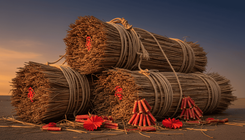
The effigies are traditionally made of bamboo and paper, sometimes straw, and filled with firecrackers. As they burn, the firecrackers burst and the figures collapse into ash. The visual is unmistakable: what seemed grand and powerful crumbles to nothing. Watching the pyre, you see the end of pride, the end of adharma, and the restoration of order.
Different regions have different customs. Ravan Dahan is most closely associated with North and Central India, where it often marks the conclusion of the Ramlila, the dramatic enactment of the Ramayana. In some places, community members carry the effigies in procession before they are set alight. In others, a performer playing Rama shoots a flaming arrow to ignite the pyre. Some places burn all three figures together; others burn them separately on successive pyres. Elsewhere, Vijayadashami is marked differently: in Bengal, Odisha and Assam it is Bijoya Dashami, when the idol of Durga is immersed; in Karnataka and much of South India, the focus is on the goddess, Ayudha Puja and Vidyarambham. In a few places, such as Bisrakh in Uttar Pradesh and Mandsaur in Madhya Pradesh, Ravana is honoured and his effigy is not burned at all. This diversity reflects the many ways the festival is adapted and reimagined across India's regions and languages.
The practice is not about humiliating the defeated or celebrating violence. It is about ritual closure and moral clarity. By burning the effigies, we are saying: this is what happens to adharma. We are teaching children that no power, no knowledge, no birth is worth the loss of dharma. We are reminding ourselves that righteousness is the deepest strength, and that when righteousness is tested, it will ultimately prevail.
This is why Ravana, Kumbhakarna and Meghnad are burned on Dussehra, and why the ritual remains vital. Each figure teaches a different lesson about dharma, about power, about duty and about pride. Together, their burning marks not just a military victory, but a victory of values that bind society together.
Common questions
Is Ravana burned the same way in every part of India?
No. Ravan Dahan is mainly a North and Central Indian tradition, and even there customs vary: some places burn all three figures together, while others burn them on separate pyres. In some places, community members carry the effigies in procession before burning; in others, a performer playing Rama shoots a flaming arrow to ignite the pyre. In regions such as Bengal and much of South India, Vijayadashami is celebrated without effigy burning, and in a few places Ravana is honoured rather than burned.
Why burn effigies instead of just telling the story?
The ritual creates a moment of collective release and closure. Watching the effigies collapse into ash makes the moral lesson visible and unforgettable—adharma cannot stand. It is especially powerful for children, who see the end of evil in a way that words alone cannot convey.
Are effigies made the same way everywhere?
Effigies are usually made of bamboo frames covered with paper or straw and filled with firecrackers, but the exact materials and size vary by region and community. Some are simple, others are elaborate, and the craftsmanship reflects local tradition and resources.

Related Articles