Why rangoli is made at home on Diwali
Welcoming light through coloured dust and rice flour

Sunil Chaurasia
16 Oct 2026 • 8min
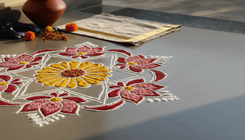
When you make a rangoli on Diwali—or the days before—you are drawing a path for Lakshmi, the goddess of prosperity, into your home. It marks the threshold as sacred space, a place prepared to receive blessing. This is not mere decoration. Rangoli has been central to Hindu homes and temples for generations, and the tradition carries meaning that goes deeper than its beauty.
The word rangoli comes from the Sanskrit rang, meaning colour, and the practice appears in households across India, though the forms and materials shift by region. In many homes, rangoli-making begins in the days before the festival itself. On Diwali morning, a fresh rangoli greets the day, welcoming both the goddess and your own intention to open your home to goodness.



The spiritual roots of rangoli at the threshold
Rangoli sits at the entrance to the home or the prayer room, the space where inside meets outside. In Hindu thought, thresholds carry weight: they mark a boundary between the ordinary and the sacred, between what is inside the home and what is beyond. By making rangoli there, you consecrate the threshold. You signal that this boundary is not merely physical but spiritual.
Lakshmi, in tradition, moves through the world during the festival season, and it is said she is drawn to homes that invite her with care and attention. A beautiful, freshly made rangoli—whether intricate or simple—shows that care. It tells the goddess: we are ready. We have prepared. The gesture matters more than the skill. A child's first rangoli and the most elaborate design both serve the same purpose.
The practice also holds a protective quality. Many households believe that making rangoli guards the home against negative influences and brings auspiciousness to all who cross the threshold. For this reason, traditional practice suggests making rangoli in the morning, refreshing it through the day, and allowing it to fade naturally. Each morning brings a fresh beginning.
How rangoli differs across regions
Rangoli is not uniform across India. In Maharashtra and Karnataka, where the tradition is especially strong, intricate geometric and floral designs are the norm, often using rice flour mixed with turmeric or coloured powders. In Tamil Nadu, the practice is called kolam, and the designs are often angular and mathematical, with deep roots in sacred geometry. In Gujarat, rangoli tends toward bold colours and bold patterns.
In some regions, rangoli is made daily, not just during festivals. What makes Diwali rangoli distinct is its size, colour and intention. Diwali rangoli is often larger and more elaborate than everyday versions. Families may spend an hour or more on the design. This extra care is itself an offering—your time and attention given to beautify the space for the goddess.
The materials matter too. While synthetic colours are now common, traditional rangoli uses natural pigments: turmeric for yellow, indigo for blue, rice flour for white, pounded flowers for pink. Using natural materials carries its own significance: the earth itself, in gentle form, becomes sacred art. Some families still prefer these traditional pigments, while others have adopted bright commercial powders. Both are part of the living tradition.
The meaning of the patterns and colours
Rangoli designs often draw from Hindu cosmology and auspicious symbols. Lotus flowers represent purity and enlightenment. Peacocks and parrots speak to beauty and joy. Geometric patterns—especially the dot grid that forms the basis of many designs—echo the structure of the universe itself. These patterns are not arbitrary. Each carries layers of meaning that connect the maker and the home to something larger.
Colours in rangoli also hold symbolic weight. Red and gold speak to prosperity and auspiciousness. Green represents growth and fertility. White is purity. Blue is often associated with Krishna and the divine. When you choose which colours to use—whether you consciously think about their meaning or simply go by what feels right—you are aligning your home with principles that matter in Hindu thought.
For children, making rangoli offers a way to learn these meanings through their hands. It is both art and education, both meditation and celebration. The repetitive motions of filling in a pattern, the pleasure of colour, the sense of completion when the design is finished—these are their own form of spiritual practice.
Making rangoli as daily practice
What makes Diwali rangoli special is also what connects it to the everyday. In many Hindu homes, rangoli-making is not reserved for festivals. Women and sometimes men make it each morning at the doorstep or in front of the shrine, a small offering before the day begins. This daily practice builds the habit of intention and care.
During Diwali, this daily practice becomes more elaborate and more conscious. The festival amplifies what many homes do anyway: begin the day by marking the threshold as sacred, by bringing colour and attention to the boundary between inside and outside. For homes that do not make rangoli regularly, Diwali is the moment when they join in. The festival invites you to participate in something older than yourself.
The rangoli does not last. By evening, people and animals have walked through it, and the colours have begun to fade. By the next morning, it is gone. This impermanence is intentional. Rangoli teaches what Hindu philosophy holds: that all forms are temporary. We make beauty not to preserve it but to make the gesture of creation. We offer it to time and to Lakshmi, knowing that tomorrow we will make it again.
How to make rangoli at home
Making rangoli requires minimal materials and no special skill. A clean doorstep or floor space is enough. Most households use rice flour or store-bought rangoli powder, available in colours from most Indian grocers. Some use finely ground flour mixed with water and coloured with natural or commercial dyes.
Start with a simple pattern—a lotus, a border of dots, a geometric shape—rather than an ambitious design. Sketch it lightly with rice flour first if you are unsure. Fill in the colours. Work slowly. The meditation is as much the point as the finished piece. If you make a mistake, smooth it over and begin again. Rangoli, by its nature, is forgiving and impermanent.
For first-timers, watching a video of someone making rangoli in your region's style is often more helpful than written instructions. YouTube and many Indian cultural websites carry examples. The best rangoli is the one you make yourself, with the materials and patterns that speak to your family's tradition.
How to make a Diwali rangoli
- Choose your space and materials Select a clean doorstep, threshold or floor area in front of your prayer room. Gather rice flour, cornflour, or store-bought rangoli powder in colours you like. You will also need a small container of water if using dry flour that needs mixing.
- Sketch a light outline Use white or light-coloured flour to sketch the outline of your design—a lotus, geometric pattern, or border of dots. Keep it simple for your first rangoli. This outline is a guide; you will fill it in with colour.
- Fill in the colours Working from the outline inward, fill sections with your chosen colours. Use your fingers or a small stick to apply the powder and guide the colours into place. Take your time; the slowness is part of the practice.
- Add fine details Add smaller details or dots around the main design to complete the pattern. Step back occasionally to see the whole effect and adjust colours or spacing as you go.
- Refresh or complete at dawn on Diwali If you make your rangoli the day before, you may want to refresh or add to it on Diwali morning itself. This fresh beginning is part of the tradition and marks the day as special.
Common questions
Is rangoli made only on Diwali or throughout the year?
In many Hindu homes, especially in South and West India, rangoli is made daily as part of morning practice at the doorstep or prayer room. Diwali rangoli is more elaborate and deliberate, but the daily habit exists year-round in households that follow this tradition.
What is the difference between rangoli and kolam?
Kolam is the Tamil and South Indian name for the same practice. The term rangoli is used more widely across North India and beyond. Both refer to coloured patterns made with rice flour and powders at the threshold, though kolam designs are often more geometric and angular.
Can I use artificial colours instead of natural materials for Diwali rangoli?
Yes. While traditional rangoli uses natural pigments like turmeric and rice flour, commercial rangoli powders are widely available and used in contemporary practice. Both serve the same purpose. Choose what feels right for your household and what is practical for you.

Related Articles