
Why Rama Broke Shiva's Bow at Sita's Swayamvara
Dharma, devotion and a test of worthiness

Kushal K
06 Nov 2026 • 7min
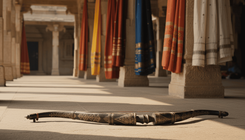
At Sita's swayamvara—the assembly where she would choose her husband—the bow of Lord Shiva was placed before the gathered suitors. No man had ever strung it. When Rama stepped forward, he not only strung the bow but broke it in two. This act is the pivot point of the whole story: it proved his worthiness to marry Sita, and it showed the truth of who Rama was.
The swayamvara itself was a test set by Sita's father, King Janaka of Mithila. He owned the bow, an ancient and sacred instrument of immense power, and he decreed that only the man who could string it would marry his daughter. This was not merely a contest of strength. A swayamvara was a woman's right to choose, and the test ensured she would choose a man of uncommon ability and dharmic standing. When the princes and kings of the realm came to try, not one could even lift the bow properly, let alone string it.



Why the Bow Belonged to Janaka
King Janaka did not simply possess the bow as a trophy. The Ramayana tells that the bow had come into his care as a sacred trust. According to some tellings, it had belonged to Shiva himself, and Janaka kept it as the greatest treasure of his kingdom. In other accounts, it was fashioned by the gods and passed to him through the line of his ancestors. Either way, it was no ordinary weapon. It was a symbol of divine power and dharmic authority. To string it meant to be worthy of bearing that power.
Janaka's choice to use this bow as the test was deliberate. He was not a man who would marry his daughter to the strongest warrior or the richest king. He wanted a husband whose inner strength—his tapasya, his dharma, his capacity for truth—matched the external test. By placing the bow in this central role, he transformed a swayamvara from a simple contest into a spiritual examination.
The Significance of Rama's Act
When Rama approached the bow, he did so without arrogance or doubt. He was aware of its power and its history, but he moved forward because this was the moment that dharma required. As he took the bow in his hands, he began to string it. The assembled crowd held its breath. Then, as he pulled the cord taut, the bow could not bear the force—it broke in half with a sound that echoed through the assembly hall.
This breaking was not a flaw or an accident. It was proof of Rama's extraordinary strength and his connection to the divine. The bow broke because no ordinary bow—not even a sacred one shaped for gods—could contain the power of Rama, who was Vishnu himself incarnate. In that moment, everyone present understood the truth: Rama was not merely a prince, but something far greater.
For Sita, the breaking of the bow held a different meaning. She had been waiting and watching, and she understood in that instant that Rama was the man she was meant to marry. Their union was not random or accidental, but written into the very fabric of the cosmos. When she garlanded Rama in the traditional gesture of choosing her husband, she was confirming what the broken bow had already declared: they were meant for each other.
The Dharmic Meaning of the Test
The entire episode teaches something profound about dharma and worthiness. The swayamvara was not about finding the strongest man or the richest suitor. It was about finding a man whose inner and outer qualities aligned with truth. Rama's breaking of the bow showed that he combined dharma, strength, divine grace and humility in a way that no other man present could match.
The bow itself becomes a metaphor. In the Vedas and the Upanishads, dharma is often described as that which holds the universe together, just as a bow holds and directs an arrow. When Rama broke the bow, it was because his own dharmic power exceeded even what the greatest divine instrument could contain. He was not destroying something precious; he was demonstrating that he carried within himself a dharma more powerful than any object, no matter how sacred.
This is also why the breaking was celebrated rather than condemned. The crowd did not mourn the loss of the bow; they cheered, because they recognised that Rama had passed the ultimate test. In many tellings of the tale, Janaka himself was filled with joy at this outcome. His daughter would marry a man whose dharma was unquestionable, whose strength was unmatched, and whose character was beyond reproach.
The Bow Across Different Tellings
Different regional versions of the Ramayana emphasise different aspects of this moment. In some accounts, the emphasis falls on the superhuman strength required to break such an object. In others, the focus is more on Rama's humility—that despite his power, he approached the task with reverence and without pride. In still others, the breaking of the bow is presented as an act of divine will using Rama as its instrument, rather than as Rama's personal choice.
These variations do not contradict each other; they are layers of the same truth. Strength alone would not have broken the bow—a very strong man might have snapped it, but that would not have moved the assembly to tears. Humility alone would not have done it—a humble man might have tried carefully and failed. What broke the bow was the union of supreme strength with absolute dharma, and that is what Rama embodied.
When you encounter this story in your own practice and study, the breaking of the bow invites you to reflect on your own inner power and how you carry it. Do you meet challenges with arrogance, or with the quiet confidence that comes from alignment with dharma? The bow breaks not because Rama forces it, but because his presence in the world is so aligned with truth that no obstacle shaped by lesser dharma can withstand it.
The story also reminds us that worthiness is tested not by intention alone but by deed. Rama did not claim to be worthy; he proved it. Sita did not choose based on promises; she chose based on what she witnessed. This is the final lesson of the bow: that dharma is not something you speak, but something you live, and that living it changes the world around you.
Common questions
Did Rama really break the bow on purpose or was it an accident?
In the traditional telling, the bow broke because Rama's inner power exceeded what even the sacred bow could contain. It was not an accident but a demonstration of his dharmic strength. Different regional versions vary in whether it is emphasised as his choice or divine will flowing through him, but all agree it revealed his true nature.
What happened to the other princes who tried the bow?
None of the assembled princes and kings could string the bow, though many tried. Some accounts describe them attempting to lift it or draw the string without success. Their failure made Rama's achievement all the more remarkable and confirmed that no ordinary man, no matter his rank or wealth, possessed the strength and dharma he carried.
Does the story of the bow appear in all versions of the Ramayana?
Yes, the swayamvara and the breaking of the bow are central episodes in all major tellings, including Valmiki's Sanskrit Ramayana and regional adaptations like the Ramacharitamanas. While some versions expand or emphasise different details, the core narrative of the bow test and Rama's breaking it is consistent across traditions.

Related Articles


