
Why Nandi the Bull Faces the Shiva Shrine
Devoted Guardian at the Temple Gate

Sunil Chaurasia
14 Nov 2026 • 6min
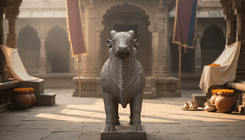
In almost every temple dedicated to Shiva, a stone or metal bull sits in the entrance courtyard, always facing toward the inner shrine where Shiva is worshipped. The nandi bull shiva temple arrangement is no accident of placement. It speaks to something central about how this tradition understands loyalty, devotion, and the relationship between a devoted follower and the divine.
Nandi is not merely a sculpture or architectural feature. He is the vahana—the vehicle or mount—of Shiva himself, one of the principal deities of Hinduism. A vahana is the creature or being that carries a deity, and in Sanskrit the word means that which bears or carries. The relationship between a deity and vahana is intimate and sacred: the vahana embodies the divine qualities the deity represents, and in return receives eternal honour and worship. Nandi, as Shiva's vahana, is understood as embodying Shiva's strength, justice and protective power.
The positioning of Nandi facing the shrine is purposeful. He stands at the threshold between the outer world and the inner sanctum, his face always turned toward the object of his devotion. For those who visit the temple, Nandi becomes a model. He shows what it means to keep your attention, your focus and your reverence fixed on the divine. To many worshippers, Nandi demonstrates the ideal form of bhakti—devotional surrender—made visible in stone or brass. He does not turn away. He does not waver. His gaze never leaves the shrine.



The Story of Nandi's Devotion
The relationship between Nandi and Shiva is told in mythology in several ways across different regions and texts. One widely known story says that Nandi was originally a gandharva, a celestial musician, cursed to take the form of a bull. Through his intense devotion to Shiva, he was blessed rather than punished: he became Shiva's closest companion and mount, granted eternal life and a place of honour in every Shiva temple. Other tellings describe Nandi as having been born as a bull and winning Shiva's favour through unwavering devotion and service.
What threads through these stories is a consistent theme: Nandi's position beside Shiva is not inherited or accidental, but earned through dedicated and single-pointed focus on the divine. This earned devotion is why he stands where he stands.
What Nandi Represents to Worshippers
When you approach a Shiva temple and see Nandi facing the shrine, you are witnessing a teaching. Nandi embodies several qualities that matter in spiritual practice. He shows steadiness—the bull is a creature of calm strength, not easily moved or distracted. He shows loyalty; his attention never strays from Shiva. He shows humility; despite being the mount of a great god, he remains in service rather than seeking glory for himself.
In some temples, worshippers touch Nandi as they enter, believing his presence brings blessings and removes obstacles from their path. Others circle him respectfully before moving deeper into the temple. The physical encounter with Nandi becomes part of the journey inward toward the shrine. He is not a barrier but a threshold guardian and a reminder of what the visit is for.
The Symbolism of the Bull
The bull itself carries ancient and layered meaning in Indian spirituality. The bull is associated with dharma—the principle of righteousness and right order—which is why Nandi is sometimes called Dharmadhyaksha, the upholder of dharma. The bull's strength is not aggressive but stable and protective. It works, it endures, it does not falter. These qualities are held to reflect something essential about Shiva himself: infinite power held in perfect stillness and discipline.
When Shiva is shown in meditation, his power is contained and inward-turned. The bull carries that same quality—tremendous potential held in calm containment. This is why the figure of Nandi facing the inner shrine becomes so meaningful. He is not restless or seeking. He simply attends.
Nandi and the Act of Worship
Understanding Nandi's placement changes how you experience a Shiva temple. You are not walking past a decoration; you are entering a space shaped by intention. The nandi facing shiva arrangement orients the entire courtyard. Everything points inward. The moment you see Nandi, you know which way to go and what your focus should be.
Many temples place a bell or bell-pull near Nandi, and some worshippers ring it as they greet him before proceeding to the shrine. This small ritual acknowledges him, honours the principle he represents, and marks a shift in your own state of mind. You are moving from the ordinary world into sacred space. Nandi stands as the threshold, the turning point.
The image of the nandi ear whisper—the idea that Nandi hears whispered prayers and carries them to Shiva—is part of some worshippers' experience, though not universal to all schools and regions. Where this understanding is part of practice, Nandi becomes an intermediary, someone who knows both Shiva and the hearts of the devotees who come to pray. He is reliably there, reliably attentive, reliably faithful.
Regional and Sampradaya Variations
The way Nandi is honoured varies across India's many Shaiva traditions. In South Indian temples, particularly in Tamil Nadu and Karnataka, elaborate stone nandis are often intricately carved and form a prominent sculptural element of the temple complex. In many Himalayan and North Indian traditions, Nandi may be present but the architectural style differs. Some temples include multiple nandis at different points in the sacred space, each one oriented toward the shrine.
What remains constant is the principle: Nandi faces inward. His placement and orientation are not random but deliberately organised to reflect the cosmic geography of Shaiva belief, where Shiva sits at the centre and all devotion flows toward that centre.
Why This Matters Now
For someone visiting a Shiva temple today, understanding why Nandi faces the shrine transforms the experience from architectural fact into spiritual teaching. You see that the temple is not a random collection of elements but a carefully composed space designed to guide your attention and your heart. Nandi's steady presence, facing the shrine across centuries and centuries, is a silent teaching about what devotion looks like and where it leads.
The next time you enter a Shiva temple and encounter Nandi, you might pause for a moment. Look at what he is facing, and the direction he has chosen. Consider what it might mean to turn your own attention that way.
Common questions
What does vahana mean?
Vahana means a vehicle or mount in Sanskrit. It is the creature that carries a deity, and the relationship is sacred and eternal. Nandi is Shiva's vahana, embodying Shiva's strength and justice.
Can I touch Nandi when I visit a temple?
Practices vary by temple. In many Shiva temples, especially in South India, worshippers do touch or make an offering to Nandi as part of entering the temple, believing it brings blessings and removes obstacles.
Are all Shiva temples oriented the same way around Nandi?
While every Nandi faces the shrine, the architectural style and placement varies across regions and traditions. South Indian temples often feature elaborate carved nandis, while North Indian temples may have different sculptural styles, but the principle of facing inward remains constant.

Related Articles


