
Why Lord Krishna Wears Yellow: The Meaning of Pitambara
The sacred cloth that holds devotion and divinity

Kushal K
01 Nov 2026 • 6min
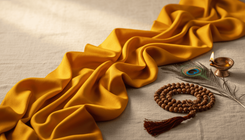
Krishna's yellow clothes, called pitambara, are far more than a costume detail. They carry layers of meaning that reach into scripture, philosophy and the devotional heart of his worship. To understand why Krishna wears yellow is to understand something essential about how we perceive divinity in the Sanatan tradition.
Pitambara means literally "yellow cloth" or "yellow silk," and it appears as Krishna's signature garment across every region of India where he is worshipped. But why yellow, and why does it matter? The answer starts with what yellow means in Hindu thought and practice.



The Symbolism of Yellow in Hindu Practice
Yellow holds sacred significance across Hindu ritual and belief. It is the colour of the sun, of light, of knowledge and divine radiance. In puja and ceremony, yellow flowers and yellow cloth are offered to invoke auspiciousness and spiritual power. When a brahmin ties a yellow thread during a ritual, or when turmeric—that golden spice—is applied to an altar, the intention is the same: to invoke purity, prosperity and the presence of the divine.
In the Vedic tradition, yellow is linked to Surya, the sun god, and to agni, the sacred fire. Both are sources of life, illumination and renewal. When Krishna wears pitambara, he is visually aligned with these energies. He becomes, in his own way, a source of light in the spiritual sense—not the light of the sun, but the light of consciousness, wisdom and love.
The choice of yellow also distinguishes Krishna from other major deities. Shiva is often depicted in blue or ash-smeared, Devi in red. This visual language helps devotees recognise and connect with each form of the divine. Yellow became Krishna's colour, and over centuries it became impossible to imagine him without it.
Krishna as the Divine Cowherd
The story of Krishna's early life shapes how we understand his appearance. As a child in Vrindavan, Krishna lived as a cowherd among the gopis, the cowherd women who adored him. He was not born a king; he lived among ordinary people, playing the flute and dancing in the forests.
In this context, pitambara takes on a different resonance. Yellow was also the colour worn by dancers and performers in ancient India. A peacock feather in his hair, a flute in his hands, yellow silk draped around him—Krishna became the ultimate performer of divine play, or lila. His yellow clothes marked him as one who moves between worlds: the divine and the earthly, the serious and the playful, the eternal and the moment.
This dual nature is central to Krishna's appeal. He is not distant or forbidding. He wears what a celestial dancer might wear, and he enters into the lives of those around him with intimacy and joy. The pitambara says: this is a god who will come close to you, who will dance with you, who is not afraid of love and colour and music.
The Jewelled Crown and Sacred Beauty
Pitambara is never worn alone. It forms part of a complete image that includes Krishna's jewelled crown, his garland of wild flowers, his peacock feather, and the precious ornaments that adorn him. Together, these create what devotees call Krishna's sringara—his beautiful, decorated form.
In temple worship across India, the deity is dressed and adorned each morning as part of the ritual day. Krishna's image is bathed, anointed with fragrant oils, dressed in fresh pitambara, crowned and garlanded. This daily dressing is not mere decoration. It is a form of seva, or service, through which devotees express their love and tend to their beloved god.
The yellow cloth also frames Krishna's divine beauty in a way that speaks to the rasa tradition—the theory of aesthetic and emotional experience in Indian arts. Yellow enhances the radiance of Krishna's face and form. It creates contrast against his dark skin. It makes him visible from far away in a crowded temple. But more than this, it heightens the sense of his otherworldliness. In the midst of normal life, pitambara marks him as transcendent.
Regional Interpretations and Variations
While pitambara is universal in Krishna worship, its meaning and significance vary slightly across regions and sampradayas, the different lineages of practice.
In North India, particularly in Mathura and Vrindavan where Krishna is believed to have lived, pitambara often features gold thread or embroidery. The cloth itself is silk, sometimes interwoven with gold. This richness reflects the grandeur of Krishna's cosmic nature—his identity as the supreme reality, or Brahman, who manifests in finite form.
In South India, particularly in Tamil Nadu, Krishna is also worshipped in yellow, but the style and draping often follows regional dress codes. The colour remains the same; the cultural expression varies. In some temples, yellow is reserved for certain festivals or times of year, while in others it is worn year-round.
In the Bhakti movement, which emerged across India from the 15th century onwards, poets and saints celebrated Krishna's yellow beauty as a sign of his accessibility. Jayadeva, the 12th-century poet, wrote of Krishna's beauty in terms that made it intimate rather than distant. Later, poets in Hindi, Marathi, Bengali and other languages echoed this, using the image of pitambara to speak of a god who could be loved and desired as well as worshipped and feared.
What Pitambara Tells Us Today
To wear yellow in Krishna worship, or to meditate on his image in pitambara, is to engage with layers of meaning that have accumulated over centuries. Yellow is not arbitrary. It carries the weight of scriptural association, the memory of ritual practice, the intimacy of the Vrindavan stories, and the aesthetic philosophy that shaped how divinity is perceived in Indian thought.
When you see Krishna in his yellow clothes—in a temple, in an image, in a meditation—you are not seeing a random choice. You are seeing the result of a long conversation between philosophy, art, devotion and lived practice. Pitambara makes Krishna visible and recognisable. It also makes him beautiful, accessible and beloved. In Hindu worship, beauty and divinity are not separate. They are one, and pitambara is one of the ways that unity is expressed.
Common questions
Is pitambara always worn in Krishna temples, or only on special days?
In many temples, pitambara is Krishna's daily dress year-round. However, some temples reserve special or richer versions of the yellow cloth for festivals and occasions like Janmashtami, Krishna's birthday. The practice varies by region and temple tradition.
Can I wear yellow cloth as part of my Krishna worship at home?
Yes. Many people offer yellow flowers, cloth or garland to a Krishna murti or image at home as an act of devotion. Some also wear yellow on days dedicated to Krishna, particularly during festivals, as a way of aligning themselves with his energy.
Does the shade of yellow matter—is bright yellow different from pale yellow?
Different temples and sampradayas prefer different shades, from bright golden yellow to softer cream yellows. Bright yellow tends to be more visible and vibrant in ceremonial settings, while softer tones are sometimes preferred for intimate worship. The spiritual significance lies in the colour family itself, not in the precise shade.

Related Articles


