Why Is the Moon Worshipped on Sharad Purnima?
Autumn's Full Moon, Time of Abundance

Aditya Pandey
19 Oct 2026 • 6min
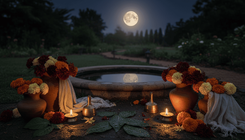
Sharad Purnima is the full moon night celebrated as a moment when the boundary between earth and heaven grows thin, and the moon is thought to be at its most potent and benevolent. On this autumn night, people worship both the moon and Goddess Lakshmi, the giver of wealth and prosperity, seeking plenty, health and the fulfilment of wishes. The night is also called Kojagari or Kojagara Purnima, a name that comes from the Sanskrit question "Ko jagarti?"—"Who is awake?" According to tradition, Goddess Lakshmi roams the earth on this night asking this question and blesses those she finds awake, which is why devotees keep vigil through the night in the moon's presence.
Sharad Purnima falls on the full moon of the month of Ashwin, which usually comes in October and occasionally at the end of September. The date shifts with the lunar calendar each year, since it is determined by when the moon becomes full in this particular lunar month. It marks the end of the monsoon rains and the arrival of sharad, the clear autumn season—a time when the harvest season begins and the year's rhythm begins to slow and clear.



Why the Moon Matters at This Moment
In the understanding that moves through Indian spiritual life, the moon is not a distant object but a presence whose cycles are woven into our own bodies and moods. The full moon in particular is seen as a time when energy is complete and concentrated. Sharad Purnima is believed to be the only night of the year when the moon appears with all sixteen kalas, or phases of completeness, making it the most perfect full moon of the year. On this night, the moon is said to be at the height of its cooling, nourishing quality—the counterbalance to the heat that has dominated the year—and its rays are believed to carry amrit, the nectar of immortality. This is why the night is associated with health, abundance and the lifting of hardship.
The moon is also traditionally connected to the mind and to clarity. Worshipping it on this night is understood not only as a prayer for blessings, but as an act of alignment—turning your own awareness towards something vast and orderly that moves according to laws beyond your control. To stay awake through the night watching the moon is to participate in this turning, a form of meditation without formal words.
The Practice of Moonlight Vigil
The most direct expression of Sharad Purnima worship is jagarana—staying awake through the night under the full moon. People sit in courtyards, on terraces or in gardens, watching the moon rise and move across the sky. Some engage in conversation, devotional songs and music; others are silent. The vigil itself is the point: the act of bearing witness, of holding attention on something beyond yourself through the hours of darkness, and of being among those Lakshmi finds awake.
The best-known custom of the night is kheer in the moonlight. Families prepare kheer, a sweet dish of rice cooked in milk, and leave it out under the moonlight, often through the night, so that it absorbs the moon's nectar-filled rays. The kheer is then offered and eaten as prasad, believed to bring health and well-being. Many families also perform Lakshmi Puja or Satyanarayan Puja in the evening, marking a ritual space with flowers and offerings of seasonal foods. Some keep a fast through the day and break it with the moon-blessed kheer. The offering is then shared among family and the wider community. This connects the worship to the practical abundance of the season—the celebration moves from spiritual practice to shared nourishment.
In parts of eastern India, particularly Bengal and Assam, the tradition is especially strong, where the night is celebrated as Kojagari Lakshmi Puja—the main Lakshmi Puja of the year in Bengal. Families worship the goddess at home, draw alpana designs, and keep the night alive together with songs, stories and prasad. The boundaries between ritual formality and festive celebration are less marked; the sense of communal awakeness is itself the purpose.
Moon Worship and the Lunar Year
The moon holds a central place in the Panchanga, the traditional Hindu calendar. Each full moon marks a turning point in the year, and each is associated with particular qualities and practices. Sharad Purnima is not the first full moon of the year, but it is widely held to be the most special one—the night when the moon shines with all its sixteen kalas and the cycle is most visible and most complete.
Sharad Purnima is also associated with the rasa lila, the divine dance of Krishna with the gopis of Vrindavan on the autumn full-moon nights. In the Braj region, the night is celebrated as Raas Purnima, commemorating Krishna's Maha Raas. In this reading, the worship of the moon becomes a way of touching that divine play—the ecstatic dance of love and devotion. This layer of meaning is particularly strong in the Vaishnava traditions, where Krishna is understood as the source and heart of all love.
The same full moon also marks Valmiki Jayanti, honouring the sage-poet traditionally regarded as the author of the Ramayana. Other traditions emphasise the festival as a harvest acknowledgement and a moment for the entire community to turn towards prosperity. Whether you frame it in devotional language or not, the practice remains consistent: the moon in autumn is a presence to be recognised, met and honoured.
How Regions Approach the Night
The way Sharad Purnima is observed varies significantly across the subcontinent. In Gujarat, where it is known as Sharad Poonam, many communities celebrate with garba under the full moon and share doodh-pauva, a dish of milk and flattened rice, in the moonlight. In Maharashtra, the night is known as Kojagiri Purnima, when families stay up together and drink spiced, boiled milk under the moon, and many honour the eldest child of the family. In Odisha, the day is celebrated as Kumar Purnima, when unmarried girls worship Kartikeya, the son of Shiva and Parvati, along with the moon, praying for a good husband. In the Braj region, it is Raas Purnima, dedicated to Krishna. In parts of South India, the observance is less prominent in the calendar, though moon worship remains part of spiritual life throughout the year.
In Nepal, the full moon is observed as Kojagrat Purnima, marking the end of the Dashain festival, with the worship of Lakshmi and a night-long vigil. The practice shifts with landscape and local custom, but the thread remains: this is a night when the ordinary world is held lightly, and attention turns upward.
What to Carry Away
If you are drawn to observe Sharad Purnima, you do not need elaborate preparations or specific permissions. The practice begins simply: on the full moon night of Ashwin, step outside and watch. You might prepare kheer and leave it in the moonlight, offer a prayer to Lakshmi, or light a lamp. You might sit in silence, or with family and friends. The point is not to get the form exactly right, but to mark the moment—to acknowledge that the year turns, that there are rhythms larger than your own, and that sometimes the most powerful thing you can do is bear witness.
Common questions
When does Sharad Purnima happen in 2026?
In 2026, Sharad Purnima is observed on the night of Sunday, 25 October. The Purnima tithi begins at about 11:55 AM on 25 October and ends at about 9:41 AM on 26 October (Indian Standard Time). Some calendars list the date as 26 October because that is when the tithi ends, but the night vigil, Kojagara Lakshmi Puja and the custom of keeping kheer in the moonlight are observed on the night of 25 October. Timings vary slightly by city, so check your local panchang.
Do I have to stay awake the whole night?
The traditional practice of jagarana involves staying awake, but you can adapt it to what feels possible. Even sitting with the moon for part of the night honours the occasion; the intention matters more than perfect adherence to the form.
What is the difference between Sharad Purnima and Kojagari Purnima?
They fall on the same full moon night, but the name and emphasis vary by region. Sharad Purnima is the general name for the Ashwin full moon. Kojagari or Kojagara Purnima refers especially to the worship of Goddess Lakshmi on this night, and is most prominent in Bengal and Assam, where it is celebrated as Kojagari Lakshmi Puja. In Maharashtra it is called Kojagiri Purnima, in Odisha it is observed as Kumar Purnima, in Gujarat it is Sharad Poonam, and in the Braj region it is Raas Purnima. The customs differ from place to place, though the full moon night and its spirit of vigil and blessing are shared.

Related Articles