Why is Goddess Lakshmi Worshipped on Diwali?
Abundance Sought in Light and Lamp Flame

Sunil Chaurasia
17 Oct 2026 • 6min
Goddess Lakshmi is worshipped on Diwali because the festival's new moon night is considered the most auspicious time of the year to welcome her into the home. Many traditions hold that this is the night she emerged from the ocean during the cosmic churning, or Samudra Manthan; others associate it with the night she chose Lord Vishnu as her eternal consort. On this auspicious night, she is believed to visit homes, bestowing prosperity, wealth and good fortune on those who welcome her with devotion and light. The tradition honours both her presence in the world and her role as the giver of abundance to households and families. This is why Lakshmi Puja, the ritual worship of the goddess, sits at the heart of Diwali celebrations across much of India.



The Samudra Manthan and Lakshmi's Birth
The story of Lakshmi's emergence comes from one of Hindu mythology's most celebrated tales. According to the Mahabharata and the Puranas, when the gods and demons churned the Ocean of Milk (Kshira Sagara) together—using Mount Mandara as a churning rod, the serpent Vasuki as a rope, and Lord Vishnu in his Kurma (tortoise) avatar supporting the mountain on his back—Lakshmi arose from the waters as a gift to the world. She appeared in her full radiant form, seated on a lotus and bearing the promise of prosperity. Of all the gods present, she chose Vishnu as her consort, placing a garland around his neck, and has remained by his side ever since.
Many traditions understand Diwali to commemorate Lakshmi's emergence or her union with Vishnu, making it an especially auspicious time to invite her blessing into homes and lives. Others link her appearance to a different day, such as Sharad Purnima. Different regions of India also tell different stories about Diwali itself—some focus on Lakshmi, others mark Lord Rama's return from exile to Ayodhya, and others still celebrate Krishna's victory over Narakasura—but the worship of Lakshmi on this night is a common thread running through Diwali observance across much of India. The underlying principle is the same: Diwali is a night when prosperity is believed to be most willing to be received.
Why Light Invites Lakshmi
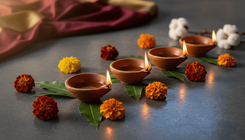
Lakshmi is traditionally associated with light, purity and auspiciousness. The lamps, or diyas, lit during Diwali are understood as both an offering to the goddess and an invitation to her presence. In the Lakshmi Puja ritual, the lighting of the lamp is far more than decoration; it is a deliberate act of welcome, a signal that the household is ready to receive her grace.
The goddess is said to avoid darkness, disorder and neglect. She flows toward light, cleanliness and devotion the way water naturally flows downhill. This is why homes are cleaned and whitewashed before Diwali, why lamps are lit in every corner, and why Lakshmi Puja is performed in the evening as dusk falls and the stars begin to show. The visual beauty of Diwali—the oil lamps, the rangoli patterns on the floor, the flowers and garlands—are not mere aesthetics but an intentional language speaking to the goddess: here is order, here is care, here is a place ready to receive you.
The Elements of Lakshmi Puja on Diwali
When you perform Lakshmi Puja on Diwali, the ritual typically includes offerings of flowers, incense, fruits, sweets and grain to an image or statue of the goddess. Many households also include an image of Ganesha, the remover of obstacles, acknowledging that prosperity flows more easily when hindrances are cleared. Many also worship Kuber, the treasurer of the gods, and Saraswati, the goddess of knowledge, while business families honour their new account books in a ritual known as Chopda Pujan or Bahi-Khata Puja. The puja follows a sequence: invocation of the goddess, offering of flowers and prayers, lighting of the lamp, and distribution of blessed food as prasad, the sacred offering returned to worshippers as the goddess's blessing.
What makes this puja distinct from daily worship is the night itself: Diwali is one of the most important nights of the year when Lakshmi is believed to move through the world, visiting homes that are ready to receive her. This is why the puja is performed with particular care and intention, and why it marks the high point of the festival for many families. The ritual affirms not just a belief in abundance, but a commitment to the values that invite it: cleanliness, generosity, devotion and family unity.
Regional and Sampradaya Variations
Lakshmi Puja is central to Diwali across much of India, but the specifics vary by region and religious tradition. In South India, particularly Tamil Nadu, Deepavali is celebrated on the morning of Naraka Chaturdashi with an oil bath and the wearing of new clothes, though Lakshmi worship remains significant. In Gujarat, the new year begins on the day after Diwali, and Lakshmi Puja marks a formal transition into the fresh year. In Bengal, Odisha and Assam, the new moon night of Diwali is celebrated primarily as Kali Puja, honouring the fierce form of the divine feminine; Bengal's main Lakshmi Puja, Kojagari Lakshmi Puja, is held earlier, on the full moon night following Durga Puja.
Some sampraday, or lineages within Hinduism, place greater emphasis on Rama's return to Ayodhya on Diwali night, while others prioritise Lakshmi as the primary focus. These differences do not contradict one another; they reflect the richness of Hindu practice and the many ways communities have made sense of the festival within their own culture. What remains consistent is the understanding that Diwali is a night of welcome, whether the welcome is for prosperity, for the victory of good over evil, or for the arrival of a beloved deity.
What Lakshmi Puja Asks of You
Worshipping Lakshmi on Diwali is not only about asking for wealth in the material sense. The goddess represents all forms of abundance: health, knowledge, courage, beauty and spiritual growth. When you light the lamp and make offerings, you are signalling that you understand prosperity as something that flows from virtue, discipline and openness. Lakshmi is said to stay in homes where people are honest, generous, hardworking and respectful of one another.
This is why the puja is often accompanied by practical acts: clearing clutter from the home, paying off old debts, settling disputes with neighbours or family, and planning for the year ahead. The ritual creates a moment to pause and ask yourself not just for wealth, but for the character and intention that make wealth meaningful. In this way, Lakshmi Puja on Diwali becomes both a prayer and a promise—a commitment to live in alignment with the values the goddess represents.
Common questions
Can you do Lakshmi Puja on a day other than Diwali?
Yes, Lakshmi can be worshipped on other auspicious days throughout the year, particularly on Fridays, during Varalakshmi Vratam in the month of Shravana, on the Thursdays of Margashirsha, and on Sharad Purnima (Kojagari Purnima), when she is also believed to roam the earth blessing those who stay awake in devotion. However, Diwali night is considered one of the most powerful and auspicious times for this puja.
What should I offer to Lakshmi during the puja?
Typically you offer flowers (especially lotus or marigold), incense, oil lamps, fruits, sweets, grain and water. Traditional Diwali offerings also include kheel (puffed rice), batashe (sugar drops) and kheer. Many households also include seasonal produce or items that hold personal significance. The key is offering with sincerity and clean hands from a clean space.
What is the best time to perform Lakshmi Puja on Diwali?
Lakshmi Puja is ideally performed in the evening during Pradosh Kaal, the period after sunset, on the new moon night of Diwali. Many traditions prefer the portion of Pradosh Kaal that coincides with a Sthir Lagna (fixed ascendant), usually Vrishabha (Taurus). The exact auspicious time, or muhurat, is calculated from the lunar calendar for your city, and many temples, panchangas and almanacs provide this information each year.

Related Articles