
Why Hindu Month Names Come From Nakshatras
Celestial Patterns, Earthly Time

Aditya Pandey
22 Nov 2026 • 6min
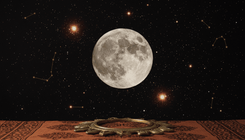
When you look at a Hindu calendar, the month names—Chaitra, Vaishakh, Jyeshtha and the rest—may seem simply to be traditional words. But each one is rooted in a specific celestial landmark: a nakshatra, one of the 27 star clusters that mark the moon's path across the sky. Understanding this connection reveals how the Hindu calendar system is built on direct observation of the night sky, and why month names stay the same across centuries even though the actual dates shift every year.



The 27 Nakshatras and the Moon's Journey
The Hindu astronomical tradition divides the moon's monthly path into 27 stations, each called a nakshatra. Modern astronomy knows these as lunar mansions—sections of the zodiac where the moon spends roughly one day of its orbit around Earth. Each nakshatra is a specific arrangement of stars, and each has a presiding deity, an elemental quality, and a ruling planet.
The 27 nakshatras are: Ashwini, Bharani, Krittika, Rohini, Mrigashira, Ardra, Punarvasu, Pushya, Ashlesha, Magha, Purva Phalguni, Uttara Phalguni, Hasta, Chitra, Swati, Vishakha, Anuradha, Jyeshtha, Mula, Purva Ashadha, Uttara Ashadha, Shravana, Dhanishtha, Shatabhisha, Purva Bhadrapada, Uttara Bhadrapada, and Revati. This list appears in the Rig Veda and other ancient texts, showing that this system is ancient.
The moon completes one orbit in roughly 27 days, spending about one day in each nakshatra. This natural rhythm gave ancient calendars their structure: a lunar month is typically marked from the moment the moon passes through one particular nakshatra to the moment it reaches that same point again.
How Nakshatras Become Month Names
The 12 months of the Hindu lunar calendar are named after 12 of these 27 nakshatras. The month name marks the nakshatra through which the full moon passes during that lunar month. This is the key to understanding the entire system.
Chaitra month is named after Chitra nakshatra, the star cluster where the full moon appears during the spring month. Vaishakh is named after Vishakha, Jyeshtha after Jyeshtha, and so on. When the full moon passes through Rohini nakshatra, that month is called Vaishakh in many regions. When it passes through Krittika, that month is Vaishakh in other parts of India—which is why the same month can have different names depending on regional tradition.
The connection is not arbitrary. Each nakshatra carries ancient associations with agriculture, ritual timing, and spiritual significance. By naming months after them, the calendar system linked the rhythm of daily life—planting, harvesting, festivals, worship—directly to the visible movement of the moon through recognizable star patterns.
Regional and Seasonal Variations
Different regions of India use different month names and sometimes place the new year at different points in the calendar. The lunisolar calendar used in North India, South India, and East India all follow the nakshatra principle but can begin their year at different times. Some traditions start with Chaitra, others with Kartik.
The month known as Vaishakh in North India is called Vaisakhi in some regions and Mesha in others, but all three names point to the same period—roughly April to May in the Gregorian calendar—and all are linked to the nakshatras visible at that time. This flexibility is a strength of the system: the actual date shifts yearly because the lunar month does not align with Earth's seasonal year, but the nakshatra names remain stable markers.
A few regions also observe an additional month inserted periodically to keep the lunar calendar aligned with the solar year. This intercalary month is also named after a nakshatra, maintaining consistency with the broader system.
Why the System Has Endured
The nakshatra-based month naming system is resilient because it describes something observable and measurable. Any person with knowledge of the night sky can verify which nakshatra the moon passes through in a given month, and therefore verify that the name is correct. This was enormously important in a pre-mechanical age: the calendar worked whether you lived in a city with trained astronomers or in a village without formal timekeeping instruments.
The Rig Veda, composed many centuries ago, already refers to these nakshatras as a known framework for understanding time. Later texts like the Surya Siddhanta, written sometime between the 4th and 5th centuries CE, formalized the system into mathematical models that are still recognizable in Hindu calendars today.
Because the system is based on the moon's actual movement, not on abstract divisions of time, the month names never become "wrong" or outdated. They shift seasonally across the Gregorian calendar, but they remain true markers of which nakshatra governs the month. Someone marking the full moon's position in Chitra nakshatra today is following the same practice described in texts written 2,000 years ago.
Living Practice and Planetary Connection
For people who follow Hindu astrology or jyotisha, the month's nakshatra also influences which practices and rituals are considered auspicious. Each nakshatra is associated with particular energies, favorable and challenging days, and guidance for important undertakings. Knowing the month's nakshatra means understanding those qualities for the entire month ahead.
This is not merely symbolic. The nakshatra system guided agricultural societies in timing their major activities. Planting, harvest, travel, and temple festivals were all scheduled with reference to the moon's position. The month names themselves carry within them this practical wisdom: they tell you not just when a month is, but what qualities that time carries.
Common questions
Are all 12 months named after the same 12 nakshatras in every region?
No. Different regions of India observe the nakshatra-based system but sometimes assign months differently. For example, the month when the full moon passes through Rohini is called Vaishakh in many regions but Kartik in others. All follow the nakshatra principle, but regional traditions create variation in naming and when the year begins.
What happens when a lunar month does not align with the Gregorian calendar?
The lunar month's date in the Gregorian calendar shifts every year because a lunar month (about 29.5 days) does not align with Earth's seasonal year. That is why a festival in Chaitra might fall in March one year and April the next. The nakshatra name stays constant even though the Gregorian date changes.
How old is the nakshatra month system?
The 27 nakshatras are mentioned in the Rig Veda, one of Hinduism's oldest texts, showing the system is at least 3,500 years old. The mathematical formalization appears in the Surya Siddhanta, written between the 4th and 5th centuries CE, which is still the foundation of Hindu calendar calculations today.

Related Articles


