
Why Hindu Festival Dates Change Every Year
Following the moon's path through the year

Kushal K
16 Nov 2026 • 7min
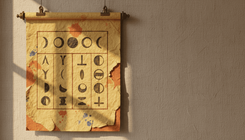
Hindu festivals do not fall on the same Gregorian calendar date each year because they are dated by the lunar and lunisolar calendar systems used in Hindu tradition, not by the solar calendar that dominates the modern world. The same festival might fall in May one year and June the next, or shift by several weeks across a span of seasons. Understanding why requires learning how the panchanga, the Hindu calendar, counts time differently from the Gregorian calendar most of us use daily.



How the lunar calendar works
The Hindu calendar is based on the moon's phases. A lunar month runs from one new moon to the next, a period of roughly 29.5 days. This is shorter than a solar month, which measures the time it takes Earth to orbit around the sun. That difference compounds: a lunar year of 12 lunar months is about 354 days, roughly 11 days shorter than a solar year of 365 days.
The lunar months have names rooted in the seasons and agricultural cycles: Chaitra, Vaishakh, Jyeshtha, Ashadh, Shravan, Bhadrapad, Ashwin, Kartik, Margshirsh, Paush, Magh and Phalgun. Each month is divided into two fortnights, the bright fortnight from new moon to full moon (called Shukla Paksha) and the dark fortnight from full moon to new moon (Krishna Paksha). Many festivals are timed to specific days within these fortnights.
Diwali, for example, falls on the new moon day in the month of Kartik. Holi is celebrated on the full moon day in Phalgun. Navratri begins on the first day of Chaitra. Because these dates are keyed to lunar phases rather than a fixed number on a calendar, they shift against the Gregorian calendar year after year.
How the lunisolar calendar keeps pace with seasons
If the Hindu calendar stayed purely lunar, festivals would gradually drift through the seasons. Diwali might fall in December one decade, September the next, and June the one after that. To prevent this, the Hindu calendar adds an extra lunar month roughly every three years.
This month is called an adhik mas or intercalary month. It carries the same name as the month before it, so you might see Adhik Ashadh (an extra Ashadh) inserted between regular months. Vedic mathematics and astronomical calculations determine when an adhik mas is needed. The traditional rule: if the sun does not enter a new zodiacal sign during a particular lunar month, that month is treated as intercalary and its observances are moved to the following regular month.
This system is lunisolar because it uses both lunar months and solar adjustment. It keeps most festivals tied to the same season year after year, even though the Gregorian dates shift. Holi remains a spring festival, Diwali remains an autumn festival, and Navratri begins in the same season whether it falls on September 25th or October 15th in Gregorian terms.
Why your festival date seems to move so much
The Gregorian calendar year is fixed at 365 days (366 in leap years), and the date of a given Gregorian day stays the same every year. January 26 is always in winter; June 21 is always near the summer solstice. By contrast, a date in the Hindu lunar calendar describes a moment in a cycle of lunar phases. The same lunar date—say, the new moon in Kartik—falls on a different Gregorian date because the lunar cycle and the solar year do not align.
The difference is predictable but not simple. A full lunar year is about 354 days, so lunar months drift earlier by roughly 11 days each year against the Gregorian calendar. But because of the intercalary months inserted periodically, the drift is interrupted and can seem erratic to someone checking a Gregorian calendar.
Regional variations also affect how a festival date appears to move. Different regions of India follow different sampradayas, or traditions, and some use the amanta tradition (where a month ends at the new moon) while others follow the purnimanta tradition (where a month ends at the full moon). These affect when a festival is considered to have begun. Additionally, different regions may calculate the moment of a new moon or full moon differently based on local astronomical observation or calculation methods, leading to festivals being observed on slightly different Gregorian dates in different parts of India.
The panchanga shows the true pattern
The panchanga is the traditional Hindu calendar document that records the lunar and solar cycles together. It lists every tithi, or lunar day, and notes which Gregorian date it falls on each year. A pundit or scholar trained in panchanga calculations can tell you the exact Gregorian date of a festival years in advance, even though that date will be different each year.
Most Hindu calendars, temple notices and community websites now publish festival dates well ahead of time, eliminating guesswork. The dates are calculated using classical rules codified over centuries, so they are reliable and consistent within a given tradition, even if two regions might observe a festival one day apart.
The panchanga also records other celestial events: eclipses, the entry of the sun into different zodiacal signs (called Samkranti), the lunar nodes, and the positions of planets. This information shapes which days are considered auspicious for beginning new ventures, getting married, or performing other significant rituals.
Why this matters for practice and observance
For those who follow Hindu festivals and rituals, the shifting Gregorian date is not a problem—it is simply how the tradition measures time. A worshipper planning to observe Ekadashi, the eleventh lunar day, does not look for an eleventh day of the month in a Gregorian calendar. They look for the eleventh tithi in a lunar fortnight, which their panchanga will tell them falls on a specific date.
For those planning around festivals while living in a Gregorian-calendar world—taking time off work, coordinating with family, planning travel—the solution is the same: check the panchanga or a Hindu calendar maintained by a temple or community organisation. These sources calculate forward reliably, and posting the dates in advance is now standard practice.
The fact that Hindu festivals move through the Gregorian calendar year is not an error or inconsistency. It is the design of a calendar system that has kept agricultural societies aligned with lunar and seasonal cycles for thousands of years, long before the Gregorian calendar was adopted worldwide. Understanding why the dates change is a window into how the Hindu tradition measures time itself.
Common questions
How far ahead can you calculate Hindu festival dates?
Using the panchanga and traditional calculation methods, Hindu festival dates can be calculated years in advance with precision. Most temples and community organisations now publish dates for the coming year, eliminating uncertainty for planning purposes.
Do all regions of India celebrate festivals on the same date?
Some regions may observe a festival one day apart due to differences in sampling traditions (amanta vs purnimanta) and local astronomical calculation methods. What matters is that each region follows consistent rules within its own tradition, so dates are predictable once you know which system your community uses.
Will a Hindu festival ever fall on the same Gregorian date twice in a row?
This is extremely rare but theoretically possible. Because the lunar year is roughly 11 days shorter than the solar year, lunar dates drift earlier each year. An intercalary month can occasionally cause a lunar date to land on or near the same Gregorian date it held several years before, but this is exceptional rather than routine.

Related Articles


