
Why Goddess Lakshmi's Vahana Is the Owl: The Story and Its Meaning
Wisdom's Shadow, Blessing's Companion

Sunil Chaurasia
04 Nov 2026 • 7min
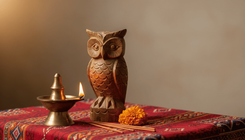
Goddess Lakshmi's vahana (vehicle or companion) is the owl, a pairing so deliberate that it shapes how we understand both prosperity and wisdom in Hindu practice. Unlike other vahanas that arrive in triumphant mythology—the eagle carrying Vishnu, the bull bearing Shiva—the owl's connection to Lakshmi arrives as a puzzle. The goddess of wealth and abundance chooses not the brightest bird, but one that sees best in darkness. This choice tells us something important about what Lakshmi truly represents.



The Story Behind the Owl
The owl became Lakshmi's vahana through two overlapping stories rooted in the Puranas. In one telling, the owl was once a yaksha—a nature spirit—who became cursed to take bird form. The curse came from a sage whose food the yaksha had scattered. Lakshmi, moved by the yaksha's suffering, granted him the honour of serving as her mount, transforming punishment into purpose. This act of redemption through service sits at the heart of the relationship.
A second narrative traces the owl to Lakshmi's own birth. When the goddess emerged from the cosmic ocean during the churning of the oceans, or Samudra Manthan, the owl was among the first creatures to serve her. The owl's keen vision in the night sky made it a natural guardian of her movements, watching over wealth's mysterious flow. Both stories emphasise the same truth: the owl does not carry Lakshmi through force or spectacle, but through humble attentiveness.
Regional traditions add their own layers. In Bengal and parts of South India, the owl features prominently in autumn harvest festivals, where Lakshmi receives offerings and the owl's presence is invoked. In some Jain traditions, the owl appears as protector of the night and guardian of hidden knowledge—roles that reinforce its association with prosperity that reveals itself to those who pay attention.
What the Owl Symbolises
The owl is nocturnal, and this matters. In Sanskrit, the owl is called uluka, and it is the creature who sees what others cannot. Where most of us are blind in darkness, the owl navigates with precision. Symbolically, this speaks to Lakshmi as the force that finds opportunity in confusion, that discerns value where others see only shadow. Prosperity is not always obvious. It comes to those whose sight is clear and whose judgment is sound.
The owl also carries associations with wisdom and learning across Indian philosophy. In the Upanishads and other texts, clarity of vision is linked to knowledge of the self and the nature of reality. By choosing the owl, Lakshmi signals that true wealth—whether material or spiritual—flows to those who cultivate wisdom. Mere possession without discernment leads to loss. The goddess's mount reminds us that abundance without understanding is unstable.
There is a paradox worth noting: in some folk traditions, the owl is considered inauspicious, a harbinger of loss or change. Yet Lakshmi rides it willingly. This suggests that even what appears unfortunate or strange can become auspicious in right relationship. The goddess does not fear the owl's shadow; she uses it. She teaches that prosperity requires the courage to move beyond conventional comfort.
The Owl and Daily Observation
When you worship Lakshmi, the presence of the owl in her iconography invites a specific kind of attention. It is an invitation to develop your own owl-sight—to see clearly, to discern, to observe. This is not mystical instruction alone; it is practical. Lakshmi blesses those who watch their resources carefully, who understand where opportunities lie, who pay attention to detail.
The owl also reminds us that prosperity moves according to natural rhythms, not according to our impatience. The owl hunts at night because that is when it thrives. It does not try to hunt by day like an eagle. Similarly, Lakshmi works through the natural unfolding of effort and dharma—righteous action. Her blessings flow along pathways already present; they do not appear through force or haste.
In many homes, small owl figurines or images appear near places where money is kept or where business is conducted. This is not superstition; it is a visual reminder to approach resources with the clarity and attention the owl embodies. When you see Lakshmi riding her owl in a painting or idol, you are seeing a teaching: prosperity comes to those who see truly, who move with awareness, and who honour both light and shadow.
Lakshmi's Owl in Ritual and Worship
During Lakshmi Puja, the goddess's vahana is honoured as part of her presence. Some families place offerings near images of the owl, recognising it as an integral part of Lakshmi's form. The owl is not secondary; it is inseparable from her blessing. To serve Lakshmi is implicitly to cultivate the qualities the owl represents.
In some temples, particularly those dedicated to Lakshmi, carved owls appear in the architecture or as part of the deity's shrine. These are not merely decorative. They are visual reminders that prosperity without clarity becomes confusion, and that true wealth includes the gift of right seeing. The owl watches over the sanctuary just as it watches over the night sky.
The pairing of Lakshmi and her owl also teaches something about relationship itself. The goddess does not sit passively on her mount; there is an active partnership. The owl carries her, alert and vigilant, while she brings blessing and grace. This is the model for how we might approach our own resources: with active attention and with trust in natural rhythms. Neither laziness nor frantic striving brings lasting abundance.
A Blessing for Clarity
The owl as Lakshmi's vahana is ultimately a blessing for clear sight. In a world where abundance can be obscured by confusion, distraction or poor judgment, the goddess chooses a mount that sees precisely. She rides the creature that thrives in conditions most of us find challenging. By doing so, she teaches that prosperity is not distant or mysterious—it is present for those who develop the clarity to perceive it.
When you encounter Lakshmi with her owl, carry this understanding forward: the goddess's blessing includes the gift of discernment. Cultivate attention. Observe carefully. Move with awareness of natural rhythms. Trust that what you seek has already begun to reveal itself to those with eyes to see. This is the message the owl brings, riding through the night at Lakshmi's side.
Common questions
Is it true that owls are considered bad luck in Hindu tradition?
In some folk traditions, owls are associated with inauspiciousness or change. However, Lakshmi deliberately chose the owl as her vahana, which shows that the bird carries different meanings depending on context. As Lakshmi's mount, the owl is auspicious and represents discernment and prosperity.
Can I keep an owl idol or image in my home for Lakshmi's blessing?
Yes. Many families place owl figurines or images in their homes, especially near places where money is kept or business is conducted, as a reminder of clarity and attentive observation. These serve as visual teachings of Lakshmi's gifts rather than as substitutes for worship.
What makes the owl different from other vahanas in Hindu mythology?
Unlike vahanas associated with strength or speed—like the eagle or lion—the owl represents clarity, discernment and the ability to see what is hidden. This distinguishes Lakshmi's blessing from mere material abundance, emphasising wisdom and right understanding alongside prosperity.

Related Articles


