
Why Ganesha Is Called Vighnaharta: The Remover of Obstacles
The Destroyer of Barriers on the Path Forward

Aditya Pandey
01 Nov 2026 • 7min
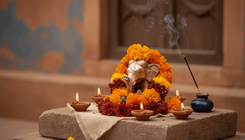
Vighnaharta means "the remover of obstacles," and it is one of the most essential names of Lord Ganesha. The word breaks into two parts: vighna, which means obstacle or barrier, and harta, which means remover or destroyer. This name captures Ganesha's primary role in Hindu devotion and practice: to clear away the hindrances that stand between you and your goals, whether those obstacles are external challenges or internal blocks to understanding and growth.
When you invoke Ganesha before beginning any task, worship or important life event, you are asking for his assistance in dissolving the barriers that might otherwise slow or stop you. This is why Ganesha is worshipped first in almost every puja, ritual or spiritual undertaking. His role is foundational: remove the obstruction, and the path becomes clear for what comes next.



The Story Behind the Name
The name Vighnaharta appears throughout Hindu scripture and mythology, but it is rooted in Ganesha's own nature as understood across the tradition. Ganesha was born from the creative will of Parvati and became her guardian, famously refusing entry to Shiva when she had not seen her husband for some time. In this encounter, Ganesha demonstrated the strength needed to stand firm against obstacles and opposition. Over time, this quality—the capacity to face and overcome difficulty—became his defining gift to those who call upon him.
The text known as the Ganesha Upanishad speaks to Ganesha's role as the one who transcends obstacles to knowledge and spiritual attainment. Different regional traditions and sampradayas (schools of practice) emphasize this aspect in different ways. In South Indian Shaivism, Ganesha is worshipped as the first principle in meditation. In North Indian Vaishnavism, he is invoked before any devotional effort. Across all these traditions, the function remains constant: he is the one who removes what blocks your path.
How Vighnaharta Works in Practice
Understanding Vighnaharta means understanding that Ganesha's role is not simply to grant wishes, but to clear the confusion, delay and resistance that often obscure what you actually need. When you face repeated setbacks in a project, or feel stuck in a spiritual practice, or sense an invisible force resisting your efforts, this is vighna—the kind of obstacle that Vighnaharta addresses.
The obstacles he removes are not always dramatic. They include the small resistances of the mind: procrastination, doubt, scattered focus, and the inability to see a way forward. They include external delays that seem to cascade without reason. They include the kind of spiritual blockage that arises when you cannot connect to your practice or feel distant from your intention. Many practitioners find that when they genuinely invoke Ganesha's help as Vighnaharta, these subtle obstacles shift more readily than they might through effort alone.
This does not mean that invoking Ganesha is a substitute for action. Rather, his work and your effort move together. You remove the internal obstacles through your own clarity and discipline; you invoke Vighnaharta to help dissolve the external and unseen ones. The clearing happens at both levels at once.
Why Ganesha Is Worshipped First
The reason Ganesha is invoked at the beginning of any significant undertaking—whether a puja, a marriage, a business venture, the start of a study or even the opening of a new shop—is directly tied to his nature as Vighnaharta. If obstacles are removed first, everything that follows has a clearer path. This is not superstition; it is a practical application of a principle that you recognise even in ordinary life: the importance of preparation, of making sure the ground is clear before you begin to build.
In temple worship, Ganesha's image or murthi is often placed at the entrance, or near the gateway, so that a visitor meets him first. This placement reflects the same idea: obstacles are addressed at the threshold. In home puja, many people set up a space for Ganesha near the entrance to the prayer room or altar, or they keep a small image of him in a room where important decisions or work take place.
This practice is reflected in many sampradayas. Before a marriage ceremony begins, Ganesha is honoured. Before a child's first day of learning, Ganesha is remembered. Before a major life transition, people invoke his name. The consistency of this across centuries and across different regions of India suggests something worth paying attention to: the removal of obstacles is understood as the foundation on which all other spiritual and practical work rests.
The Relationship Between Vighnaharta and Self-Effort
There is sometimes confusion about whether calling on Vighnaharta means that obstacles will simply disappear, or whether it is an invitation to see your own barriers more clearly. The honest answer is both, and this distinction matters. Some obstacles are indeed dissolved by grace and the sincere invocation of Ganesha's name. Others remain, but your perception of them shifts; you see a way through that you could not see before, or you find the strength to face what you were avoiding.
This is why many people who work with Ganesha as Vighnaharta report not that their problems vanish, but that they move through problems with less resistance. An obstacle that felt like a wall becomes a problem you can solve. A confusion that seemed insoluble becomes an area where you suddenly find clarity. A fear that blocked you becomes something you can acknowledge and move past.
The work of Vighnaharta, then, is not to protect you from all difficulty—that is not his function—but to ensure that the obstacles you face are genuine ones, not illusions created by your own confusion or resistance. And for the genuine obstacles that remain, he gives you steadiness and the ability to see what must be done.
Bringing Vighnaharta Into Your Own Practice
If you want to work with Ganesha as Vighnaharta, the approach is simple and does not require elaborate ritual. You can begin with a sincere acknowledgment of where you feel stuck, either silently or aloud. You might say, "Ganesha, remover of obstacles, help me see clearly what blocks my path. Help me dissolve what can be dissolved and give me courage for what remains."
Some people keep an image of Ganesha on their altar or in their workspace. Some light a lamp before him on days when they feel particularly stuck. Some people chant "Om Gam Ganapataye Namaha," a traditional invocation that honours Ganesha and calls on his help. The details matter less than the sincerity of your turning toward him and your willingness to participate in the clearing of your own path.
What matters most is that you are not passively waiting, but actively engaging with the removal of obstacles. Vighnaharta works in partnership with your own effort, your own willingness to see what needs to be seen and do what needs to be done. When you invoke him with this understanding, the obstacles that have seemed fixed often begin to move.
Common questions
What exactly is a vighna that Ganesha removes?
A vighna can be external obstacles like delays and setbacks, or internal ones like doubt, procrastination, confusion and scattered focus. Many practitioners find that both kinds shift when they invoke Ganesha with sincere intention.
Do I have to do a full puja to invoke Vighnaharta?
No. You can simply acknowledge where you feel stuck and ask Ganesha for clarity and help. A lamp, an image, or even sincere words spoken silently can be enough. The key is genuine turning toward him and your own willingness to participate in clearing your path.
Why is Ganesha worshipped before every major undertaking?
Because obstacles are addressed first, the ground is clear for everything that follows. This principle—preparation and removal of hindrances before beginning—is reflected across Indian traditions and applies to marriage ceremonies, a child's first day of learning, and major life transitions.

Related Articles


