
Why Dussehra Is Celebrated After Navratri
The Victory That Follows Nine Nights of Devotion

Kushal K
18 Oct 2026 • 6min
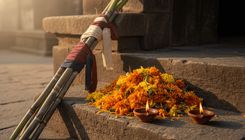
Dussehra comes after Navratri because the two festivals are not separate observances but consecutive parts of a single spiritual journey. Navratri—the nine nights of the goddess—is a period of invocation, worship and preparation. Dussehra, also known as Vijayadashami, falls on the tenth day of the bright fortnight of Ashwin, when that accumulated devotion reaches its purpose: the triumph of good over evil. Together they tell a single story: first the calling down of divine power through nine nights of ritual and fasting, then the celebration of victory made real on the tenth day. To understand why Dussehra follows Navratri, you need to understand what each one represents and how they connect through both mythology and practice.



The Mythology of Nine Nights and Triumph
The classical narrative is rooted in the story of Durga, the supreme goddess who took form to defeat the buffalo demon Mahishasura. According to popular tradition, this battle raged for nine days and nights. Durga fought with increasing intensity, meeting and vanquishing the demon's army and generals through each successive night. On the tenth day, she slew Mahishasura himself, and that day—Vijayadashami, "the tenth day of victory"—celebrates this triumph. Some traditions place Mahishasura's death on Navami, the ninth day, with the tenth day marking the celebration of the victory.
A second great story is woven into the same day. According to a well-known tradition, before his final battle with Ravana, Lord Rama worshipped the goddess Durga to seek her blessings—an invocation remembered in Bengal as Akal Bodhan, the "untimely awakening" of the goddess, since her worship had traditionally been held in spring. Blessed by the goddess, Rama defeated Ravana on the tenth day. This is one reason the two festivals are so closely bound: the worship of the goddess during Navratri leads directly to the victory of Dussehra. The very name Dussehra is often explained as dasha-hara, "the defeat of the ten-headed one," referring to Ravana.
This structure is not accidental. The nine nights represent the struggle needed to overcome ignorance and evil; the tenth day represents success achieved through sustained effort and grace. The goddess does not win by accident or on a whim; she wins through nine nights of focused battle. Similarly, Navratri is not an arbitrary nine-day fast or celebration. It is a nine-night invocation of the divine feminine principle—Shakti—to awaken her power within the devotee's own consciousness. Only when this inner work is complete, on the tenth day, does that power manifest as victory. Dussehra is that victory made real.
The Devotional Purpose of the Sequence
During Navratri, a devotee fasts, worships, and calls upon the goddess through ritual and mantra. Each day is traditionally associated with a different form of the goddess, known together as the Navadurga—Shailaputri, Brahmacharini, Chandraghanta, Kushmanda, Skandamata, Katyayani, Kalaratri, Mahagauri and Siddhidatri—each representing a different quality of divine power. By the ninth day, the devotee has invoked all these forms. Many families then break their fast, either on Navami after Kanya Puja or on Dashami, and on Dussehra that accumulated spiritual work finds its expression. Families perform Shastra Puja, honouring weapons, tools and instruments of their work; many worship the Shami tree and the goddess Aparajita; and in Maharashtra, people exchange leaves of the apta tree as symbolic "gold" with friends and relatives. Blessings are sought and received. What was internal—the nine nights of prayer and discipline—becomes external and shared.
This is why Dussehra cannot come before Navratri. The victory celebrated on Dussehra is not a generic triumph; it is the result of the nine nights that precede it. To celebrate Dussehra first would be to celebrate victory without the preparation, which contradicts the entire spiritual logic of the festival. The sequence encodes a principle: power must be cultivated over time through devotion and discipline before it can be claimed and celebrated.
Regional Expressions and Variations
While the core connection between the two festivals is shared across India, the way people observe and emphasise them varies by region. In North India, Navratri is often marked by fasting and the worship of the goddess through specific rituals and pujas. Dussehra is celebrated with Ramlila performances—dramatic retellings of the Ramayana—that culminate in the burning of effigies of Ravana, his brother Kumbhakarna and his son Meghnad, symbolising the defeat of evil. The festival thus connects to the larger story of Rama's victory over Ravana, another celebration of good triumphing over evil.
In Bengal, Odisha and Assam, the last days of Navratri are celebrated as Durga Puja, one of the grandest festivals in India. On the tenth day, Bijoya Dashami, the idols of Durga are immersed in rivers and ponds, marking her return to her husband Shiva's abode on Mount Kailash, and families exchange greetings and sweets.
In South India, the festival is known as Dasara in Karnataka, Andhra Pradesh and Telangana, and as Navaratri and Vijayadashami in Tamil Nadu and Kerala. Golu, the display of dolls arranged on steps, is a central ritual in Tamil Nadu and neighbouring regions, and families prepare sundal (spiced legumes) each day and offer visitors thamboolam—betel leaves, turmeric, kumkum and small gifts. The final days are marked by Saraswati Puja and Ayudha Puja, when books, instruments and tools are worshipped, and on Vijayadashami many young children begin their education in the ritual of Vidyarambham. Mysuru in Karnataka is famous for its grand royal Dasara celebrations, and in Telangana, women celebrate the floral festival of Bathukamma during this period.
In Gujarat, Garba and Dandiya raas—circle dances—are performed throughout Navratri, with celebration intensifying as the tenth day approaches, and Dussehra is often marked by eating fafda and jalebi. Despite these regional differences, the fundamental structure remains: Navratri is the period of devotion, and Dussehra is the day of victory and closure.
The Larger Spiritual Meaning
The reason Dussehra follows Navratri reflects a principle woven through much of Hindu practice: the idea that transformation requires sustained effort before it can be celebrated and sealed. Durga does not defeat Mahishasura by accident; the goddess must pursue the battle over nine long nights. Similarly, a devotee does not spontaneously overcome ignorance; nine nights of focused practice, fasting and prayer prepare the way. On the tenth day, the victory is real because it has been earned.
This teaches something deeper than ritual mechanics. It suggests that in your own life, periods of discipline and invocation—whether they are literal fasts, daily practice, or sustained focus on a goal—must precede the celebration of success. The structure of Navratri and Dussehra is not arbitrary tradition; it is a template for how change happens. Nine nights of cultivation lead to a tenth day of harvest and victory.
Carrying the Festival Forward
When Dussehra arrives after Navratri, it is an invitation to think back over the nine days: what inner work did you do? What qualities of the goddess did you invoke? What has shifted in you? The tenth day is not a moment to stop; it is a moment to acknowledge what has been achieved and to carry that strength into the year ahead. The victory celebrated on Dussehra is not final. It is the foundation from which new work, new devotion and new cycles of growth begin.
Common questions
Is Dussehra always on the tenth day after Navratri starts?
Dussehra always falls on Dashami, the tenth lunar day of the bright fortnight of Ashwin, immediately after Navratri. However, because lunar days (tithis) do not align exactly with solar days, a tithi can occasionally be skipped or extend across two days. As a result, Navratri may sometimes last eight or ten days instead of nine, and the date of Dussehra can differ by a day between regions. The sequence of nine nights of the goddess followed by the day of victory remains the same.
Can you celebrate Dussehra without observing Navratri?
Dussehra has meaning on its own as a celebration of victory over evil, and some people observe only the tenth day with prayer and offerings. However, the deeper spiritual significance of the festival—the completion of inner work and the manifest result of devotion—is best understood and experienced when Dussehra follows a period of Navratri practice.
Does every Indian region celebrate Dussehra the same way after Navratri?
No. North India emphasises Ramlila performances and the burning of effigies of Ravana, Kumbhakarna and Meghnad. Bengal, Odisha and Assam celebrate Durga Puja and Bijoya Dashami with the immersion of Durga's idols. South India observes the festival with Golu, Saraswati Puja, Ayudha Puja and Vidyarambham, and Gujarat celebrates with Garba and Dandiya. The core meaning is shared, but the specific rituals and foods vary by region and sampradaya.

Related Articles


