
Why Coconut Is Offered in Hindu Worship
The Sacred Fruit of Purity and Surrender

Aditya Pandey
07 Nov 2026 • 6min
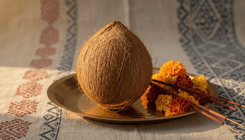
Coconut holds a central place in puja, the ritual worship performed in Hindu temples and homes. You will see it offered at nearly every sacred ceremony: placed at the foot of a deity, broken at auspicious moments, or set atop a kalash (ritual pot) during major pujas. But why has this particular fruit become so essential to worship across India? The answer lies in what coconut represents—purity, completeness, and the surrender of the individual self to the divine.



The Symbolism of the Coconut
The coconut is not arbitrary in Hindu ritual. Its structure itself teaches a spiritual lesson. The outer husk is hard and fibrous, representing the layers of ego and ignorance that obscure our true nature. Inside lies a white kernel, pure and nourishing—the inner self waiting to be revealed. The water at the centre symbolises the divine nectar, the ultimate truth within all beings. When you break a coconut in puja, this breaking open is understood as the dissolution of ego and the unveiling of the atman (the eternal self).
The fruit also carries the quality of purity in a practical sense. Coconut is one of the few foods that remains untouched by insects and decay until it is fully ripe and falls naturally. This incorruptibility makes it ritually fitting as an offering to the divine. Unlike fruits that bruise and spoil, coconut keeps its integrity, and this quality mirrors the spiritual integrity devotees seek in themselves.
Coconut in Different Pujas and Contexts
Coconut appears in different forms depending on the puja being performed. In the Kalash Puja, a young coconut is placed at the apex of the kalash, crown-like, representing divine abundance and blessing. The coconut here sits directly above the ritual pot, symbolising the descent of grace into the vessel—and by extension, into the worshipper's heart.
When breaking coconut at a temple, the act is called Nariyal Phor. This is performed at moments of auspicious transition—at the start of a new venture, at the opening of a new building, or after a major ritual. The breaking is not violent but ceremonial. The sudden split reveals the white flesh inside, an act witnessed as a release of potential and divine blessing. Many temples keep a stone or platform specifically for this purpose.
In daily home worship, a whole coconut is often placed before the deity as an offering. In some traditions, coconut water is offered as a drink to the deity before being distributed as prasad (blessed food) to worshippers. In others, the kernel is offered after being prepared as a part of festival foods. The flexibility of coconut—its water, flesh, oil and fibres all having ritual or practical use—makes it economical and accessible across regions and economic backgrounds, which partly explains its universal adoption in puja.
Regional and Seasonal Variations
The prominence of coconut in worship correlates with its geography. In Kerala, Tamil Nadu, Karnataka and coastal regions where coconut palms thrive, the fruit features more prominently and more frequently in offerings. Coastal temples often use coconut in nearly every daily puja, while in drier inland regions, it may be reserved for significant occasions when it can be sourced.
Coconut is also especially important in worship during the month of Shravana (July-August in the Gregorian calendar), when new coconuts mature. Many temples hold Nariyal Purnima (full moon of Shravana) celebrations where breaking coconut forms a central ritual. Similarly, during Diwali and other major festivals across India, coconut modaks (dumplings) and coconut-based sweets are made as offerings and prasad.
What the Offering Means
To offer coconut in puja is to offer something complete. The fruit is self-contained: it travels long distances without decay, feeds and nourishes, provides oil for the body, fibre for use, and water to drink. This completeness—the sense that nothing is wasted, everything is purposeful—is what makes coconut spiritually significant as an offering.
When you place a coconut before a deity, you are offering both material substance and spiritual intention. The hard exterior represents the protection of sacred space. The soft interior represents vulnerability and openness to the divine. The water represents fluidity and life force. Breaking it openly before witnesses transforms a personal offering into a communal one, as the broken coconut is then distributed as prasad.
For the person making the offering, coconut represents surrender. The ego, like the hard husk, must crack open so that the pure kernel of the self can be revealed. This is why breaking coconut is done with reverence, not carelessness. It is a moment of intention—the act itself is the prayer.
When Coconut Is Not Used
While coconut is standard in most Hindu pujas, there are exceptions. In some ascetic traditions and certain theological contexts, coconut is avoided because its very completeness and nourishment is seen as too worldly. Some ascetics prefer offerings of flowers, water or simple fruits that represent renunciation rather than abundance. In Vaishnavite temples of certain sampradayas (lineages), the preferred offering may emphasize simplicity over substance.
Coconut is also not offered in shaivite worship during certain inauspicious periods, and some households avoid using it if the husk is cracked or the kernel damaged, as this is considered inauspicious. In these cases, flowers, incense or other fruits substitute the coconut.
The availability of coconut also shapes its use. In regions or seasons where coconut is scarce or expensive, other fruits and offerings take precedence. Puja is meant to be accessible, and a devotee's sincere intention matters more than the specific material offered. A coconut offered without reverence holds less power than a flower offered with an open heart.
Common questions
What is the difference between offering a whole coconut and breaking one?
A whole coconut placed before a deity represents an intact offering of purity and completeness. Breaking coconut (Nariyal Phor) is performed at moments of transition or new beginnings, and the act itself—the sudden split revealing the white flesh—is seen as a release of potential and blessing. Not all pujas require breaking; many use whole coconut as a standing offering.
Can I use a dried coconut or must it be fresh?
Traditionally, a fresh coconut with its husk is preferred for ritual breaking, as the husk should split cleanly and the flesh be white and intact. A dried or aged coconut may not break properly and is considered less auspicious. For offerings of coconut water or kernel in daily worship, dried coconut can be used if fresh is unavailable, though it is less favoured ritually.
Is coconut used the same way in all Hindu temples?
No. Coastal regions where coconuts grow abundantly use them in nearly every puja, while inland temples may use them only for major festivals. Some ascetic and renunciate traditions avoid coconut because its nourishment is seen as worldly, preferring flowers or simpler offerings instead. Practice varies by region, sampradaya, and the deity being worshipped.

Related Articles


