
Why Coconut Is Offered in Hindu Puja
The fruit that bridges earth and sky

Kushal K
08 Nov 2026 • 8min
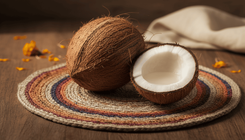
When you sit before a shrine or enter a temple, you will often see a coconut placed there—sometimes whole, sometimes split open, sometimes used to crown a water pot. Coconut in puja is offered because it holds profound spiritual meaning across Hindu practice: it is the fruit of the earth that reaches toward the sky, and its structure mirrors the human being we seek to purify and elevate.
The coconut's place in worship runs deep in Hindu tradition. Its three eyes recall the three eyes of Shiva. Its hard shell speaks to the ego and ignorance that must be broken. The white kernel inside is the pure self, awaiting liberation. The water within is the life force itself. In offering a coconut, you acknowledge all of these layers—the obstacle and the essence both. This is why the coconut appears in rituals that mark turning points: when you undertake a new venture, enter a temple, perform a havan (sacred fire ritual), or mark a transition from one life stage to another.



Coconut in the Kalash
The kalash—a brass or metal water pot—is central to nearly every significant puja. At its mouth sits a coconut. This is not decoration. The kalash represents the cosmos itself: the water within is primordial, the pot is the container of creation, and the coconut crowning it stands for the seed of the universe, or sometimes for the divine principle overshadowing creation. The coconut's presence transforms a simple pot into a cosmically complete symbol.
When the kalash is placed at the threshold of a puja space, or installed for a ceremony that spans several days, that coconut remains. It will be worshipped alongside the kalash. In some sampradayas and regions, when the puja closes, that coconut is broken and distributed as prasad—blessed food—to those who attended. In others, it is left untouched, completing its role by presence alone.
Breaking the Coconut
Breaking a coconut is a ritual act in itself, done at temples and at home. You may do this at the start of an important undertaking, or when you visit a shrine to mark a milestone or seek a blessing. The sound of the shell splitting is sharp and definitive: it marks a threshold crossed, an old thing broken, a new phase begun.
The break must be clean. In South Indian temples, priests perform this on a metal peg, using force and intention. In other settings, the coconut may be placed in a sturdy cloth and struck with an axe or hammer. The aim is to split it completely in a single or very few strikes, without shattering it into many fragments. A clean break is seen as a good sign; a coconut that splinters irregularly may need to be ritually disposed of properly, as it carries confused energy.
Once broken, the white kernel is extracted. Part becomes prasad, given to worshippers. Part is offered into the sacred fire if a havan follows. Some remains on the altar. The water, if present, may be poured into the earth, or offered at the root of a sacred plant or tree. Nothing is wasted.
What the Coconut Represents
In Hindu cosmology, the coconut embodies multiple truths at once. It is known as shriphal—the fruit of abundance and blessing. Its three eyes reference the three eyes of Lord Shiva, linking it to destruction of illusion and ultimate truth. Its outer husk speaks to layers of conditioning and attachment that cover our true nature. The white kernel inside is the atma, the eternal self. The water is the divine grace flowing within.
Because the coconut's form contains these meanings, offering it is a form of mental prayer—a gesture that reaches toward your own inner truth. When you break open a coconut, you enact symbolically what yogic and meditative practice attempts: the breaking of the barrier between the false self and the real one.
In different regions and sampradayas, the emphasis shifts. In Tamil Nadu, the coconut is so central that breaking it at a temple is sometimes called the sweetest offering—it requires real effort and commitment, and the break itself is witnessed. In North India, the coconut on the kalash may receive more emphasis than the act of breaking. In rituals tied to the devas (divine powers), an unbroken coconut is offered whole. In rituals of ancestor worship, breaking it honors the transition between worlds.
Coconut Across the Calendar
Coconut appears in puja throughout the year. During Dussehra, when the year's new ventures are blessed, breaking a coconut is a common offering. During Navaratri, coconuts appear in temples and at home altars. In regional festivals tied to the harvest—Pongal in Tamil Nadu, Makar Sankranti in northern India—the coconut marks the turning of seasons and the gratitude owed to the earth and sun. At weddings, at pujas for a new home or shop, at the blessing of a child, a coconut is almost always present.
In daily puja at home, even a simple one, many people keep a coconut on the altar. It need not be whole; it can be a piece, or coconut water in a small vessel. The form matters less than the intention. The coconut testifies that this space is sacred, and that the person maintaining it understands the layers of meaning woven through their own devotion.
When and How to Offer Coconut at Home
If you keep a home altar, a fresh coconut placed there—whole, or in a clean earthen or brass vessel—is a meaningful offering. You need not break it; its presence itself is powerful. If you wish to break one, choose a moment that feels significant to you: the start of a new project, the beginning of a difficult practice, a moment of transition. Speak your intention aloud or silently, make the break clean if you can, and do not worry if the shell does not split perfectly—the gesture itself matters.
After breaking, you may offer part of the kernel in your puja, consume part as prasad yourself, share it with family, or leave it as an offering in your home shrine. The water you may pour at the root of a plant, or leave on your altar in a small cup. There is no single right way; what matters is that you are giving something of real value—the fruit of the earth—and acknowledging the layers that bind together the material and the divine.
The coconut asks nothing of you but presence and intention. It offers itself completely: water, kernel, shell, the space between. This willingness to give all of itself is part of its power as an offering.
How to break a coconut at home for puja
- Choose your coconut and moment Select a fresh, undamaged coconut. Choose a time when you are unhurried and your intention is clear—whether you are marking a new beginning, seeking blessing, or moving through a transition.
- Set up safely Wrap the coconut in a clean cloth or place it in a sturdy cloth bag. This contains fragments and protects your hands. You may also place it on a stable surface if using a hammer or axe, but never place your hands beneath the tool.
- Strike with intention Using a hammer, axe, or the blunt end of a metal peg if at a temple, strike firmly along the seam or equator of the coconut. Aim for one or two clean strikes to split it open. Speak your intention aloud or silently as you do this.
- Extract the kernel Once the shell is split, carefully remove the white kernel with a knife or scraper. The water inside, if present, may pour out during the break; if not, there is little to none, which is normal.
- Separate the offerings Set aside portions for your puja—some kernel to offer, some to consume as prasad, some to share if you wish. Pour any water at the root of a plant or onto the earth, or leave it in a cup on your altar. Dispose of the shell respectfully, burying it or placing it where it can decompose naturally.
- Receive the blessing Consume your portion of the kernel as prasad, or accept what you have prepared as blessed. The coconut has given itself fully; receive what is offered in that spirit of complete offering.
Common questions
Can I offer a coconut that isn't completely fresh?
A fresh coconut is preferable, but if one has been sitting for a short time and shows no signs of mold or rot, it is acceptable. If you are breaking a coconut and it smells musty or sour inside, it is better to dispose of it respectfully—bury it, or place it where it can decompose naturally—and obtain a fresh one. The offering should reflect care and intention.
Do I need to break the coconut if I offer it whole?
No. Offering a whole coconut is complete in itself, particularly when it crowns a kalash or sits on an altar. Breaking is a separate ritual action, appropriate when you are initiating something new or seeking to mark a significant transition. The form depends on your intention and the context of your puja.
What should I do with the coconut water after offering?
You may drink it as prasad, pour it at the root of a tree or plant, leave it on the altar for a time and then discard it respectfully, or offer it to animals. There is no single correct answer; what matters is that you treat it as blessed and do not waste it thoughtlessly. Some traditions specify particular uses, so if you are following a specific practice lineage, ask a teacher.

Related Articles


