
Why Ayodhya Celebrates Diwali with Lamps: A Sacred Tradition
Light Reclaims the Sacred City

Kushal K
04 Nov 2026 • 6min
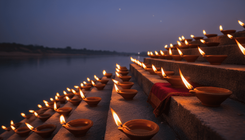
Ayodhya's Diwali celebration revolves around lamps for a reason that reaches to the heart of the festival itself: it is the city where Ram is said to have returned from exile, and the lighting of lamps marks that homecoming. This is not merely one festival practice among many, but a custom woven into Ayodhya's spiritual identity. For centuries, the city has observed Diwali by illuminating its ghats, temples and streets with oil lamps, turning this observance into something uniquely resonant—a landscape of light that speaks to the triumph of light over darkness, and the return of the divine to its earthly home.



The Connection to Ram's Return
The heart of Ayodhya's Diwali tradition lies in the Ramayana, the ancient Sanskrit epic that is central to Hindu devotion. According to this text, Ram spent fourteen years in exile, and Diwali marks the night of his return to Ayodhya with his wife Sita and brother Lakshman. In celebration of this homecoming, the citizens of Ayodhya are said to have lit lamps to welcome him. This story has shaped the festival for generations: the lighting of lamps is not symbolic alone, but a re-enactment of that ancient welcome, performed anew each year.
In Ayodhya itself, this narrative carries particular weight. The city is not simply where the story is set, but the place where devout Hindus believe the events occurred. That living connection—between the sacred text and the sacred geography—makes the lighting of lamps feel less like commemoration and more like participation. When someone in Ayodhya lights a lamp on Diwali, they are not just marking a festival date; they are joining in an act that residents have performed since the age of the Ramayana itself.
The Ghat Deepotsav: A City Transformed
In recent years, Ayodhya's Diwali observance has grown to a scale that brings the lamp-lighting tradition into the foreground of the city's identity. The Ghat Deepotsav—the festival of lamps on the riverbank—has become a major public event, where the banks of the Sarayu River are illuminated with vast numbers of small oil lamps arranged in patterns and rows. This visible transformation of the landscape has made Ayodhya's specific relationship to Diwali widely known, attracting visitors and media attention.
Yet the Ghat Deepotsav, while modern in its scale and coordination, rests on an older foundation: the household and temple lamp-lighting that has been Ayodhya's Diwali custom for centuries. The riverbank display gives visible form to something that individuals and families have always done in their homes and prayer spaces. The effect is to amplify a practice that is deeply local and personal into something that shapes how the entire city observes the festival.
Lamps as Sacred Offering
In Hindu practice, a lamp or diya is not merely a source of light. It is an offering to the divine, and the act of lighting one is a form of worship. The flame that burns in an oil lamp is understood to carry the light of consciousness itself—the awareness that illuminates all things. When someone lights a lamp, they offer that light to the deity they honour, and in Ayodhya at Diwali, the lamp becomes a way of welcoming and honouring Ram.
This understanding shapes how Diwali lamps are treated in Ayodhya. They are not decorations, though they are decorative; they are ritual objects. Families may light lamps in front of their household shrine, or place them in windows and on doorways to sanctify the threshold between inner and outer space. The oil used is often derived from seeds considered auspicious—sesame or coconut oil. The wick is twisted from cotton. These details are observed because each element is understood to carry its own spiritual quality.
Regional Variations in Observance
While the lamp tradition is central to Ayodhya's Diwali, the way people observe the festival varies by household, family lineage and personal practice. Some families focus on the household lamp-lighting and prayer; others participate in the public gatherings and the Ghat Deepotsav. Some observe fasting as part of their Diwali practice, while others do not. These variations do not diminish the lamp-lighting custom, but rather show it as flexible enough to accommodate different approaches to the same festival.
The significance of lamps in Ayodhya also differs slightly from some other regions of India. In parts of South India, Diwali traditionally focuses on ritual bathing and the lighting of oil lamps for specific deities. In parts of North India outside Ayodhya, fireworks and sweets hold prominence alongside lamps. But in Ayodhya itself, the lamp tradition has been amplified by the narrative of Ram's return—it is not one practice among many, but the practice through which the festival's meaning is most directly expressed.
What to Do if You Observe This Tradition
If you want to observe Ayodhya's Diwali lamp tradition yourself, whether in Ayodhya or elsewhere, the practice is straightforward but intentional. Obtain or make small oil lamps, fill them with oil and place a cotton wick in the top. Light the lamp with presence and awareness, understanding the flame as an offering. You might light a lamp in front of a small shrine, or place lamps in windows or on a shelf where they can burn safely. The number and placement are matters of personal choice and family custom; what matters is the intention behind the act.
If you are in Ayodhya during Diwali, you may visit the Ghat Deepotsav to see the public observance, or light lamps in your own space in the city. Either way, the act connects you to the ancient story of Ram's welcome, and to the generations who have lit lamps in this city to mark that return. The light you kindle becomes part of a continuity that reaches backward to the text and forward to the future.
Common questions
When do people light lamps in Ayodhya for Diwali?
The lamps are lit on the evening of Diwali itself, which falls on the new moon day (Amavasya) in the Hindu month of Kartik, varying each year according to the lunar calendar. Families may begin lighting lamps in the evening and keep them burning through the night.
How many lamps are typically lit in Ayodhya's Ghat Deepotsav?
The exact number of lamps lit during the Ghat Deepotsav event has grown significantly in recent years, with recent celebrations drawing hundreds of thousands of lamps arranged on the riverbanks. The precise count varies from year to year depending on the scale of the organized event.
Can I light lamps for Diwali if I am not in Ayodhya?
Yes. The practice of lighting oil lamps during Diwali is observed across India and by Hindus worldwide. While Ayodhya has a particular significance because of its connection to Ram's story, lighting lamps on Diwali is a universal practice that you can observe anywhere with the same reverence and intention.

Related Articles


