
Why a Special Seat Is Used During Puja
Elevation in presence, purity in practice

Aditya Pandey
19 Nov 2026 • 7min
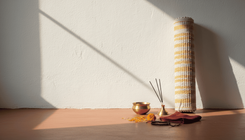
When you sit for puja—the ritual of worship and offering—you are not sitting on an ordinary mat or cushion. A puja asana, or sacred seat, serves a purpose that goes beyond comfort. It marks a transition: from your everyday space into one set apart for devotion.
The puja asana creates a boundary. Spiritual practice requires a shift in awareness, and the act of sitting on a dedicated seat signals that shift to your mind and body both. You are no longer in the space where you cook or rest or work. You are in the space where you meet the divine. This boundary matters, whether you are in a temple, a home shrine, or anywhere else you practise.



Why Elevation Matters
The asana lifts you slightly from the ground. This elevation is not merely practical, though it does protect you from dampness and dirt. In Hindu tradition, height carries meaning. To sit higher than the space around you is to sit with dignity and respect, and to offer that dignity to the practice itself. When you sit for puja, you are neither lying down in rest nor standing in ordinary activity. You are in a state between, elevated and intentional.
This elevation also prevents the flow of energy downward into the earth. Some traditions hold that without a proper asana, the spiritual power raised during worship would be grounded away rather than contained and circulated within your own being. Whether you understand this in terms of subtle energy or simply as symbolic preparation, the effect is the same: the asana keeps your awareness and intention gathered in the space of practice.
Purity and Sacred Materials
The material of your asana carries meaning. Traditional asanas are made from natural fibres that do not retain the subtle impressions of other activities or other people. Kusha grass, cotton, wool, or silk are the materials most commonly used. Each has a different significance and is chosen according to the nature of the worship.
Kusha grass asanas hold a special place in Vedic ritual. Kusha is mentioned in the oldest texts as purifying and protective. It is often woven into mats for Vedic ceremonies, and some traditions use small kusha bundles placed at specific points on the asana to anchor the sacred space. Other practitioners prefer cotton or wool because these materials are grounding and comfortable for longer periods of sitting. Silk is sometimes chosen for particular deities or occasions where refinement and luxury are part of the offering.
The choice of material also prevents mixing the sacred with the mundane. An asana used only for worship does not absorb the residue of ordinary life. You would not wear your puja asana to sit and work, nor would you use your daily meditation cushion for worship. This separation keeps the two domains distinct in your mind and in the energy of your home.
How the Asana Structures Space
When you place your asana before your shrine or altar, you are creating a nested set of sacred boundaries. The shrine is the innermost circle. The puja asana is the second circle: the space immediately around you where worship happens. Beyond that is your home, then your neighbourhood, then the wider world. Each layer contains the power and intention of the one inside it.
Many traditions call for the asana to face a particular direction—often east toward the rising sun, or toward the deity you are honouring. This orientation aligns your body with both cosmic forces and the energy of the deity. Your asana then becomes a fixed point in your home's sacred geography. Over time, regular practice in the same spot, on the same asana, deepens the spiritual quality of that place. The seat becomes magnetised by repetition.
This is why moving your asana to a different room, or replacing it with whatever cushion is handy, shifts the quality of your practice. Not because the gods care where you sit—they do not—but because you are working with your own mind and energy. Consistency and dedicated space create a container where practice naturally deepens.
Asanas for Different Practices
The size and texture of your asana can vary depending on what you are doing. For a short puja or mantra practice, a compact mat of about 60 by 90 centimetres is sufficient. For pranayama or meditation, where you may sit for twenty minutes or more, a larger asana gives you room to settle comfortably without your legs or back touching the floor beyond it.
Some practitioners keep different asanas for different purposes. One might be used for deity worship, another for meditation, another for pranayama. This separation ensures that each practice remains energetically pure and distinct. If you have limited space, one good asana is enough—but if you do, reserve it only for spiritual practice.
The texture matters too. A rough weave holds your body more securely and prevents slipping during practice. A smooth surface can make sitting very still easier, as there is less physical distraction. Personal comfort is valid here: you should not spend your meditation struggling against an uncomfortable seat, as that becomes the focus rather than your practice. The asana should support your intention, not fight against it.
Bringing the Practice Home
If you are starting a home practice, a simple cotton or wool asana is all you need. It need not be expensive or decorative. What matters is the intention you invest in it: that this seat is reserved for worship, for meditation, for connection to something larger than daily life. Once you commit to using it only for practice, it becomes sacred through use.
Place it in the same spot each time. Face the same direction. This consistency is the soil in which your practice grows. You are not being superstitious; you are being smart about how human awareness works. Repetition, space, and dedicated materials all train your mind to shift gears more easily each time you sit. What felt formal and deliberate in the first week becomes natural by the fourth month.
Your puja asana is an invitation to yourself. It says: here, in this spot, on this seat, you step out of time. You set down the day's concerns. You sit in the presence of what you hold sacred. That simple gesture—rolling out your asana, sitting down, and crossing the threshold—is itself the beginning of worship.
Common questions
Can I use any cushion or yoga mat for puja, or does it have to be a traditional asana?
Any dedicated mat works if you use it only for worship and keep it clean and separate from daily life. Traditional materials like cotton, wool, or kusha are preferred because they do not absorb impressions from other activities, but what matters most is your consistent intention to set that seat apart as sacred.
Does the direction my asana faces make a difference to the worship?
Many traditions recommend facing east, the direction of the rising sun and new beginnings, or toward the deity you honour. Consistency matters more than perfection—choose a direction and keep to it so your space becomes magnetised by repetition.
What should I do if I don't have space for a permanent puja asana?
Store a small mat rolled up near your shrine and unroll it each time you worship. The act of setting it out is itself a ritual signal to your mind that you are entering sacred time. Over time, this simple object becomes spiritually charged through dedicated use.

Related Articles


