Who Is Lord Dattatreya and What Is Dattatreya Jayanti?
The Guru of Gurus, Walking the Path Between

Sunil Chaurasia
21 Oct 2026 • 7min
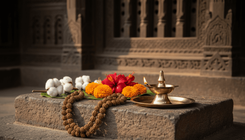
Dattatreya Jayanti celebrates the birth of Lord Dattatreya, one of the most enigmatic figures in Hindu tradition. He is revered as the Adi Guru—the original guru—embodying the teachings that all existence is a path to knowledge. Unlike deities often depicted in temples with specific forms and rituals, Dattatreya exists in many traditions across Hindu, Buddhist and Jain practice, making him a unique bridge between different spiritual paths. His life and teachings remain relevant to anyone seeking to understand what a true spiritual teacher represents.



Who Is Lord Dattatreya?
Dattatreya is understood differently across Hindu traditions, but most commonly he is seen as an incarnation of the Trimurti—Brahma, Vishnu and Shiva united in one form. He is often described as a wandering ascetic, barefoot and unbound by the rules that govern ordinary life. The name Dattatreya itself comes from two words: Datta, meaning "given," and Atreya, referring to the sage Atri. This reflects his origin story: he was given as a gift from the divine to the sage Atri and his wife Anasuya as a blessing.
Dattatreya's form when depicted is singular in Hindu iconography. He is shown with a single body but representing the cosmic principle of all knowledge. He carries a staff, a bowl for alms, and wears a garland of rudrakshas—beads sacred to Lord Shiva. His appearance is meant to evoke a renunciate, someone who has stepped beyond worldly concerns. Yet he is never shown as withdrawn or distant; instead, he moves among people as a teacher and guide.
The Story of Dattatreya's Birth
The birth of Dattatreya unfolds within a story of virtue, devotion and divine grace. According to tradition, the sage Atri performed severe tapasya (spiritual practice) seeking a son who would be a source of knowledge and liberation. His wife Anasuya, renowned for her chastity and devotion, also performed deep practice. Moved by their sincerity, Brahma, Vishnu and Shiva blessed them. Rather than being born from Anasuya in an ordinary way, Dattatreya manifested as a divine child, carrying within him the qualities of all three deities.
The story emphasizes that Dattatreya's arrival was not chance but the fruit of conscious spiritual work. Atri and Anasuya had aligned themselves so deeply with dharma (righteousness) that they became vessels through which the divine could express itself. This reflects a teaching central to Hindu thought: that devotion and right living create the conditions for grace to flow. Dattatreya's birth is thus not a historical event to be dated, but a teaching embedded in narrative form about how humans can invite the infinite into their lives.
What Dattatreya Teaches Through His Life
Dattatreya is known as a guru who learned from twenty-four masters. These were not human teachers in the ordinary sense, but aspects of nature itself. He learned from the ocean about depth and constancy, from the wind about freedom and presence, from fire about transformation. By naming these unusual gurus, the tradition points to a radical idea: that everything in creation has something to teach. The divine guru is always speaking if we know how to listen.
This approach makes Dattatreya a model for a particular kind of spirituality—one that does not require isolation in a cave or retreat to a monastery. He wandered among villages and forests, engaging with whoever he met. He wore ashes on his body, dressed like a renunciate, yet was fully present to the world. His teachings emphasize that liberation is not something to achieve in the future but a recognition of what already is. The universe itself, exactly as it appears now, is the teaching.
In many traditions, Dattatreya is venerated as a Nath—a yogi who transcends the normal flow of time and remains eternally present. Stories describe him appearing to seekers across different eras to offer guidance. This is not understood as literal time-travel but as a way of expressing that his wisdom transcends any single period. A person in deep meditative practice might experience an encounter with Dattatreya that feels vividly real, yet is understood to be an interior meeting with the principle of eternal wisdom that his name invokes.
Dattatreya Jayanti: How and When It Is Observed
Dattatreya Jayanti is observed on the full moon day in the lunar month of Margashirsha, which typically falls in late November or December according to the solar calendar. The exact date shifts each year because it follows the lunar calendar, and is determined anew each year by calculating the moon's phases. On this day, temples dedicated to Dattatreya hold special pujas (rituals of worship), and devotees gather to remember his life and teachings.
The observance is simpler and quieter than some major festivals. There are no strict fasting rules or elaborate household preparations expected of every Hindu family. Instead, those drawn to Dattatreya—particularly seekers on a spiritual path and those studying under a guru—mark the day through meditation, study of his teachings, and offerings at temples where he is worshipped. In regions like Maharashtra, Karnataka and Andhra Pradesh where Dattatreya tradition is particularly strong, ashrams organized around his teachings hold special satsang gatherings where his philosophy is discussed and explored.
The core practice of Dattatreya Jayanti is remembering the principle he represents: that the universe is the guru, that all experience teaches, and that true renunciation comes not from rejecting the world but from seeing through the illusion that separates the self from the divine. Many who observe it spend time in quiet reflection or in reading texts associated with his teachings, such as the Avadhuta Gita, a scripture that presents non-dual philosophy through his voice.
Dattatreya in Different Spiritual Traditions
Dattatreya's reach extends beyond mainstream Hindu worship into many regional and philosophical traditions. In tantric practice, he is honored as a master of the highest practices. In Advaita Vedanta—the philosophy of non-duality—he represents the sage who has fully realized the unity of self and Brahman (the ultimate reality). In some Buddhist traditions of Tibet and Southeast Asia, teachers have been called Dattatreya or recognized as embodiments of his principle.
This diversity reflects something important about Dattatreya: he represents a function rather than a fixed doctrine. He is the guru who meets the seeker exactly where they are, teaching through whatever life presents. This is why his worship has never been confined to a particular community or practice. A person might revere Dattatreya while following any other deity or spiritual path, because his principle—that life itself is teaching—sits at the heart of all genuine seeking.
Common questions
When is Dattatreya Jayanti 2026?
Dattatreya Jayanti falls on the full moon in Margashirsha, typically in late November or December. For the exact date in 2026, you will need to check the lunar calendar or panchanga (Hindu calendar). The date changes yearly because it follows the moon's phases, not fixed solar dates.
Can I celebrate Dattatreya Jayanti if I follow another deity or tradition?
Yes. Dattatreya represents the principle of universal teaching and the guru principle itself, which sits above sectarian boundaries. Many seekers honor him alongside their primary practice. There is no requirement to abandon other devotions; instead, you can spend time in reflection or meditation on his teachings about learning from all of life.
What is the connection between Dattatreya and the Avadhuta Gita?
The Avadhuta Gita is a key scripture in which Dattatreya's teachings are presented. It teaches non-dual philosophy—the idea that there is no fundamental separation between the individual self and ultimate reality. Reading or studying this text is a common way devotees engage with his philosophy during Jayanti celebrations.

Related Articles