
What the Meaning of Om Reveals About Sound and Self
The sacred syllable that echoes through all existence

Abhilash Ramakrishna
07 Nov 2026 • 6min
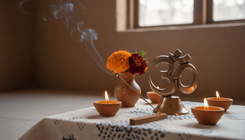
Om is not simply a sound you chant at the start of yoga class. It is the fundamental sound of existence in Hindu philosophy, and understanding its meaning of om carries you into the deepest questions about the nature of reality, consciousness and the self.
In Sanskrit tradition, om—sometimes written aum—is understood as the primordial sound from which all creation unfolds. It is the sound that vibrates at the heart of the universe. When you chant om, you are not making a metaphorical gesture; you are sounding the vibration believed to underlie all manifestation. This is why om appears at the opening of many sacred texts, and why it remains central to meditation and yoga practice thousands of years after the oldest scriptures were composed.



Om in the Upanishads
The Mandukya Upanishad is devoted almost entirely to explaining om, and it reveals how profound this single syllable becomes when examined closely. The Upanishad describes om as containing four states of consciousness: waking, dreaming, deep sleep, and turiya—a fourth state beyond all three, sometimes called pure consciousness or witness consciousness.
Each syllable of om corresponds to one of these states. The 'a' sound carries the waking state, in which you experience the external world through your senses. The 'u' sound corresponds to dreaming, the realm of internal experience and imagination. The 'm' sound represents deep sleep, where all experience dissolves. And the silence that follows the 'm'—the space after the sound fades—points to turiya, the unchanging awareness that witnesses all three states. This framework suggests that om is not describing something outside you, but the architecture of your own consciousness.
The Mandukya Upanishad teaches that meditating on om is a direct path to understanding atman, the true self, as identical with Brahman, the ultimate reality. By chanting and contemplating the syllable and its silence, you are meditating on the structure of existence itself.
The Symbol and Its Geometry
The visual form of om—often written as ॐ—carries meaning as dense as the sound itself. The symbol begins with a curve like the number '3', which contains the first three sounds 'a', 'u' and 'm'. A crescent shape sits above this, and a dot rests at the apex. These geometric elements work together as a map of the states of consciousness described in the Upanishad, but they also function as a visual anchor during meditation.
When you see the om symbol, your mind may settle more easily into the state of awareness it represents. Many practitioners place the symbol on their meditation altar, in their home shrine, or where they practice yoga. The symbol and the sound work together: the shape gives the mind something to rest upon, while the chanting engages the vibration of the voice and the sensation in the body. For those who practise japa—repetitive chanting of a mantra—om often appears as the opening sound, settling the mind before moving into the practice.
The Science of Chanting Om
When you chant om aloud, you are working with the actual physiology of sound and breath. The practice requires you to draw breath deeply, engage your voice and vocal cords, and complete the syllable with the closing hum of the 'm' sound. This activates the vagus nerve, which runs from your brain stem to your belly and plays a central role in the parasympathetic nervous system—the branch that slows your heart rate, steadies your breathing and moves you toward calm.
Many practitioners report that chanting om produces a subtle vibration in the head and chest that feels soothing and centering. Modern research into chanting has found that it can reduce stress, lower blood pressure and improve focus. But these benefits emerge as a side effect of the practice, not as its primary purpose. In the traditional understanding, the physical and mental effects follow naturally from aligning yourself with the fundamental vibration of existence.
The way you chant om matters. The sound should be drawn out slowly: the 'a' and 'u' carried for most of the breath, the 'm' hummed for the final portion, then silence before the next breath. Some traditions teach a specific proportion—chanting the vowels for three counts and the 'm' for one count—but the exact ratio matters less than the quality of attention you bring to the practice. Rushing through om misses its power; dwelling in it allows the vibration to settle your mind.
Om Across Regions and Traditions
The meaning and use of om varies slightly across different schools of yoga and sampradayas, the lineages of Hindu practice. In some traditions, om is chanted at the beginning and end of practice. In others, it opens and closes meditation. Some teachers emphasize the sound itself; others focus on the silence that follows. In Iyengar yoga, for instance, practitioners often chant om three times to open practice, while in some Vedantic schools, the focus is more heavily on contemplating the symbol and the silence.
In the broader Hindu tradition, om appears in arati—the ritual waving of lamps before a deity—where it is often chanted or sung as part of the offering. It also appears in puja, more formal ritual worship, where the syllable marks transitions between parts of the ceremony. These variations reflect a living tradition in which om's meaning remains consistent—the primordial sound and symbol of ultimate reality—even as the application shifts with different practices and contexts.
Bringing Om Into Your Practice
If you are new to chanting om, begin simply. Find a quiet space where you can sit comfortably for a few minutes. Breathe in through your nose, then chant om on your exhale, allowing the sound to emerge naturally without forcing. Let the 'a' and 'u' blend together in a single note, and end with the 'm' hummed with your lips gently closed. After the sound fades, sit in the silence for a breath or two before beginning again. Practice for three to five rounds, or for five to ten minutes if you prefer.
You need no special knowledge or prior experience to begin. The power of om lies not in doing it perfectly, but in the attention you bring to it. Whether you chant it aloud or silently in your mind during meditation, the meaning of om—that vibration connecting you to the whole of existence—remains the same. Let your practice be an exploration rather than a performance.
Common questions
Can you chant om silently in your mind instead of aloud?
Yes, silent chanting (called ajapa japa when practiced continuously) is equally valid and often preferred during formal meditation. Many practitioners alternate between aloud and silent chanting depending on their setting and what feels right for their practice that day.
What is the difference between om and aum?
Om and aum represent the same sound and concept, written differently. Aum (with the 'a' separate) reflects the Sanskrit pronunciation more precisely, while om is a simplified transliteration. Both are used interchangeably in English-language practice.
How often should you chant om to feel the benefits?
Even a few minutes of chanting daily can produce noticeable effects on your calm and focus. Many traditions recommend practicing at least three rounds at the start of your day or meditation, though longer or more frequent practice deepens the effect.

Related Articles


