
What Raksha Bandhan Means: Story, Ritual and Family Bond
Sister's sacred thread, brother's lifelong vow

Kushal K
09 Nov 2026 • 7min
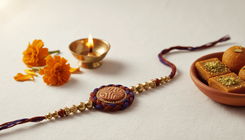
Raksha Bandhan marks the bond between brother and sister, celebrated during the full moon of the month of Shravana. The word raksha means protection and bandhan means to tie, so the festival centres on a sister tying a rakhi—a sacred thread or decorated band—around her brother's wrist as a symbol of their relationship and his pledge to protect her. It is one of the most widely observed festivals across India, though the way people celebrate it varies by region and family tradition.



The Meaning Behind the Thread
The rakhi is the ritual object at the heart of Raksha Bandhan. A sister ties it on her brother's wrist while performing an aarti, a ritual of worship using light, and applying a tilak (a mark of blessing) to his forehead. By tying the rakhi, she is not making a request for protection—she is invoking it, blessing her brother with good health, long life and prosperity, and establishing his role as her protector. The thread itself carries this intention. Over time, rakhis have become more ornate: some are embroidered with beads, sequins and bells, others are made of silk or studded with stones, but the core idea remains unchanged. What matters is not the cost or beauty of the rakhi, but the connection it represents and renews.
The brother, in turn, accepts the rakhi and the responsibility it carries. He gives her a gift, often money or jewellery, and promises to be there for her through her life. This is not a small promise. In the joint family systems that once predominated in India, a brother's protection of his sister had real legal and economic weight. Even today, when family structures have changed, the ritual holds its force. Many Indians who live abroad or whose siblings live in different cities still observe Raksha Bandhan by mailing rakhis or performing the ritual over video call, showing how deeply the meaning runs.
Legends That Shape the Festival
Several stories from Hindu mythology are woven into the meaning of Raksha Bandhan. The most widely known involves the Devas and Asuras, the gods and demons in ancient texts. When the gods were losing a battle against the demons, the goddess Indrani, wife of the king of the gods, tied a protective thread around her husband Indra's wrist. With that blessing, he won the battle. This story is one reason the festival is also called Indra Puja in some regions.
Another important story involves Krishna and Draupadi, a character from the Mahabharata. When Krishna cut his finger while handling sugarcane, Draupadi tore a piece of cloth from her sari and wrapped it around his wound to stop the bleeding. Krishna was moved by her action and promised to protect her always. Later, when Draupadi was publicly humiliated in the royal court, Krishna kept that vow by miraculously extending her sari so that it could never be fully removed, protecting her honour. This story, though not always mentioned in Raksha Bandhan celebrations today, shows how the festival connects to the theme of protection and the bonds we forge through small acts of care.
In some regions, the stories emphasised are different. In Bengal, for instance, people sometimes recall the bond between Krishna and his sister Subhadra, or between the demon king Bali and the goddess Lakshmi, depending on local tradition. These variations show how a single festival can carry many meanings at once.
How Raksha Bandhan Is Observed
The ritual itself follows a simple structure, though the details vary by family and region. On the day of the festival, a sister typically prepares a small altar with the rakhi, a diya (lamp), flowers, and sometimes sweets or fruit. The brother sits before her. She lights the diya, performs aarti by moving the flame in circular motions in front of his face, applies a tilak to his forehead, and then ties the rakhi around his wrist. After the ritual, they often exchange sweets and spend time together.
In North India, the festival is widely observed as described above. In South India, the day is often called Avani Avittam or Nariel Purnima and carries different ritual practices, though the theme of auspicious bonds remains. In Maharashtra, some families tie a silk thread rather than a decorated rakhi. In Punjab, the equivalent festival is called Saluno and has its own character. These regional differences are not departures from the "real" Raksha Bandhan—they are how the festival lives in different parts of India.
Today, some sisters tie rakhis to brothers who are not siblings by blood—to cousins, close friends, or even to mark a cherished teacher's role in their life. Some brothers reciprocate by tying a rakhi to their sisters, creating a more reciprocal gesture. These shifts show how the festival's meaning—the solemnisation of protection and care in close relationships—can stretch beyond its traditional form while keeping its core intact.
Raksha Bandhan and Bhai Dooj: What Sets Them Apart
Raksha Bandhan and Bhai Dooj are often confused because both celebrate the bond between brother and sister. They are observed at different times in the lunar calendar and carry different meanings. Raksha Bandhan happens during the full moon of Shravana. Bhai Dooj comes later, on the second lunar day after the new moon of the month of Kartik, roughly two months later. At Bhai Dooj, sisters apply a tilak to their brothers' foreheads and pray for their wellbeing. Brothers give them gifts in return. While Raksha Bandhan emphasises the brother's protection, Bhai Dooj is more centred on the sister's blessing and prayer for her brother's health and happiness. Both affirm the sibling bond, but each does so through a different lens and at a different moment in the year.
Celebrating Raksha Bandhan Today
Raksha Bandhan remains deeply woven into Indian life, even as family structures and geographies change. For many, it is an occasion to reconnect with siblings or extended family, to affirm ties that might be strained or distant, and to remember the old promise to look after one another. It is not only for those who follow Hindu traditions—people of other faiths often observe Raksha Bandhan as a secular celebration of sibling love, or integrate it into their own family practices.
If you want to mark the day, you can tie a rakhi—whether store-bought or handmade—and perform the ritual as your family does it. What matters most is being present with the person you are honouring, speaking the intention behind the thread aloud if that feels right to you, and letting the ritual remind you of the bond you share.
Common questions
Can a sister tie a rakhi to someone other than a brother?
Yes. Many sisters tie rakhis to cousins, close friends, teachers or mentors to mark important protective relationships in their lives. Some brothers also reciprocate by tying a rakhi to their sisters. The ritual's meaning—solemnising protection and care—can extend beyond traditional sibling relationships.
What is the difference between Raksha Bandhan and Bhai Dooj?
Raksha Bandhan happens during the full moon of Shravana and emphasises the brother's protection. Bhai Dooj comes two months later on the second lunar day after the new moon of Kartik, and focuses on the sister's blessing and prayer for her brother's wellbeing. Both celebrate the sibling bond but through different rituals and intentions.
What should I do if my brother or sister lives far away?
Many people observe Raksha Bandhan remotely by mailing the rakhi or performing the ritual together over a video call. The distance does not break the connection—what matters is the intention and the moment of honouring the bond, even if it happens across physical space.

Related Articles


