
Vikram Samvat and Shaka Samvat: The Hindu Calendar Eras Explained
Two ancient systems marking time in Hindu tradition

Kushal K
07 Nov 2026 • 6min
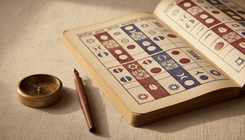
India follows two main calendar eras today: the Vikram Samvat and the Shaka Samvat. The Vikram Samvat is older and more widely used in North India, while the Shaka Samvat is the official calendar of the Indian government. Both systems are lunar or lunisolar—they track the moon's phases rather than the sun alone—and both begin at different moments in history. Understanding these two eras helps you read festival dates, puja calendars and religious texts written in the Hindu tradition.



The Vikram Samvat: The King's Calendar
The Vikram Samvat is named after the Mauryan king Vikramaditya, who is traditionally said to have ruled from Ujjain around 57 BCE. Scholars debate the exact historical Vikramaditya, but the calendar that bears his name has been used across India for over two thousand years, and it remains the basis for the Hindu religious calendar today.
In the Vikram Samvat, year one starts from 57 BCE in the Gregorian calendar. This means that today's Vikram year is about 57 years higher than the Gregorian year—so when the Gregorian calendar shows 2024, the Vikram Samvat shows 2081. The new year in this system falls in the spring, usually around late March or early April, coinciding with the festival of Gudi Padwa in Maharashtra, Navratri preparations across North India, and other regional new year celebrations.
The Vikram Samvat divides the year into twelve months, each named after the zodiac constellations or nakshatras. Chaitra is the first month, and Phalgun is the last. Because the lunar month is shorter than the solar month, an extra lunar month—called an adhik maas or intercalary month—is added roughly every three years to keep the calendar aligned with the seasons. This is what makes it lunisolar.
North India, Nepal, Rajasthan and parts of central India have long used the Vikram Samvat for religious purposes, festival dates and daily life. Many traditional temples, astrologers and panchang (almanac) makers still reference it.
The Shaka Samvat: The National Calendar
The Shaka Samvat, also called the Shalivahana Samvat in some traditions, begins from 78 CE. Its founder is less certain historically, though it is often attributed to the Shaka king Kanishka or rulers of the Satavahana dynasty. The Shaka year is therefore about 79 years lower than the Gregorian year—so 2024 Gregorian is roughly 1946 Shaka.
The Shaka Samvat is the official calendar of the Indian government. In 1957, the Indian government adopted the Shaka era as the basis for the National Calendar of India, designed to provide a uniform dating system across a country with many regional traditions. The Indian National Calendar, also called the Gregorian Saka Calendar, aligns Shaka months with Gregorian months for civil purposes, beginning on 22 March (or 21 March in leap years). This makes it solar, not lunar—it tracks the sun's annual cycle rather than the moon's.
You will see Shaka dates printed on official Indian documents, government communications and formal correspondence. Most Indians know both their Gregorian date and their Shaka Samvat date. However, for religious observances, festivals and scriptural study, the Vikram Samvat and its lunar months remain standard.
Why Two Calendars Exist
The coexistence of two eras reflects India's history. The Vikram Samvat predates the Shaka Samvat by over a century, and by the time the Shaka era emerged, the Vikram calendar was already deeply embedded in religious life, regional kingdoms, and astronomical practice. Different parts of India adopted different systems—North India favored Vikram, while South India and the Deccan used Shaka and other systems like the Kali Yuga.
When India became independent, the government needed a unified civil calendar for administration, taxes, and official records. Rather than abolish the older systems, which remained meaningful to millions of people, the government chose to adopt the Shaka Samvat as the civil standard while allowing the Vikram Samvat to continue in religious and regional life. The result is that India officially operates on two timescales at once.
In practice, this means you will encounter both dates in daily Indian life. An official letter uses the Shaka Samvat; a temple announces a festival date using the Vikram Samvat and the lunar month. A panchang (almanac) often lists both. Understanding both systems helps you read Indian calendars, make sense of astrological charts, and appreciate how Hinduism has preserved multiple ways of marking time.
Regional and Practical Use Today
South India, while historically using different calendar systems, now commonly understands both the Vikram and Shaka eras due to national standardization and education. Tamil Nadu, Karnataka, and Andhra Pradesh may refer to additional regional calendars alongside these two—for example, the Tamil calendar counts from a different epoch—but the Vikram and Shaka Samvats remain widely recognized.
For someone following Hindu festivals and rituals, the Vikram Samvat's lunar months are what matter. Ekadashi (the eleventh day of the lunar fortnight), Purnima (the full moon), Amavasya (the new moon), and festivals like Diwali and Holi are all determined by lunar positions tracked in the Vikram calendar. The Shaka Samvat's solar months are useful for civil planning and government business, but they do not align directly with when fasts, pujas and celebrations occur.
If you are working with a panchang to plan a ritual or check an auspicious date, you will be reading Vikram months and lunar dates. If you are filling out a government form or reading official news, you will likely see Shaka years. Both are correct; they are simply tools for different purposes, rooted in different moments of India's long history.
Many people in India know both their Vikram and Gregorian birth years, and astrologers may ask for your Vikram year when creating a birth chart. Over time, familiarity with both systems becomes second nature to anyone engaged with the Hindu calendar, whether for devotion, astrology or simply understanding the world around them.
Common questions
What year is it in Vikram Samvat right now?
The Vikram year is approximately 57 years ahead of the Gregorian year, so in 2024 CE it is around 2081 Vikram Samvat. The exact Vikram date depends on whether the new year has passed in the spring.
Which calendar does the Indian government use officially?
The Indian government uses the Shaka Samvat as the official civil calendar. The National Calendar of India, adopted in 1957, is based on the Shaka era and aligns with Gregorian months for administration, but the Vikram Samvat remains standard for religious observances and festivals.
Why do temples and panchangs use Vikram instead of Shaka?
The Vikram Samvat is lunar and tracks the moon's phases, which determine when Ekadashi fasts, full moons, new moons and festivals actually occur. The Shaka calendar used by government is solar and fixed to Gregorian months, so it cannot align with lunar religious dates.

Related Articles


