
Vidyarambham: Writing the First Letters on Vijayadashami
A child's sacred initiation into learning

Aditya Pandey
12 Nov 2026 • 7min
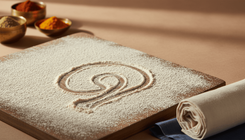
Vidyarambham is a South Indian ritual that marks a child's formal entry into learning. On the day of Vijayadashami—the festival celebrated across India to commemorate Durga's victory over the buffalo demon—families gather in the presence of a guru or elder to guide the child in writing their first letters. The child sits before rice flour spread on a plate or board, and traces letters or symbols with a finger, beginning their journey into knowledge with the blessing of both a teacher and the goddess Saraswati, who presides over learning, music and wisdom.
The ceremony is rooted in the Vedic understanding that learning is not simply the transfer of information but a sacred act, and that beginning this act with intention, in the presence of elders and under an auspicious planetary alignment, sets the child on a path toward true knowledge. Vidyarambham joins many other Hindu ceremonies that mark passage and change: just as Annaprashana welcomes a child to solid food and Upanayana initiates a student into formal study of scripture, Vidyarambham formalises the child's readiness to begin the disciplines of reading and writing.



When Vidyarambham Happens
Vidyarambham is performed on Vijayadashami, also known as Dussehra—the tenth day of the bright fortnight in the month of Ashwin, which falls in September or October. The date follows the lunar calendar and shifts from year to year. In South India, particularly among Tamil and Telugu families, this ceremony is standard practice; it is observed more selectively in other regions.
The timing is deliberate. Vijayadashami celebrates the triumph of good over evil and is considered highly auspicious for beginning new ventures. The day aligns with Saraswati Puja, which honours the goddess of learning, and so the combination of divine favour and astrological fortune is believed to bless the child's education from its outset. Some families perform Vidyarambham for children as young as two or three years old, though others wait until the child is older and can better grasp the symbolism of what is happening.
Preparing the Space and Gathering
In the days before the ceremony, the family prepares a clean, altar-like space in the home or temple. A low table, a prayer platform or even a mat on the floor can serve as the place where the ritual unfolds. The space is cleaned with water, often decorated with flowers, and small lamps or decorative lights may be placed nearby—though the focus remains on simplicity and intentionality rather than elaborate display.
The ceremony requires the presence of a guru, often a learned family member, a teacher, a priest, or someone respected in the community for their knowledge. The guru acts as the conduit between the child and the divine blessing of learning. Family members and close friends gather as witnesses. The child wears new clothes, and in many South Indian families, particular attention is paid to dressing the child in auspicious colours or traditional garments.
The Ritual of Writing the First Letters
At the appointed time, the child is seated before a flat surface—traditionally a wooden board or a shallow tray. This is covered with rice flour or sand, which can be easily marked with a finger or a small stick. Some families use a slate and chalk, or paper and pencil; the tool matters less than the symbolic act of marking something permanent onto a receiving surface.
The guru guides the child's hand to trace the first letters or symbols. These are often the letters of the child's name, sacred syllables such as Om, or the initial letter of the presiding deity. The act is unhurried. The guru may whisper an auspicious phrase as the child makes their marks, and the parent or an elder may hold the child's hand, guiding the movement. Some families also include the child tasting honey or rice—a gesture of inviting sweetness into their learning—or touching rice and jaggery as part of the blessing.
Mantras may be chanted during this phase of the ceremony. These vary by region and sampradaya, but they typically invoke Saraswati and seek her blessings for clarity, wisdom and the joy of learning. The child themselves does not need to chant or memorise; their role is to be present and to participate in the physical act of writing.
The Role of the Guru and the Blessing
The guru's presence is essential. In the Hindu understanding of education, the guru is not simply an instructor but a guide and a transmitter of knowledge who shapes not just the intellect but also the character and spiritual development of the student. By formally introducing the child to learning in the presence of a guru, the family is placing the child under the protection and guidance of an experienced teacher, and beginning a relationship that traditionally lasts for years.
Before, during or after the ritual, the guru often imparts a blessing to the child. This may be a spoken prayer, a ritual gesture such as placing the hand on the child's head, or the symbolic tilak (a mark or paste placed on the forehead). The blessing is a transfer of good wishes, protection and the transmitted grace of all the teachers who came before.
After the Ceremony: Sustaining the Intent
Once Vidyarambham is complete, the child is understood to have formally begun their education. In many families, the ceremony is followed by a small gathering—relatives are invited, prasad (blessed food) is offered and shared, and the child is given gifts, often books or writing implements. This celebration reinforces that learning is valued within the family and in the community.
The days and weeks after the ceremony matter as much as the ceremony itself. Some families make a practice of having the child continue to trace or write letters regularly in the weeks that follow Vidyarambham, deepening the muscle memory and connection to the act of learning. Others use the ceremony as the moment they enrol the child in school or begin formal instruction at home. The ritual is the container; it is the family's intention and consistency that fills it with meaning.
In some South Indian traditions, a small written record is kept of the ceremony—the date, the guru's name, the first letters the child wrote, and sometimes a blessing or prayer recorded by hand. This record becomes a treasured document, marking the child's formal entry into the world of learning.
Common questions
Can Vidyarambham be performed outside of Vijayadashami?
While Vijayadashami is the traditional and auspicious day for Vidyarambham, some families perform it on other auspicious dates determined by a calendar or guru if the child's circumstances require it. However, the ceremony loses much of its ritual significance and connection to Saraswati Puja if moved away from Vijayadashami.
What age should a child be for Vidyarambham?
Children are typically between two and five years old when Vidyarambham is performed, though the specific age varies by family tradition. The key consideration is that the child can sit still for a short time and respond to gentle guidance, rather than a strict age requirement.
What if my family is not South Indian? Can we still perform Vidyarambham?
Vidyarambham is a South Indian ritual rooted in Tamil, Telugu and Kannada traditions, and its practices are most established in those communities. Families from other backgrounds who wish to honour a child's entry into learning may adapt elements of the ceremony, though consulting with a guru or elder familiar with the tradition helps preserve its integrity.

Related Articles


