
Vidura in the Mahabharata: Why His Wisdom Matters Today
The Blind Counsellor's Timeless Teachings on Duty and Dharma

Abhilash Ramakrishna
24 Oct 2026 • 6min
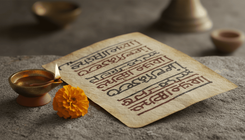
Vidura is one of the Mahabharata's most compelling figures: a blind counsellor born outside the royal household, yet the moral compass of a kingdom on the brink of ruin. His wisdom—known as Vidura Niti, or the teachings of Vidura—speaks directly to the struggles anyone faces today: how to act rightly when those in power will not listen, how to keep your integrity when corruption surrounds you, and what it truly means to serve. The story of Vidura and his counsel matters because he shows us that wisdom is not about being heard. It is about speaking truth.



Who Vidura Was
Vidura appears throughout the Mahabharata as the uncle and trusted advisor to the royal family of Hastinapura. Born as the son of a king and a servant, he occupied an unusual place in the court—present but always in the shadows, respected for his judgment but never in line for power. This gave him something rare: clarity without ambition. He witnessed the schemes that led to the Kuru family's downfall, the dice game that stripped the Pandavas of their kingdom, and the buildup to the great war. He lived at the heart of events he could not control, which is the condition that forges wisdom.
What made Vidura different from other advisors was not his intelligence alone, but his refusal to compromise his principles for safety. When King Dhritarashtra favoured his son Duryodhana, when injustice became policy, Vidura spoke against it. He was not heeded. Yet he continued to counsel righteousness, knowing the cost would be his own estrangement from the court.
The Teachings of Vidura Niti
Vidura Niti—the counsel Vidura offers to Dhritarashtra—is recorded in the Udyoga Parva section of the Mahabharata. These teachings cover dharma, statecraft, morality and the duties of a ruler. The core of Vidura Niti is not abstract philosophy. It is advice for living rightly in a corrupt world.
One of its central themes is that a person of integrity must speak truth even when it brings no reward. Vidura tells Dhritarashtra that silence in the face of wrong is itself a wrong. To keep quiet about injustice is to become complicit in it. This is not comfortable advice—then or now. Most of us stay silent to keep the peace or protect ourselves. Vidura suggests that real peace comes only through honesty, and that the protection we seek through silence is an illusion.
Another strand of Vidura Niti concerns the nature of duty. You are not responsible for outcomes you cannot control, Vidura teaches, but you are wholly responsible for acting according to dharma. Do your duty without attachment to success or failure. This mirrors the teaching Krishna gives Arjuna in the Bhagavad Gita, and it resonates because it releases us from the paralysis of perfectionism. You do what is right. The result is not your burden to carry.
Why Vidura's Wisdom Endures
Vidura speaks to anyone who has faced the tension between loyalty to an institution and loyalty to principle. In the Mahabharata, he serves a king he knows to be wrong. He loves the court that will eventually cast him out. Yet he does not abandon his duty to speak truth. He simply accepts that being heard is not the same as being obeyed.
This is why his teachings matter today. We live in systems—workplaces, families, communities—where injustice often has institutional backing. The person who points out corruption may be silenced or sidelined. The whistleblower is rarely thanked. Vidura shows us that this does not make the speaking any less necessary. His life is proof that your integrity is yours to keep, regardless of whether anyone else values it.
His teachings also address a modern confusion: the idea that wisdom must come from power. Vidura was blind and low-born, excluded from kingship, yet he was the wisest voice in Hastinapura. This cuts against the grain of our world, which assumes authority flows from position. Vidura teaches that real wisdom is independent of status. It comes from clarity of mind, knowledge of dharma, and the courage to live according to it.
Learning from Vidura's Example
Vidura never expected the family he advised to transform overnight. He made his counsel available and accepted that most of it would be rejected. This is itself a teaching: do not withhold your wisdom waiting for the perfect moment or the perfect audience. Speak. Plant the seed. What grows from it is not your responsibility.
The second lesson is that righteousness has a cost. Vidura paid with exile and estrangement. He accepted this because he understood that dharma sometimes demands sacrifice. The Mahabharata does not show him as bitter about this. He simply knew that certain things mattered more than comfort.
Third, Vidura demonstrates that you do not need to be in charge to be influential. He had no formal power, yet his moral example shaped events. He proved that integrity itself is a form of strength, one that no position of authority can take away.
Bringing Vidura's Teaching Into Life
You carry Vidura's wisdom into the world not by becoming a counsellor to others, but by living according to the principles he taught: speak truth without demanding to be heard, act according to dharma without obsessing over results, and hold your integrity even when it costs you. These are not passive virtues. They require courage and clarity.
When you face a choice between what is easy and what is right, remember Vidura. When you are tempted to stay silent to protect yourself, or to compromise your principles to fit in, think of the blind counsellor who kept speaking truth in a court that would not listen. He could not change Hastinapura. But he changed himself. In the end, that is all any of us can control, and it is more than enough.
Common questions
What is Vidura Niti exactly?
Vidura Niti refers to the counsel and teachings Vidura offers in the Mahabharata, particularly to King Dhritarashtra. These teachings, found in the Udyoga Parva, cover dharma, statecraft, ethics, and the proper conduct of a ruler and an individual.
Did Vidura's advice change the course of the Mahabharata war?
No. Although Vidura spoke truth and counsel to prevent the conflict, his advice was largely rejected by those in power. His role shows that wisdom is not always heeded, but the duty to speak it remains important regardless of the outcome.
How is Vidura different from Krishna in the Mahabharata?
While Krishna teaches Arjuna through the Bhagavad Gita at a crucial moment and intervenes actively in events, Vidura counsels from the shadows and is repeatedly ignored. Both offer wisdom on dharma, but Vidura's path is one of unheeded counsel, while Krishna's is direct action.

Related Articles


