
Urmila in the Ramayana: The Wife Left Behind
A queen's sacrifice, written out of the story

Kushal K
24 Oct 2026 • 7min
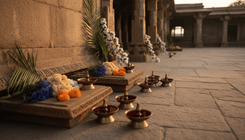
Urmila's name appears only twice in most tellings of the Ramayana, yet her choice shaped the course of the epic. When Lakshmana decided to follow his brother Rama and sister-in-law Sita into exile, his wife Urmila was left alone in Ayodhya for fourteen years. She is the Ramayana's forgotten woman—not heroic or tragic enough for the main plot, but present in every scene she is absent from. Her story reveals something essential about what the text values and what it overlooks.



Who was Urmila?
Urmila was the daughter of King Janak and the younger sister of Sita. In the Ramayana narratives that survive, she appears briefly as Sita's attendant during the wedding ceremonies, and then largely vanishes from the story. She married Lakshmana, Rama's younger brother, and by all accounts was a devoted wife. But beyond this outline, very little is told. The epics do not dwell on her character or her inner life the way they do for other women in the story—not as intensely as they do for Sita, and not with the complexity given to figures like Kaikeyi or Draupadi in related texts.
This absence itself is instructive. Urmila is the overlooked counterpart to Sita: both women were married to men who were asked to abandon their ordinary lives. But where Sita's departure into the forest is detailed and debated, Urmila's remaining behind receives almost no attention. The text seems to regard her as incidental to the real drama, yet her position was almost as demanding as Sita's.
The choice Urmila did not make
Urmila had no say in Lakshmana's decision. When Rama was banished to the forest, Lakshmana chose to go with him. This was his prerogative as a devoted younger brother—a choice celebrated in the Ramayana as an example of perfect loyalty. But it was also a choice that bound Urmila to a different kind of exile: fourteen years in a city where her husband was absent, where she had no companion of her own rank, and where she would have to navigate the complex politics of Ayodhya's court alone.
The texts do not record her agreeing to this or objecting to it. She is simply left. In some regional tellings, Urmila takes vows of fasting and silence during the period of exile, maintaining spiritual discipline in her husband's absence. In others, she spends the years in prayer and devotion. These variations suggest that over time, storytellers felt the need to fill the gap the texts left, to give Urmila some agency or dignity in her abandonment. But in the oldest textual sources, she is largely voiceless.
This silence is troubling to modern readers, but it also reflects something true about the text's concerns. The Ramayana is above all a story about dharma—righteous duty—as it applies to men in positions of power or moral trial. Rama's choice, Lakshmana's choice, even Sita's choice to follow her husband are all framed as dharmic acts. Urmila's situation, by contrast, is not framed as a choice at all, and therefore not as a test of virtue. She simply endures what happens to her.
What the stories tell us that remain
In the versions that do address Urmila's fourteen years, a pattern emerges. She is often described as performing acts of tapasya—austerity and spiritual practice—on behalf of her husband's welfare. In some accounts, she undertakes a vow not to sleep properly, resting only lightly so that her vigil might help protect Lakshmana in the forest. This echoes the theme of female self-sacrifice that runs through the Ramayana, but it is a sacrifice no one asked for and no one fully acknowledges.
The Uttara Kanda, the final book of the Ramayana (whose authorship and age are debated by scholars), includes more material about Urmila than earlier sections, though she still plays no active role in the main narrative. When Rama and his companions return to Ayodhya after fourteen years, Urmila is present and welcomed, but her years of waiting are not celebrated or even substantially remarked upon. She returns to her place as Lakshmana's wife without ceremony or recognition.
This treatment reflects the text's overall approach to women who are not at the center of the dharmic action. Sita is remembered because she is Rama's wife and because her suffering defines his. But Urmila suffers in a way that serves no one and resolves no dilemma. The text has no framework for valuing her pain.
Why Urmila matters now
The relative invisibility of Urmila in the traditional Ramayana has made her a focal point for modern retellings and feminist readings of the epic. Writers like Smita Chandra and others have imagined Urmila's inner life during those fourteen years, asking what thoughts and feelings the text did not record. These reimaginings are not attempts to "correct" the Ramayana but to ask what questions the original text leaves unasked.
Urmila's story also illuminates how the Ramayana constructs dharma. The text values action and sacrifice in public life—the duties of a prince, a wife following her husband, a brother's loyalty. But it has little to say about the quiet, private endurance that falls to women who are left behind. Urmila's fourteen years of waiting are not dramatized as a test or a virtue precisely because they do not fit the framework of dharmic action as the text understands it.
For readers today, Urmila is a reminder that every story contains silences as well as words. The Ramayana tells us much about Rama, about Sita's trials, about Lakshmana's devotion. But it tells us almost nothing about the woman who maintained the household and the family's interests during their absence, who had no choice in her exile and no recognized role in the epic's resolution. Her story reveals not a flaw in the Ramayana but a particular vision of what counts as important, what deserves narration, and whose suffering the text regards as meaningful.
When Lakshmana finally returns from the forest, Urmila is simply there. She does not speak, does not claim recognition, does not even appear in many of the homecoming scenes. She has served her dharma, whatever it was, without the text ever quite defining it. That absence of definition—that gap between what Urmila endured and what the Ramayana says about it—is her story.
Common questions
Was Urmila mentioned in the original Sanskrit Ramayana?
Yes, but very briefly. She appears in the Valmiki Ramayana but is given little space or dialogue. Most regional and later versions, including the Uttara Kanda, give her slightly more attention, though she remains a marginal figure compared to Sita or other main characters.
What did Urmila do during the fourteen years Lakshmana was gone?
The texts do not specify clearly. Some regional versions describe her performing tapasya or spiritual vows on her husband's behalf; others suggest she spent the years in prayer and devotion. In many tellings, she remained in Ayodhya managing the household, but the texts do not dwell on these details.
Why is Urmila so little known compared to other women in the Ramayana?
The Ramayana focuses on active choices and public dharmic trials—Rama's exile, Sita's suffering in captivity, Lakshmana's loyalty. Urmila's endurance in waiting does not fit this framework and so receives minimal narration, though her story raises important questions about whose suffering the text values.

Related Articles


