
Understanding Hindu Funeral Rites
Death Honoured, the Soul Released

Aditya Pandey
08 Nov 2026 • 5min
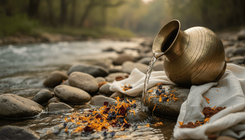
Hindu funeral rites, known as antyeshti or antyesti samskara, form one of the sacred samskaras—the rituals that mark the passages of life. They are designed to honour the deceased and to help release the soul from its attachment to the body, freeing it for its journey beyond.
When death occurs, these rites begin immediately and continue through the days and months that follow. The practices vary by region, family lineage and sampradaya, but the underlying intention remains consistent: to perform one's duty toward the dead and to support the soul's transition. For many Hindus, these rituals provide a structured path through grief while fulfilling a sacred obligation.



The Role of Cremation
Cremation is the central act of Hindu funeral rites. The body is washed, dressed and placed on a pyre, usually built in an open cremation ground. The eldest son or the closest family member typically lights the pyre, performing the act known as mukhagni—kindling the fire near the mouth.
This immediate return of the body to the elements—fire, earth, water and air—is understood as liberating the atman, or soul, from its material form. The fire burns away the body completely, leaving no trace. This is distinct from burial practices in other traditions and reflects the Hindu understanding that the physical form is temporary while the soul is eternal. Once the body is fully cremated, the ashes are collected.
The Ashes and Their Dispersal
After cremation is complete, the ashes are typically collected and immersed in a river or other body of water. Where possible, families scatter the ashes in the Ganges or another holy river, as this is considered particularly auspicious. However, ashes may be immersed in any flowing water.
Some families keep a small portion of the ashes if they wish to perform rituals in their own home or to scatter them at a later date in a place of significance. This flexibility reflects the practical reality that not all families can reach a holy river immediately. The dispersal of ashes into water symbolises the final release of the deceased, allowing the soul to be carried onward without remaining tied to any earthly location.
Post-Funeral Observances
After cremation, the immediate period is observed with specific practices. Many families maintain a period of ritual impurity—considered a time when the household is in transition—which typically lasts for thirteen days, though the exact duration varies by tradition and region. During this time, the family avoids auspicious activities and often refrains from cooking, with food prepared by neighbors or other members of the community.
Throughout this period, daily offerings of food or water may be made to support the soul, and prayers are offered. On the tenth, eleventh or twelfth day—the timing depends on regional custom—a feast called the terahvi ceremony or shraddha is often held. Family members gather, prayers are recited, and food is offered first to the deceased (in the form of an offering made in their name) and then distributed to those present and sometimes to brahmins or the poor.
The terahvi is named for the thirteenth day in some traditions, though the actual ceremony is often held on the eleventh or twelfth. Its purpose is to formally conclude the period of mourning and to strengthen the bond between the living and the deceased through ritual and shared food.
Shraddha Offerings and Long-Term Remembrance
Beyond the immediate post-funeral period, annual remembrance continues through shraddha, offerings made during specific times in the lunar calendar. These are typically performed on the death anniversary and during the fortnight known as Pitru Paksha, which falls in the Hindu month of Bhadrapada (usually September or October).
Shraddha offerings include rice cakes, sesame seeds, water and other foods presented with the understanding that they nourish the soul of the deceased. These rituals acknowledge that the relationship between the living and the dead does not end with cremation; rather, it transforms into one sustained through memory and ritual action. Many families perform shraddha annually throughout the lives of those who remember the deceased, and some continue them for generations.
The specifics of shraddha vary significantly by region, caste and family tradition. Some families focus on offerings to the nearest male ancestor, while others remember multiple generations. The rituals serve both to honour the dead and to reinforce family bonds and continuity across time.
Regional and Sectarian Variations
Hindu funeral practices encompass many variations. In some regions, the period of ritual impurity may be shorter or longer than thirteen days. Some communities favour certain rivers for ash dispersal, or maintain particular forms of the terahvi ceremony. Certain sampradayas, or spiritual lineages, have their own ritual protocols.
In some cases, particularly where a person has lived in a city far from their place of origin, or where circumstances prevent traditional cremation, alternative approaches may be followed. The underlying principles—honouring the deceased, supporting the soul's transition, and maintaining connection through remembrance—persist across these variations.
Common questions
What happens if cremation is not possible?
While cremation is the standard Hindu practice, some communities or circumstances may require alternative approaches. In such cases, the underlying intention—to release the soul from attachment to the physical form—is honoured through adapted rituals and prayers. Consult your family's sampradaya or a knowledgeable elder for guidance specific to your tradition.
How often should shraddha be performed?
Shraddha is typically performed annually on the death anniversary and during Pitru Paksha. Many families continue annual observance for generations. The frequency and scope of shraddha—whether offered to one ancestor or multiple—varies by family tradition and regional custom.
Who can perform the funeral rites?
The primary responsibility usually falls to the eldest son or closest family member, particularly in performing mukhagni. However, the specific role and eligibility of those who participate varies by sampradaya and region. If no son is present, a close relative may fulfill this duty, and guidance from your family's tradition should be sought.

Related Articles


