
Ugadi and Gudi Padwa: New Year Customs of the Deccan
Spring's Renewal, Rooted in Region

Abhilash Ramakrishna
09 Nov 2026 • 7min
Ugadi and Gudi Padwa are names for the same festival, marking the Hindu new year across different parts of the Deccan. In Andhra Pradesh and Telangana, it is called Ugadi; in Maharashtra, it is Gudi Padwa. In Karnataka, it is observed as Chaitra Sukladi or simply Yugadi. The festival falls on the first day of the month of Chaitra according to the lunar calendar, which usually comes in March or April. Both names and all these variants celebrate the spring equinox and the start of the new year in the Hindu calendar, with roots in the Deccan's distinct cultural heritage.



The Origins and Regional Names
The term "Ugadi" comes from two Sanskrit words: "yuga", meaning age or year, and "adi", meaning beginning. So Ugadi literally means the beginning of a new year. This name has been in use for centuries in Andhra Pradesh and Telangana, where it is deeply woven into local identity.
"Gudi Padwa" has a different etymology. "Gudi" refers to the flag or decorated pole that is raised outside homes on this day, while "Padwa" comes from the Prakrit word for the new moon day that marks the festival. The raising of the Gudi is a distinctive feature of Maharashtrian celebration, making the name inseparable from this visual practice.
These are not different festivals, but the same observance wearing different regional dress. In the Kannada-speaking regions of Karnataka, the day is sometimes called Chaitra Sukladi—the first day of the bright fortnight of Chaitra. What varies is not the spirit, but how each region marks it. Understanding both names helps you recognize the same festival whether you are in Pune, Hyderabad, or Bangalore.
Ugadi Pachadi: The Flavours of the New Year
The most recognizable ritual unique to Ugadi is the preparation and sharing of Ugadi Pachadi (or Gudi Padwa Pachadi), a special chutney that captures the essence of the festival's meaning. Pachadi is a traditional dish made from six flavours: jaggery (sweet), neem leaves (bitter), raw mango (sour), salt (salty), chilli powder (spicy), and tamarind (tangy). Some versions include other ingredients like ginger or tulsi.
Each flavour represents a different human emotion or aspect of life. The sweetness of jaggery symbolizes the hope for happiness in the year ahead. The bitterness of neem represents the sorrows and challenges that will come. The sourness of raw mango stands for disappointment, the salt for friendship and loyalty, the heat of chilli for courage, and the tang of tamarind for surprise or the unexpected.
The ritual is simple but profound: each member of the family tastes a small portion of this chutney on the new year morning. In doing so, they acknowledge that life brings all these experiences—joy and sorrow, sweetness and bitterness—and they prepare themselves to meet each with equanimity. It is a way of saying that a full life contains all these flavours, and we are grateful for all of them. The practice reminds us that the new year is not about chasing only happiness, but about living with balance and grace.
The Gudi: Symbol of Victory and Prosperity
In Maharashtra, the raising of the Gudi is the day's most visible act. A Gudi is a bamboo or wooden pole, often five to seven feet tall, decorated with colourful cloth, usually silk in bright reds, yellows or greens. At the top is tied a bundle of neem leaves, a clay pot, and a garland of flowers—often marigolds. A sugar cane stalk may also be attached to one side of the pole.
The Gudi is raised on the roof, the balcony, or outside the front door of the home, and it remains there throughout the day. The practice is believed to have originated in commemoration of the victory of Krishna, the avatar of Vishnu, over the demon Kansa. When the Gudi is raised, the family is said to be symbolically hoisting the flag of victory and prosperity over their home for the year to come.
Different families and communities add their own touches. Some tie sacred threads or ribbons to the pole. Others adjust the height or style of decoration according to local custom. The Gudi is more than ornament; it is a public announcement of faith and readiness to meet the new year with courage. In neighbourhoods across Maharashtra, the forest of Gudis raised on one morning creates a striking collective image—the whole community raising its flags together.
New Year Rituals and Customs
Beyond the Pachadi and Gudi, the observance of Ugadi and Gudi Padwa follows a pattern that is remarkably consistent across the Deccan, even as local details shift.
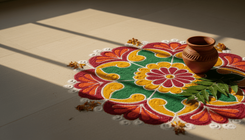
Homes are cleaned and decorated with rangoli (coloured powder patterns) on the morning of the festival. Many families visit temples early in the day to receive blessings and perform prayers. Fresh clothes, often new and sometimes traditional, are worn. Elders in the family are greeted and their blessings sought. Friends and neighbours visit each other, exchange sweets and savouries, and wish one another well for the year ahead.
Many families prepare special dishes: in Telangana and Andhra Pradesh, Pesarattu (a lentil crepe) and Gujhaya (a sweet dumpling) are traditional foods. In Maharashtra, puran poli (a bread with a sweet filling made of jaggery and lentils) is commonly made, along with fried snacks and various pickles. The cooking itself is a ritual; preparing these dishes on the new year morning is believed to set the tone of care and abundance for the months to come.
Some communities observe fasts (vrats) on this day, though the practice is not universal—it varies by family and local custom. In many homes, the new year morning is considered auspicious for starting new endeavours: launching a business, beginning studies, or planting seeds are considered specially blessed on this day.
The Significance Across Communities
Ugadi and Gudi Padwa are deeply rooted in the regional identity of the Deccan, yet they also carry meanings that resonate across Hindu tradition. The spring equinox has always marked renewal and the return of life after winter. The new year here is not arbitrary, but tied to the cycles of nature that governed agricultural life for thousands of years.
Today, as the Deccan has grown into modern cities, these observances continue to anchor people to their heritage and to seasonal time. They remind us that the new year is not just a date on a calendar, but a moment to pause and recommit to balance, gratitude and growth. Whether it is tasting all the flavours in Pachadi or raising a flag of hope, the ritual is the message: we are beginning again, and we are ready.
Common questions
What month does Ugadi and Gudi Padwa fall on?
Ugadi and Gudi Padwa are observed on the first day of Chaitra in the lunar calendar, which typically falls in March or April. The exact date shifts each year because it is determined by the lunar calendar, not the Gregorian calendar.
Can I make Ugadi Pachadi with different ingredients?
The core six flavours—sweet, bitter, sour, salty, spicy, and tangy—are essential to the meaning of Pachadi, but many families add or substitute ingredients based on local availability and family tradition. Common additions include ginger, green chilli, and tulsi leaves. The key is that each flavour is present and tasted.
Is Ugadi and Gudi Padwa celebrated the same way in every region?
No. While the festival marks the new year across the Deccan, Maharashtra is known for raising the Gudi, Andhra Pradesh and Telangana emphasize Pachadi, and Karnataka has its own local names and practices. The core is shared, but the details are distinctly regional.

Related Articles


