Tulsi Vivah 2026: The Story Behind This Sacred Marriage
When the Sacred Plant Weds the Divine

Sunil Chaurasia
20 Oct 2026 • 7min
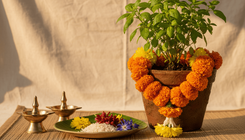
Tulsi Vivah is the ceremonial marriage between the tulsi plant and Lord Vishnu, usually in his form as the sacred Shaligram stone, observed each year in the month of Kartik, after the monsoon and at the beginning of winter. In 2026, Tulsi Vivah falls on Saturday, 21 November, and many households will perform this ritual, marking the sacred union that celebrates devotion and the renewal of auspicious beginnings. The Tulsi Vivah story goes far deeper than a symbolic wedding: it is rooted in ancient mythology, spiritual practice and a tender relationship between humans, the divine, and the living plants in our homes.
This festival holds a special place in the Hindu calendar. Unlike many celebrations that mark historical events, Tulsi Vivah commemorates the eternal relationship between the tulsi plant—considered the earthly form of the goddess Vrinda, and in many traditions a form of Lakshmi—and Lord Vishnu. The marriage ritual comes just after Prabodhini Ekadashi, when Vishnu is believed to awaken from his four-month cosmic sleep, and it traditionally marks the reopening of the Hindu wedding season after the months of Chaturmas.



The Mythology of Vrinda and Vishnu
The Tulsi Vivah story draws from the life of Vrinda, whose tale appears in texts such as the Padma Purana and the Shiva Purana. According to the mythology, Vrinda was the wife of Jalandhara, a powerful asura king. She was a deeply virtuous and devoted wife, and the strength of her chastity and devotion to her husband made Jalandhara invincible. So long as her virtue remained unbroken, no one—not even the gods—could defeat him, and Jalandhara used this protection to wage war against the gods.
To end Jalandhara's tyranny, Lord Vishnu took on the form of Jalandhara himself and approached Vrinda, breaking her chastity through this deception. With her virtue broken, Jalandhara lost his protection and was slain in battle by Lord Shiva. When Vrinda discovered the deception, she was heartbroken and, in her anguish, cursed Vishnu to become a stone—the origin of the Shaligram, the sacred black stone worshipped as a form of Vishnu. Vrinda then gave up her life. Moved by her devotion, Vishnu blessed her: she would be reborn as the tulsi plant, forever sacred and beloved by him, and he, in his Shaligram form, would be wedded to her. No offering to Vishnu would be complete without tulsi leaves. Their marriage each year celebrates this eternal devotion and her transformation into the holiest plant in the household.
Different regional and scriptural traditions record variations of this tale—in the Brahma Vaivarta Purana, for example, Tulsi is married to the asura Shankhachuda—but the core remains constant: Vrinda's unshakeable devotion transcends her physical form and becomes the living tulsi in every home where it is grown.
When and How Tulsi Vivah Is Observed
Tulsi Vivah is celebrated during the month of Kartik (October–November in the Gregorian calendar), in the bright fortnight (Shukla Paksha) that follows the new moon of Diwali. It is most commonly performed on Dwadashi, the twelfth lunar day, the day after Prabodhini Ekadashi, though some families perform it on the evening of Ekadashi itself, and in some places the observance continues up to Kartik Purnima. In 2026, Prabodhini Ekadashi falls on Friday, 20 November, and Tulsi Vivah on Saturday, 21 November. The exact date shifts each year according to the lunar calendar, and many households determine the timing by consulting the panchanga (traditional calendar).
The ritual itself is deeply personal yet follows certain customs. In homes, women and girls typically take a leading role in the ceremony, dressing the tulsi plant as a bride in a red chunri and adorning it with bangles, sindoor and other bridal ornaments. Flowers, especially marigolds, are woven into the decoration. A wedding canopy is often made of sugarcane stalks around the tulsi. A Shaligram stone, or an image of Vishnu or Krishna, is placed beside the decorated tulsi as the divine groom. In many families, a couple performs the kanyadaan, giving away the bride, which is considered a deeply meritorious act—especially for couples who do not have a daughter of their own.
Prayers and mantras are recited to bless the union, and the rituals of a Hindu wedding, such as the circling of the sacred pair, are often followed. Offerings commonly include sugarcane, amla, water chestnuts (singhara), seasonal fruits and sweets, which are offered to the tulsi and then shared as prasad (blessed offering). The ritual can be as simple as a heartfelt prayer or as elaborate as a full ceremonial wedding, with invitations to family and neighbours. Regional variations exist: in the Braj region and in Gujarat, it is celebrated with great festivity, while in South India, the Dwadashi is observed as Ksheerabdi Dwadashi, with the worship of tulsi and Vishnu.
The Spiritual Significance of the Ritual
Tulsi Vivah carries layers of spiritual meaning for practitioners. On one level, it honours the sacred plant itself—tulsi is revered as a manifestation of divine energy and has been used in Hindu prayer and traditional medicine for centuries. Growing tulsi in the home is considered an act of devotion, and the plant is believed to purify the household spiritually. The marriage ritual acknowledges this sanctity and deepens the connection between the household and the divine through the plant.
The festival also marks a turning point in the year. Coming after the monsoon and the four months of Chaturmas, when auspicious ceremonies such as weddings are traditionally avoided, Tulsi Vivah symbolizes new beginnings and the renewal of devotion. For many, performing the ritual is a way of expressing commitment to their spiritual practice and to maintaining a conscious relationship with the sacred in daily life. The wedding of tulsi and Vishnu is, in this sense, an invitation to the household to renew its own relationship with the divine.
Furthermore, the ritual celebrates the feminine divine and women's spiritual authority. Women traditionally take a central role in the ceremony, and the plant itself is honoured as a form of the goddess. This places the practice within a broader conversation about feminine power in Hindu spirituality and the reverence given to women as keepers of household ritual and sacred knowledge.
Tulsi in Daily Practice and Beyond
The significance of Tulsi Vivah extends to how practitioners engage with tulsi year-round. The plant is maintained with special care and attention. Many families water it daily, light a lamp before it in the evening, speak to it with devotion, and pluck its leaves for use in prayer or in traditional remedies. Tulsi is believed to ward off negative energy and illness, and its leaves are commonly used in Ayurvedic preparations and in daily worship—especially in offerings to Vishnu and Krishna, which are considered incomplete without tulsi leaves.
In traditional Indian homes, the tulsi plant often holds a central place—in the courtyard, on a balcony, or in a dedicated small shrine called a tulsi vrindavan—because it is considered the guardian of the home and its inhabitants.
The Tulsi Vivah festival demonstrates how Indian spiritual practice weaves together mythology, seasonal cycles, personal devotion, and the living world. It is not merely a ritual performance but an affirmation of the sacred relationship between humans and nature, between devotion and the divine presence that dwells everywhere—even in a humble plant in the courtyard.
Whether you keep tulsi in your home or are drawn to this festival for the first time, Tulsi Vivah invites you to pause and celebrate what is sacred in the everyday. It is an opportunity to honour devotion itself—in all its forms—and to remember that spiritual practice flourishes not in separation from the world but in intimate relationship with it.
Common questions
What is the difference between Tulsi Vivah and Prabodhini Ekadashi?
Tulsi Vivah and Prabodhini Ekadashi occur close together in Kartik but serve different purposes. Prabodhini Ekadashi, also called Dev Uthani Ekadashi, marks Lord Vishnu's awakening from his four-month sleep and the end of Chaturmas, while Tulsi Vivah celebrates the sacred marriage between tulsi and Vishnu in his Shaligram form. Tulsi Vivah is most commonly performed on Dwadashi, the day after Prabodhini Ekadashi, though some households perform it on the evening of Ekadashi itself. In 2026, Prabodhini Ekadashi falls on Friday, 20 November, and Tulsi Vivah on Saturday, 21 November.
Can you perform Tulsi Vivah if you don't have a tulsi plant at home?
Traditionally, the ritual is performed with a living tulsi plant, as it is central to the ceremony. However, some practitioners have adapted the ritual by visiting a temple where tulsi grows, or by planting tulsi in their home before the festival. It is better to prepare in advance than to perform the ceremony without the plant.
What happens to the tulsi plant after Tulsi Vivah?
After the marriage ceremony, the tulsi continues to be treated with reverence and care. It is watered daily, honoured with a lamp in the evening, and its leaves are used for prayers, offerings and traditional remedies throughout the year. The plant is believed to remain especially blessed and protective of the household until the next Tulsi Vivah.

Related Articles