
Trataka: The Yogic Practice of Steady Gazing
Focus the mind, strengthen the eyes, clear the sight.

Aditya Pandey
11 Nov 2026 • 8min
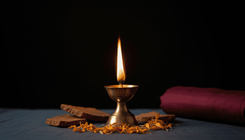
Trataka is a yogic technique in which you gaze steadily at a single point—usually a candle flame, a dot, or an image—to focus the mind and purify the eyes. The name comes from the Sanskrit root meaning "to gaze" or "to look", and the practice appears in hatha yoga texts as one of the shatkarma, or cleansing techniques. Unlike most yoga practices, which work through movement or breath, trataka works through stillness and attention. It is simple to begin but demands patience, and many practitioners find it one of the most direct ways to settle a scattered mind.



What Trataka Is and How It Works
Trataka trains the mind to hold a single point without wandering. In a busy day, attention jumps from thought to thought, screen to screen. This habit of jumping leaves the mind tired and scattered. Trataka reverses it by asking the mind to rest on one thing. Over weeks and months, this stillness deepens, and the scattered thoughts begin to settle.
The practice is also said to purify the eyes and improve their function. The Gheranda Samhita, a classical yoga text, describes trataka as one of the shatkarma, the techniques that prepare the body for advanced yoga. In this context, it was understood to cleanse the subtle channels and strengthen the eyes. Modern practitioners report that regular trataka can improve focus, reduce eye strain, and sharpen vision, though these claims fall outside the scope of formal medical proof.
The simplest form uses a candle flame as the object of gaze. You sit before a lit candle in a quiet space and look steadily at the flame without blinking. When the eyes tire, you close them and hold the image in your mind. This cycle of external gazing and internal retention is the heart of the practice.
Choosing Your Focus Object
The most common choice is a candle flame, and for good reason. The flame is alive and moving, which draws the gaze naturally, yet it holds a fixed place in space, which trains attention. A steady flame about an arm's length away at the level of your eyes is ideal. If a candle is not available or not suitable, you can use a black dot on white paper, a small image of a deity, or a yantra—a geometric diagram used in meditation.
The key is that the object should have a clear focal point. It should be neither too bright nor too dim, and the space around it should be plain, without competing distractions. Some practitioners prefer a dot because it removes the element of the flame's movement and creates an even stronger focus. Others find that the subtlety of the flame trains the mind more deeply because it requires greater attention to hold steady.
The object you choose will shape the practice subtly. Gazing at a flame carries a quality of inner heat and transformation. Gazing at a dot is more austere and direct. Gazing at a sacred image or yantra brings devotion or mantra into the practice. Try different objects and see which one holds your attention most naturally.
Setting and Posture
Sit in a comfortable, stable posture—cross-legged on a cushion, in a chair with your feet on the ground, or in any position in which you can remain still for ten or fifteen minutes without strain. Your spine should be upright but not rigid. Rest your hands on your lap or your knees.
The room should be quiet and dimly lit. If you are using a candle, it should be the primary source of light. Darkness around the object makes the gaze stronger and prevents your eyes from being drawn to other things. Avoid practicing when you are tired or hungry, as your focus will waver. Early morning or evening is ideal, when the mind tends to be calmer.
Position the object at arm's length away and at the level of your eyes, so you do not have to strain your neck or look upward or downward. This neutral alignment keeps the practice comfortable and allows you to sit longer without fatigue creeping in.
The Practice Itself
Begin by looking at your chosen object with steady attention. Your eyes are open and relaxed, not staring hard but held gently on the focal point. Blink naturally—do not try to avoid blinking or hold your eyes open unnaturally, as this causes strain. Let the blink happen when it needs to.
Keep your gaze for five to ten minutes if you are beginning. As your practice deepens over weeks and months, you can extend this to fifteen or twenty minutes. The aim is not to push but to stay comfortable and alert.
When your eyes tire or begin to water—and they will—close them gently. Immediately bring the image of what you were gazing at into your mind's eye. You will see an afterimage, a bright shape. Hold this image in your awareness without straining. Let it fade naturally. When it has completely faded, if you have time, open your eyes and gaze again.
This cycle—gazing, closing, holding the inner image, letting it fade—is the complete practice. Do not rush from the gazing into activity. Sit quietly for a minute or two after the practice ends, allowing your eyes and mind to settle.
Variations and Adaptations
Some practitioners add mantra to trataka, repeating a phrase silently while gazing. Others pair it with pranayama, a breathing technique, though this is more advanced. In some schools of yoga, trataka is practiced in complete darkness, gazing at an internal light, though this demands prior experience with the basic form.
If your eyes are sensitive or you have a condition like dry eye, you may find a black dot easier on your eyes than a flame. If you cannot sit still easily, you might begin with just three to five minutes rather than pushing toward ten. The practice adapts to where you are, not the other way around.
Beginning Your Practice
Start with two or three sessions a week. This regularity builds the habit without overwhelming you. Choose the same time each day if you can—the mind settles more easily into a rhythm. Keep a simple notebook and write down what you notice: how long you managed to gaze, what quality the inner image had, whether you felt calmer afterward. These notes help you track progress in a practice where growth is subtle.
Expect the mind to wander. This is not failure; it is the whole point. Each time you notice the mind has drifted and you bring it back to the object, you are training attention. The practice is not about never wavering, but about noticing when you have wavered and coming home to the focal point again.
How to practise trataka
- Prepare your space Sit in a quiet room that is dimly lit. Choose a comfortable upright posture—cross-legged on a cushion or seated in a chair. Place your focal object (candle, dot, or image) at arm's length away and at the level of your eyes, so your neck remains neutral.
- Gaze steadily Look at your object with gentle, steady attention for five to ten minutes. Blink naturally when you need to. Keep your eyes relaxed, not staring hard. If your mind wanders, simply return your gaze to the object.
- Close and visualize When your eyes tire or begin to water, close them gently. Immediately hold the afterimage you see in your mind's eye. Do not strain to keep it—let it fade naturally on its own.
- Open again if time allows Once the inner image has faded completely, you may open your eyes and gaze again for another round, or end the practice. Either way, sit quietly for a minute after you finish, allowing your eyes and mind to settle.
- Practice regularly Begin with two or three sessions a week. Consistency builds the habit more reliably than longer occasional sessions. Choose the same time each day if possible, so the mind settles more easily into rhythm.
Common questions
How long should I practise trataka each day?
Begin with five to ten minutes if you are new to the practice. As your ability to focus strengthens over weeks and months, you can extend it to fifteen or twenty minutes. Consistency matters more than length: three sessions a week, done steadily, builds focus more reliably than occasional long sessions.
Can I use something other than a candle?
Yes. A small black dot on white paper, an image of a deity, or a geometric yantra work equally well. The dot is often easier on the eyes, while a flame's gentle movement may help attention settle. Choose whichever object draws your gaze most naturally.
What should I do if my eyes water or become tired?
This is normal, especially when you begin. Close your eyes gently, hold the afterimage in your mind, and let it fade. Watering usually means you are gazing too intently or your eyes need a rest. If discomfort continues, reduce the practice length and ensure your focal object is at eye level and arm's length away.

Related Articles


