
The Story of Prahlada and Narasimha: Divine Protection Through Devotion
When a child's faith breaks through evil

Abhilash Ramakrishna
04 Nov 2026 • 6min
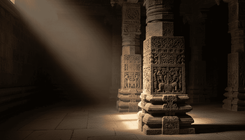
The story of Prahlada and Narasimha shows what happens when a child's devotion stands against all odds. Hiranyakashipu, a powerful demon king, had been granted a boon that made him nearly invincible: he could not be killed by god or man, by weapon or animal, inside or outside, during day or night. Certain of his safety, he became proud and cruel, even forbidding the worship of the gods. Yet his own son, Prahlada, was born with unwavering faith in Vishnu. Despite his father's threats and attempts to kill him, Prahlada refused to abandon his devotion. His constancy moved the gods, and Vishnu took a form that was neither man nor animal—Narasimha, the lion-headed avatar—to protect his young devotee and restore dharma.



The Birth and Nature of Prahlada
Prahlada was born to Hiranyakashipu and his wife Kayadhu. The child's extraordinary faith became clear even before his birth. When Kayadhu was captured and held prisoner by the gods' teacher, the sage Narada, he taught her about Vishnu while the unborn child listened from the womb. Through this teaching alone, Prahlada absorbed complete devotion, so that when he was born, his love for Vishnu was already absolute. Unlike his father, who sought power through tapasya only to use it for domination, Prahlada's devotion was selfless and pure. He wanted nothing but the presence and grace of Vishnu, and he held this intention with a clarity that neither punishment nor terror could shake.
Even as a child in Hiranyakashipu's asura court, Prahlada spent his time in japa, meditation and remembrance of Vishnu. He recited the names and virtues of the divine with such genuine love that other young asuras in the court were drawn to him. When his father learned of this, he felt not pride but rage. A son devoted to Vishnu was a betrayal of everything Hiranyakashipu stood for. He ordered the child killed—first by fire, then by poison, then by serpents, then by drowning. Each time, Prahlada's faith and Vishnu's grace protected him. He remained unhurt and calm, his devotion never wavering, as if even an asura child's sincere remembrance of the divine carried a power that no force could overcome.
Hiranyakashipu's Pride and the Breaking Point
Hiranyakashipu's cruelty to his son deepened as Prahlada remained unbroken. The demon king had once performed intense tapasya to gain his boon, and Brahma had granted it, believing the conditions were impossible. Yet it was exactly this impossible combination that would later prove his undoing. Hiranyakashipu could not see that his own son, small and gentle, held a strength his strength could not touch.
On his final attempt, Hiranyakashipu gathered his court and challenged Prahlada directly. He pointed to a stone pillar in the great hall and demanded that Prahlada prove that Vishnu, if he was truly everywhere, must be in the pillar too. "Call your Vishnu from within this stone," the demon king mocked. "If you can, I will believe. If you cannot, I will kill you now." Prahlada simply replied that Vishnu was indeed everywhere, in the pillar and beyond. He had no doubt. Then, as Hiranyakashipu approached the pillar in his fury, it shattered.
Narasimha Emerges
From the broken pillar came Narasimha, a form never before seen—part lion, part man, terrible and radiant beyond description. He was neither purely animal nor purely human, so he broke the first condition of the boon. He appeared at twilight, between day and night, breaking the second. He placed Hiranyakashipu on his thighs, which were neither floor nor sky, breaking the third. And he killed the demon with his nails, neither weapon nor bare hand, breaking the fourth.
Yet Narasimha's purpose was not merely destruction. He had come to protect Prahlada. The moment the demon king fell, Narasimha's terrible form softened when the young boy approached without fear. While all others trembled at the sight of him, Prahlada walked forward with complete trust and devotion, knowing that Vishnu had come. In this encounter, the absolute protection of the divine was revealed: Narasimha saved Prahlada not through magic or distant intervention, but by descending into his world to meet his father's evil directly. A child's sincere faith had called down an avatar.
What the Story Teaches
This narrative appears in the Bhagavata Purana and other texts, and it remains one of the most beloved stories in the Hindu tradition because it speaks to something fundamental about devotion. Prahlada's example shows that faith is not a reward for strength or success. A child held captive and threatened can hold truth more steadily than a king with all the world's power. His devotion was not blind acceptance but active, conscious love that he chose and defended even when it cost him everything.
The story also reveals the Hindu understanding of dharma—that the cosmos itself bends toward justice. When someone commits to dharma with complete sincerity, the divine itself moves to protect and restore order. Narasimha did not appear because Prahlada was special or privileged, but because he held his devotion true in circumstances designed to break it. That constancy opened a path for grace.
The festival of Narasimha Jayanti celebrates this liberation, held during the month of Vaishakha according to the lunar calendar. Many households and temples mark the day with special worship, storytelling and remembrance of how the divine appears when righteousness is threatened. The tale reminds devotees that protection comes not through control or force, but through steadfast faith and alignment with what is true and right.
Common questions
When is Narasimha Jayanti celebrated each year?
Narasimha Jayanti is observed in the month of Vaishakha according to the lunar calendar, falling on different dates in the Gregorian calendar each year. You can check the exact date through a current panchanga or Hindu calendar for your region.
Did Hiranyakashipu have any way to survive his boon?
Yes—the boon explicitly excluded killing by god or man, weapon or animal, inside or outside, day or night. Narasimha existed outside all four categories: he was neither purely god nor man, neither weapon nor bare hand, neither inside nor outside, and neither day nor night. This loophole could only be exploited by a form that had never existed before.
What is the connection between Prahlada's devotion and his survival?
Prahlada's sincere, unwavering remembrance of Vishnu is what ultimately protected him through all attempts on his life. In the Hindu tradition, genuine devotion is seen as a spiritual force that calls divine grace. His faith did not save him through magic, but by aligning him with dharma and drawing Vishnu's protection directly into his life.

Related Articles


