
The Story of Prahlada and Holika Behind Holi
Devotion's Victory Over Evil, Celebrated in Fire

Kushal K
07 Nov 2026 • 6min
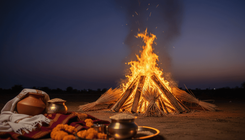
The holika and prahlada story is the spiritual heart of Holi, India's festival of colour and joy. It is the tale of a boy whose faith was unshakeable, and a demon king whose arrogance led to his downfall. This ancient legend, told in the Bhagavata Purana, shows us why Holi is observed each year during the full moon of Phalguna, the last month of the lunar calendar: it celebrates the triumph of dharma, or righteous living, over adharma, or wrongdoing.



Who Was Prahlada
Prahlada was born a demon, the son of Hiranyakashipu, one of the most powerful asuras ever to walk the earth. Hiranyakashipu had earned a boon from Brahma that made him nearly impossible to kill: no man or god, no weapon made by the gods, no beast and no being could slay him, neither by day nor by night, neither inside nor outside, neither on earth nor in the sky. Drunk on this power, the demon king declared himself supreme and forbade all worship of Vishnu, the preserver god.
Yet Prahlada, despite being born into a demon family, was deeply devoted to Vishnu from childhood. He spent his days singing the god's names, meditating on his forms and speaking of his kindness to all who would listen. His father found this devotion unbearable. Again and again, Hiranyakashipu tried to kill his own son—throwing him from mountains, poisoning him, burning him—but each time, Prahlada's faith protected him. The boy emerged unharmed.
The Trial by Fire
Hiranyakashipu finally decided that only his sister Holika could destroy the child. Holika was a demoness with a boon of her own: fire could never harm her. The demon king commanded Holika to enter a blazing fire with Prahlada in her lap. Surely, he thought, the boy would burn.
Holika and Prahlada entered the flames together. The fire roared and crackled all around them, consuming wood and kindling. But Prahlada, protected by his unwavering faith in Vishnu, sat calmly in the demoness's lap, singing the god's name. As the fire raged, a remarkable thing happened: Holika, despite her boon against fire, was consumed by the flames. Prahlada walked out of the inferno without a single burn on his skin. His devotion had triumphed where power could not.
The trial took place during the night of the full moon in Phalguna. Hiranyakashipu, enraged beyond measure, finally confronted his son himself. But as the boy stood before him, the god Vishnu took the form of Narasimha, half-man and half-lion—a form that was neither man nor beast, fulfilling the terms of the boon. At the threshold of his palace—neither inside nor outside—at dusk—neither day nor night—Narasimha tore apart the demon king and restored order to the universe.
Why We Celebrate Holi
The story of Holika Dahan, the burning of Holika, forms the darker, more solemn aspect of Holi. On the evening before Holi, people gather to light bonfires. They circle the flames, sing, pray and sometimes offer grain or wood to the fire as a way of honouring the event. The bonfire represents the fire that could not consume Prahlada's faith, and it symbolises the burning away of evil, ego and attachment from our own lives.
The next morning comes Rangwali Holi, the festival of colours. People throw coloured powder, splash water and embrace one another, celebrating the joy that follows when dharma prevails. Friends and enemies reconcile. The colours themselves have meaning: red represents love, green represents new life, yellow represents good health, and blue honours Krishna, the beloved avatar who is said to have loved to play with colours.
For many, Holi is also a harvest festival, marking the end of winter and the beginning of spring. In this sense, it belongs alongside other new-year festivals across India. But it is the story of Prahlada that gives Holi its deeper meaning: the knowledge that faith and righteousness, however small and powerless they may seem against overwhelming force, will ultimately prevail.
Prahlada's Legacy
The way Prahlada is remembered varies by region and by sampradaya, or spiritual tradition. In South India, particularly among Vaishnavas who follow the path of devotion to Vishnu, Prahlada is seen as an exemplar of bhakti, the loving devotion that connects a human being to the divine. He had no weapons, no armies and no magical powers of his own. What he had was faith so complete that it could not be shaken.
In some retellings, Prahlada becomes a beloved teacher after his father's death. He rules wisely and teaches his people the importance of dharma. In others, he is said to have spent his life in meditation and service, never using his position to seek revenge or personal gain, even though he had every reason to do so. The Bhagavata Purana describes him as one of the greatest devotees of Vishnu, and his example is studied by spiritual seekers across centuries.
The holika and prahlada story reminds us that Holi is not only about spring colours and playful celebration. It carries within it a teaching about the power of faith, the nature of evil, and the promise that those who walk the path of dharma will not be abandoned, however dark the night may become. When you see the Holika Dahan fire this year, or when you throw colours at Rangwali Holi, you are participating in a story that has been told and retold for thousands of years—a story that speaks to something true about the human spirit.
Common questions
What is the connection between Holika Dahan and the bonfire on Holi?
Holika Dahan commemorates the trial by fire in which Prahlada was protected by his faith while the demoness Holika was consumed. The bonfire lit on the evening before Holi honours this event and symbolises the burning away of evil and ego.
Was Prahlada really a demon?
Yes, Prahlada was born an asura, or demon, because his father Hiranyakashipu was a demon king. But Prahlada's devotion to Vishnu set him apart from his father's world, and he is remembered as one of the greatest devotees in Hindu tradition.
How does Prahlada's story relate to Narasimha?
After Prahlada survived the fire, his father Hiranyakashipu confronted him in anger. Vishnu then took the form of Narasimha, half-man and half-lion, to overcome the demon king while fulfilling the terms of his boon, which protected him from man and beast alike.

Related Articles


