
The Story of Ekalavya, Dronacharya and Guru Dakshina
When devotion bows to duty.

Abhilash Ramakrishna
04 Nov 2026 • 6min
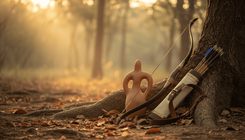
Ekalavya's story comes from the Mahabharata, one of Hinduism's two great epics. It illustrates the principle of guru dakshina—a gift or service a student offers to their teacher—and what happens when duty and devotion collide with worldly bonds.
Ekalavya was the son of Hiranyadhanush, a king of the forest-dwelling Bhil people. Though born outside the warrior caste, he had a burning desire to become an archer. He went to Dronacharya, the legendary military teacher who trained the royal princes of Hastinapur, and asked to be his student. Dronacharya refused. He said he taught only the sons of kings and would not take on a student from Ekalavya's birth.
Ekalavya did not argue or grow bitter. Instead, he went into the forest, made a clay statue of Dronacharya and placed it in his shelter. Every day he bowed before the statue and practised archery in front of it, treating the clay figure as his true guru. Through years of discipline and reverence, he became a master archer—some say surpassing even Arjuna, the foremost archer among the Kuru princes whom Dronacharya openly taught.



The Teacher's Dilemma
One day, Dronacharya took his royal students hunting in the forest. A dog began to bark at them, and the sound led them to discover Ekalavya. They were astounded by his skill with the bow. When Dronacharya asked him who had taught him, Ekalavya bowed and said, "You, teacher. I have no other guru. Everything I know comes from practising in front of your statue."
Dronacharya faced a troubling situation. Arjuna was promised to be the finest archer of his age, the best of the royal students Dronacharya had trained. But now Ekalavya had become even more skilled. Dronacharya's promise to Arjuna's father was at risk.
Dronacharya was bound by loyalty to the royal family who paid him and by a duty he had undertaken to Arjuna. Yet Ekalavya was technically his student, having taken him as guru in his own heart. The principle of guru dakshina suggested that a student should give whatever the teacher asked. Dronacharya now had to decide whether his commitment to Arjuna outweighed the spiritual bond with Ekalavya.
The Guru Dakshina
Dronacharya approached Ekalavya and said, "You have learned from me, though I did not teach you directly. Now it is time for you to offer your guru dakshina. I ask for your right thumb." This was not a random request. In archery, the thumb is crucial—the string must pass over it cleanly for accurate shots. Without his right thumb, Ekalavya could never shoot again.
Ekalavya did not hesitate. He severed his own right thumb and offered it to Dronacharya without anger or protest. He bowed and said, "I am grateful, teacher. You have given me what I needed."
This act reveals the depth of guru dakshina as a spiritual principle. It is not a transaction or a payment for services rendered. It is an expression of absolute surrender to the teacher's authority and wisdom. Ekalavya understood that his guru's request, however harsh, held a truth he did not yet grasp.
Ekalavya's Path After the Sacrifice
After losing his thumb, Ekalavya withdrew from the world of warfare and ambition. He became a great hunter and a spiritual teacher to his own people. Though he could no longer compete for the throne or the renown that comes with martial prowess, he found purpose in guiding his community and deepening his inner discipline.
In some interpretations, Ekalavya's loss of the thumb is seen as his liberation from attachment to worldly achievement. In others, it is a tragic sacrifice demanded by a teacher who served other masters. Both readings honour the text's moral complexity. Ekalavya demonstrates that true honour lies in faithful surrender, regardless of the cost. He also shows us the vulnerability of those outside the circles of power and patronage.
The Broader Teaching
The Ekalavya story reveals several layers of dharma—duty and righteousness—that operate at once. Dronacharya had a duty to the royal family and to Arjuna. Ekalavya had a duty to his guru and to his own honour. There is no simple answer to which duty should win. The story does not present Dronacharya as villainous or Ekalavya as foolish. Instead, both characters are bound by obligations that cannot all be met.
For students of philosophy, this story raises questions about power and access. Ekalavya could only become Dronacharya's student by deception—by treating a statue as a real teacher, with no formal acceptance. The story acknowledges that talent and devotion alone are not enough to enter certain circles. Yet Ekalavya's unofficial path led him to excellence that rivalled those trained openly.
The Meaning of Guru Dakshina Today
Guru dakshina has evolved in meaning over centuries. In ancient texts, it sometimes meant material gifts—gold, land or livestock. In other cases, it meant service, often lasting years. In the Ekalavya story, it becomes something more profound: the willingness to give up what is most precious when the guru asks it.
Today, guru dakshina is understood less as literal self-harm and more as the spirit of offering—the recognition that a teacher who has shaped your understanding deserves gratitude and respect. It might mean financial support, care in old age, continued learning and service to the lineage, or simply the honouring of what the teacher has given.
The story reminds us that devotion to knowledge and to one's teacher is a value the tradition has always held dear. Ekalavya's sacrifice, understood as spiritual surrender rather than punishment, remains a powerful image of how seriously the ancient world took the student-teacher bond.
Common questions
What is guru dakshina, and why did Ekalavya offer his thumb?
Guru dakshina is a gift or offering a student makes to honour their teacher. It is not payment, but an expression of respect and surrender to the teacher's wisdom. Ekalavya gave his thumb because when a guru asks for something, refusing is seen as rejecting the relationship itself—the sacrifice shows absolute faith.
Did Ekalavya actually stop being an archer after losing his thumb?
In the Mahabharata account, Ekalavya stopped competitive archery and instead became a hunter and spiritual guide to his own people. The story suggests he found a different purpose, though losing his thumb made warfare no longer possible for him.
Was Dronacharya wrong to demand Ekalavya's thumb?
The story does not judge Dronacharya as wrong, but it does show he faced a conflict between his duty to Arjuna and his spiritual relationship with Ekalavya. The text leaves readers to reflect on the cost of loyalty to power and the vulnerability of those outside privilege.

Related Articles


