
The Onam Legend of King Mahabali and What It Means
When a just ruler returns to his beloved people

Sunil Chaurasia
09 Nov 2026 • 7min
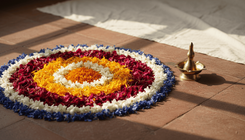
Onam is one of South India's most loved festivals, celebrated across Kerala and beyond with joy and colour. At its heart lies the legend of King Mahabali—a devoted asura ruler whose reign was so righteous and beloved that his people asked the gods to let him return to them once each year. That return, celebrated with flower arrangements, feasts and ritual, is what Onam honours.
The festival is not, as some might think, a celebration of a victory over evil. Mahabali was not evil. He was a just and generous king whose people flourished under his rule. Yet he poses a problem that matters deeply in Hindu philosophy: a good and capable ruler who does not follow the dharma of the gods, and must therefore be brought to heel. Understanding that tension—and how Onam resolves it—opens the meaning of the festival.



The Story of Mahabali's Rise and Fall
Mahabali was an asura—a being whose power rivals that of the gods. Yet unlike many asuras in the scriptures, he is remembered as righteous. Under his rule, there was no theft, no violence, no deception. Taxes were fair, and all people—whether Brahmin or Shudra—prospered equally. His subjects loved him genuinely. They ask the question that unsettles the gods: why should we fear or obey the gods when Mahabali rules us so well?
This prosperity troubles Indra and the other deities. Mahabali grows more powerful with each passing year, and his devotion to dharma has won the respect even of the wise. The gods cannot topple him through force or cunning. So they turn to Vishnu. In his fifth avatar, as Vamana—the Dwarf—Vishnu comes to test the king.
Vamana, appearing as a small boy, approaches Mahabali and asks for a gift. In keeping with the dharma of kingship, Mahabali promises to grant whatever the boy desires. Vamana asks for three paces of land, measured by his own steps. Mahabali agrees, amused. As Vamana grows to cosmic size, his first step spans the earth, his second the sky, and his third reaches the underworld. Mahabali has nothing left to give, so he offers his own head. Pleased by the king's selflessness and steadfast dharma even in defeat, Vishnu grants him a boon: he will not be forgotten. His subjects will celebrate his memory every year, and he will be allowed to return to his beloved people once each year to see that they are well.
That annual return is Onam.
Why the Gods Needed to Act
In Hindu philosophy, the gods and the asuras represent different principles. The gods are guardians of dharma and order, while asuras typically embody power and desire. Mahabali is the rare asura who seems to embody dharma itself, which creates a puzzle: if dharma is being upheld, why intervene?
The answer lies in Mahabali's nature as an asura. No matter how just his rule, an asura cannot ultimately serve the cosmic order in the way a devata—a divine being aligned with the gods—can. Mahabali's very existence, however virtuous, represents a kind of imbalance. The gods are not punishing him for cruelty, but restoring what they see as the proper hierarchy. In this reading, Vamana's victory is not about good defeating evil, but about the maintenance of cosmic order.
This is why Onam does not celebrate Vamana's triumph as a battle won. Instead, it commemorates Mahabali's nobility. He accepted his defeat with grace, asked for nothing for himself, and earned through his steadfastness the greatest gift: to live eternally in his people's hearts.
The Customs of Onam: Pookalam and Sadya
Onam is celebrated over ten days, traditionally beginning in late August or early September and determined by the lunar calendar. The festival is marked by several beloved customs, most prominent among them the creation of pookalam and the preparation of the Onam sadya.
Pookalam—the flower carpet—is the visual heart of Onam. In homes and temples, bright flowers are arranged in elaborate circular patterns on the floor, layer upon layer, growing larger each day of the festival. Pookalam is not fixed or rigid; each family creates their own design. The flowers—marigolds, jasmine, hibiscus and others—are living and fresh, and the daily renewal of the pookalam, which is replaced each morning, carries a spiritual meaning: the impermanence of all things, and the beauty that lies in creating anew. Some say the pookalam is an offering to Mahabali as he walks through homes unseen, blessing his subjects.
The Onam sadya—sadya means feast—is a traditional vegetarian meal served on banana leaves. It includes curry made with vegetables and pulses, papad, pickles, rice, and payasam, a milk-based dessert. The sadya is eaten communally, often with family and neighbours. In some homes, the meal is prepared with particular care during Onam, honouring both the festival and the tradition of hospitality that marks Mahabali's own just rule.
Other customs include singing the onavilladis, or Onam songs, which tell the story of Mahabali and the gods, and playing kaikottikali—a traditional clapping game that involves rhythmic movement and hand-clapping, often performed in groups. These customs vary by region; some areas emphasise boat races or plays, while others focus on the pookalam and prayer.
Onam Across Kerala and Beyond
Onam is celebrated most vibrantly in Kerala, particularly among Malayali Hindus, but the festival has significance across South India and among Malayali communities worldwide. The exact dates and customs vary by location and family tradition, and some celebrations follow the Malayalam calendar month of Chingam, while others align with astronomical events determined by the Panchanga—the Hindu calendar.
In Kerala, particularly in Ernakulam and Kottayam districts, some of the region's biggest celebrations see thousands gathering for processions, races, and communal feasts. Yet Onam remains equally meaningful in homes where the pookalam is modest, and a small meal is shared. The festival does not require grandeur to hold its significance; what matters is the act of remembrance and the values—justice, generosity, and love of one's people—that Mahabali represents.
What Onam Teaches
Onam is unusual among Hindu festivals in that it celebrates a figure who was defeated. Yet this is precisely why it matters. Mahabali's story teaches that dharma is not simple virtue rewarded with victory, but sometimes a deeper principle of cosmic order. His nobility lay not in winning, but in accepting his fate with grace, and in earning love from his people that outlasted his reign.
For those who celebrate, Onam is an occasion to remember and embody the values Mahabali represented: fairness, generosity and protection of all who depend on you. The pookalam is created fresh each day because beauty and goodness must be renewed. The sadya is shared because a ruler is only as good as the wellbeing of those he serves. And the ten days of celebration keep alive the memory of a king who asked nothing for himself, yet earned a place in the hearts of his people forever.
Common questions
How long does Onam last?
Onam is celebrated over ten days, traditionally beginning in late August or early September. The exact dates shift each year according to the lunar calendar and the Malayalam month of Chingam, which is determined using the Panchanga.
Why do people make a new pookalam every day during Onam?
The daily renewal of the pookalam carries spiritual meaning: it represents the impermanence of all things and the beauty that lies in creating anew each day. Some say it is also an offering to Mahabali as he returns to walk unseen through homes, blessing his subjects.
What makes Mahabali's story different from other asura tales in Hindu mythology?
Unlike many asuras, Mahabali is remembered as a just and righteous ruler. His subjects loved him genuinely, and the gods did not defeat him for cruelty or evil, but because his power as an asura—however virtuous—represented an imbalance in cosmic order that needed to be corrected.

Related Articles


