
The Nine Forms of Durga Worshipped During Navratri
Each day, a different strength.

Kushal K
08 Nov 2026 • 6min
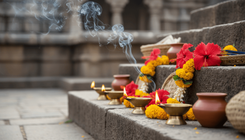
During Navratri, the nine-day festival of the Devi, worshippers honour the nine forms of Durga, each one embodying a particular aspect of divine power. Over the course of the festival, you encounter these forms in sequence, so that by the ninth day you have moved through the full spectrum of the Devi's strength: her power to protect, to destroy, to nurture and to transform.
The nine forms are known as Navadurga, and their names and qualities have been passed down through regional and scriptural traditions, though the names and the order can vary depending on which tradition you follow. What remains constant is the principle that each form represents a dimension of shakti—divine feminine power—that we need to cultivate in ourselves, and that the Devi embodies in her fullness.



Shailaputri and Brahmacharini
The first form, Shailaputri, is the daughter of the mountain. She is associated with stability and the foundation upon which all else rests. In some tellings, Shailaputri is the first incarnation of Durga in this cosmic cycle, born to the mountain king Himalaya. She is worshipped to establish roots and to begin the journey of devotion with grounding and purpose.
The second form, Brahmacharini, represents the tapasya or discipline of spiritual practice. Where Shailaputri is the ground, Brahmacharini is the seeker walking the path. Her name points to the way of the brahmachari, the devoted student. She embodies patience, austerity and the strength to persist through difficulty. In worship, Brahmacharini is invoked to deepen focus and to strengthen the will.
Chandraghanta and Koosmanda
Chandraghanta, the third form, wears the moon as a bell upon her forehead. She is dynamic and radiant, the warrior who is swift to act against untruth. She is also a healer and protector of children. Where Brahmacharini is inward discipline, Chandraghanta is outward luminosity and courage. She destroys demons—obstacles and illusions—with fearlessness.
Koosmanda, the fourth form, is radiant like the sun itself. Some accounts give her name as deriving from cosmic light, the energy at the centre of creation. She is maternal and nourishing, and is said to dwell in the hearts of all beings. Koosmanda is called upon for abundance, vitality and the warmth of divine grace. She rides upon a lion, and is often depicted holding the earth in her palm like a grain of sesame.
Skandamata and Katyayani
Skandamata is the mother of Skanda, also known as Murugan, the god of war and wisdom. She represents the protective love of the mother, fierce in defence of her child. She is the fifth form, and her worship calls forth the strength of unconditional care. She sits upon a lion and holds her child in one arm while remaining ready for battle.
Katyayani, the sixth form, is the warrior born to fulfil a destiny. According to tradition, she was created by the gods when they needed a champion to defeat the buffalo demon Mahishasura. Katyayani is the form of Durga most explicitly linked to the central story of Navratri—the victory over Mahishasura. She is fearless, strategic and unstoppable. Her worship grants the courage to face one's greatest challenges.
Kali and Mahagauri
Kali, the seventh form, is the most intense of the Navadurga. Dark and unbounded, she dances on the corpse of ego. She represents destruction, not as an end but as a clearing, as the dissolution of what no longer serves. Kali is often misunderstood by those outside the tradition, but within Sanatan Dharma she is beloved as the ultimate liberator. She is worshipped to burn away illusion, fear and attachment. Her fierce compassion is the love that cuts away falsehood.
Mahagauri, the eighth form, is the spotlessly white one, serene and gentle. After the intensity of Kali, Mahagauri represents peace, clarity and the purity that remains after destruction is complete. She is both compassionate and wise. Mahagauri is approached for forgiveness, for inner peace and for the grace to move forward unburdened. She rides a white bull and carries weapons, so that her gentleness is paired with strength.
Siddhidatri and the Return
The ninth form, Siddhidatri, is the giver of all spiritual perfections and supernatural gifts. She sits upon a lotus and grants the eight siddhis—the eight powers of transformation and realisation. Siddhidatri represents the culmination of the nine days: the integration of all that came before into a state of completeness and liberation.
Each form of Durga contains all the others, but by encountering them one by one during Navratri, you learn to access each quality when it is needed. Devotees often keep a small image or a picture of the nine forms in their home altar or carry them in their mind's eye through the nine days. Some visit temples dedicated to each form in turn, or recite the Devi Mahatmya, the scripture that recounts her victories. The practice is not about worship of separate goddesses but about recognising the many dimensions of the singular divine power that sustains all existence.
As Navratri closes and you enter the tenth day, Vijayadashami, the festival of victory, the nine forms merge back into the one. The Devi is whole again, and you carry forward the strengths you called upon and the clarity you gained.
Common questions
What order are the nine forms of Durga worshipped in Navratri?
The nine forms are worshipped in sequence over the nine days: Shailaputri (day 1), Brahmacharini (day 2), Chandraghanta (day 3), Koosmanda (day 4), Skandamata (day 5), Katyayani (day 6), Kali (day 7), Mahagauri (day 8), and Siddhidatri (day 9). However, the order and names can vary between different regional traditions and texts.
Why are there nine forms of Durga and not just one?
The nine forms represent different aspects of shakti, or divine power. Each one teaches a quality needed for spiritual growth: grounding, discipline, courage, nourishment, protection, warrior strength, dissolution of ego, peace, and perfection. Together, they show that the single Devi contains the full spectrum of what creation needs.
Can I worship the nine forms of Durga outside of Navratri?
Yes. While Navratri is the main festival dedicated to the Navadurga, you can honour these forms at any time. Some devotees keep images of all nine at home, recite their names as a daily practice, or visit temples dedicated to each form. The Devi Mahatmya can also be read throughout the year to deepen this worship.

Related Articles


