
The Narayanastra: Ashwatthama's Weapon in the Mahabharata
Divine Fire That Brought the War to Its End

Aditya Pandey
01 Nov 2026 • 6min
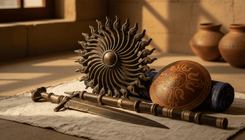
The Narayanastra holds a unique place in the Mahabharata's arsenal of divine weapons. Ashwatthama, the son of Drona and one of the last surviving commanders of the Kaurava army, deployed this weapon during the final hours of the war. To understand why, you need to know what had led him to that moment: the death of his father, the collapse of Kaurava resistance, and the urgency of a commander who felt he had nothing left to lose.



What Was the Narayanastra?
The Narayanastra was a celestial weapon bestowed by Nara and Narayana—described in Hindu tradition as incarnations or aspects of divine force—upon Ashwatthama's father, Drona. Unlike other astras (weapons) that could be summoned through mantras and meditation, the Narayanastra had a distinctive quality: it was said to multiply infinitely as it encountered resistance. The more force met it, the more the weapon multiplied. It was not a weapon of precision but of overwhelming devastation, a last resort when victory through conventional means had already slipped away.
In the Mahabharata, only a handful of warriors possessed celestial weapons. Arjuna had the Pashuparastra. Karna possessed several astras, including the Nagastra and the Vasavi Shakti. Drona had the Narayanastra, and when he fell in battle, Ashwatthama inherited his knowledge of it. That inheritance would define the final act of the war.
The Crisis That Led to the Narayanastra
By the time Ashwatthama considered using the Narayanastra, the Kaurava cause was collapsing. Karna had died at Arjuna's hands. Duryodhana lay dying on the battlefield. The Kaurava generals were being picked off one by one. Ashwatthama himself had been wounded multiple times. The Pandavas, despite their losses, still had the numbers and the momentum.
What finally pushed Ashwatthama to the weapon was a moment of profound humiliation and rage: the death of his father, Drona, not in fair combat but through deception. Yudhisthira's army had spread the rumour that Ashwatthama had been killed, causing Drona to lose the will to fight and lay down his arms. Unprotected, he was then slain. For Ashwatthama, this was both an unbearable loss and a stain on honour. After Drona's death, Ashwatthama assumed command of the Kaurava forces, but he was inheriting a war already lost.
On the night after Drona's fall, with the Kaurava forces scattered and the Pandava camp vulnerable in darkness, Ashwatthama saw an opening. He led a small night raid into the sleeping Pandava encampment. It was in this night assault, finding himself facing overwhelming odds and with no path to victory, that Ashwatthama resolved to use the weapon he had inherited from his father.
How the Weapon Was Deployed
According to the Mahabharata, Ashwatthama summoned the Narayanastra and aimed it at the Pandava forces. The weapon descended upon the sleeping army like a celestial fire, spreading and multiplying as warriors attempted to resist it. The text describes warriors rushing to fight it, only to find the weapon growing stronger with each blow they struck.
The multiplication of the weapon proved impossible to counter through conventional combat. Even the great Arjuna, despite his prowess, could not defeat it by fighting back. What finally subdued the Narayanastra was not courage or martial skill but dharma itself—or specifically, a form of complete surrender. According to the account, when Arjuna and the Pandavas ceased to resist and instead appealed to Krishna for mercy, the weapon's power began to wane. Krishna instructed them to remain completely still, to resist it no further, and the Narayanastra's multiplying force had nothing left to feed upon.
The Limitations of Divine Power
The use of the Narayanastra reveals something important about celestial weapons in the Mahabharata: they are not absolute, and they cannot overcome dharma. Ashwatthama had wielded the mightiest weapon available to him, yet it could not change the fundamental outcome of the war. The Kaurava cause had been unjust—founded on greed, maintained through deception, and sustained by the desire to exclude the rightful Pandavas from their kingdom. No weapon, however divine, could transform that.
In fact, Ashwatthama's use of the Narayanastra is sometimes understood as a violation of the codes of war. A night attack on a sleeping army, followed by the indiscriminate use of a multiplying celestial weapon, was seen even by his own side as a crossing of boundaries. It was an act of desperation, not honour.
The Weapon's Legacy
The Narayanastra has echoed through Hindu tradition as a symbol of power that transcends ordinary limits, yet remains subject to the larger forces of justice and truth. It stands in contrast to Arjuna's weapons, which he used within the bounds of duty and righteousness. The weapon itself was not evil, but its use by Ashwatthama—born from rage and desperation rather than from righteous duty—marked it as the weapon of a cause already lost.
For those who study the Mahabharata, the Narayanastra raises a question that the epic returns to again and again: does power determine the outcome of events, or does truth? The war was already decided not by weapons but by the weight of justice. Ashwatthama's desperate gambit with the Narayanastra was, in that sense, an answer to a question already answered.
Common questions
Why couldn't Arjuna defeat the Narayanastra with his own weapons?
The Narayanastra grew stronger when warriors resisted it with force. Arjuna could not overcome it through combat because the weapon multiplied with each strike. It was only subdued when Arjuna and the Pandavas stopped fighting back and appealed for mercy instead.
Was Ashwatthama's use of the Narayanastra considered dishonourable?
Yes, many texts regard the night raid and use of the weapon as crossing the boundaries of righteous warfare. Deploying a weapon of mass destruction against a sleeping army, rather than in direct combat, was seen as a violation of the codes that governed the war.
Did the Narayanastra change the outcome of the Mahabharata?
No. Although the weapon caused great devastation in the night raid, it did not alter the Kaurava defeat or win back the war. The fundamental injustice of the Kaurava cause meant that no weapon could reverse the outcome already determined by dharma.

Related Articles


