
The Meaning of Lakshmi's Footprints at Diwali
Where Prosperity Walks into the Home

Abhilash Ramakrishna
04 Nov 2026 • 6min
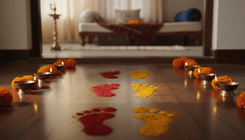
During Diwali, many households draw or paint Lakshmi's footprints leading into the home. These red or yellow footprints—called Lakshmi paadukha or pada chinh—are far more than decoration. They represent an invitation, a welcome, and a prayer. The footprints tell a story: they show where the goddess of wealth and prosperity has walked, blessing the threshold and carrying abundance inside.
This custom sits at the heart of how many people observe Diwali. It turns the festival from something external—fireworks, sweets, gifts—into something intimate. You are saying to Lakshmi: *this house is ready to receive you*. In doing so, you acknowledge that abundance is not something that arrives on its own. It arrives through intention, cleanliness, beauty, and spiritual readiness. The footprints are both an invitation and a reminder.



Why footprints matter in Hindu practice
In Hindu thought, footprints carry spiritual weight. To follow in someone's footsteps means to inherit their path and their blessing. The feet are also the point of contact between the earth and the body—the grounding place. When you draw Lakshmi's footprints, you are creating a physical trace of her movement through your home, as if she has truly walked through your door.
Lakshmi is not confined to temples or distant heavens. She moves through the world, choosing which homes to visit and which families to favour. The footprints acknowledge this: they show her arrival. They also reflect an older understanding of prosperity. In agricultural societies, the monsoon arrived in visible patterns—the tracks of oxen in fields, the prints of cattle moving to water. Lakshmi's footprints draw on this real-world image of movement and presence. Prosperity comes through motion, through action, through feet meeting the earth.
The footprints also speak to the act of crossing a threshold. In many traditions, thresholds are sacred spaces where blessing must be invited. You do not assume the goddess will enter; you draw a path to show where she is welcome.
How the footprints are drawn
The footprints are typically drawn using red ochre, turmeric paste, or rice flour mixed with colour, beginning from the front door or entrance and leading inward toward the prayer space or the centre of the home. Some households extend them all the way to the family shrine or the pooja room. The footprints usually follow a path that makes sense in the layout of the home—curving upstairs, around corners, as if Lakshmi is truly walking through the rooms.
Each footprint is shaped like a human foot, though some variations show stylized lotus flowers instead, since Lakshmi traditionally sits on a lotus. The toes point forward, showing direction and motion. The footprints are often decorated with coloured rice, flowers, or small dots made with vermillion (sindoor). In some regions, people add patterns or auspicious symbols around the footprints—diyas (oil lamps), rangoli designs, or flowers pressed into the material while it is still damp.
The act of drawing the footprints is itself a ritual. The person drawing them—often the woman of the household, but any adult family member—is focused and present while doing so. The floor is cleaned thoroughly first. Many households draw the footprints fresh on Diwali day or the day before, though some maintain them throughout the festival period. The work is careful, purposeful, and meditative. You are preparing a path for the divine.
Regional and family variations
Different regions express this custom in their own way. In many parts of North India, particularly in Uttar Pradesh, Maharashtra, and Madhya Pradesh, drawing Lakshmi's footprints is a common household practice. In South India, the emphasis sometimes falls more on writing her name or drawing her symbols. In Gujarat, the footprints may be drawn with particularly elaborate decoration and bright colours.
Within families, the custom evolves. Some households use fresh henna or mehendi to draw them, especially where mehendi is already part of the Diwali preparation. Others use turmeric, which carries its own auspicious significance. The materials available, the space of the home, and family tradition all shape how the footprints look. There is no single rigid form. What matters is the intention: the footprints are an act of welcome and readiness.
Some families draw the footprints only at the door, while others create an entire path through the house. Some use a single colour; others layer them with flowers and rangoli around them. The custom has evolved too: some households now use stencils to create uniform, detailed footprints, while others keep the practice simple and unpainted. All these variations are valid.
The footprints as a daily reminder
Once drawn, Lakshmi's footprints remain visible throughout the home—at least until they gradually wear away or fade. During this time, they serve as a daily reminder of your intention. Each time you walk past them, you are walking in Lakshmi's footsteps. You are reminded that prosperity is not distant or abstract; it walks through your home. It moves alongside you.
The footprints also invite others to see your readiness. When guests arrive for Diwali celebrations, they see the footprints and understand immediately that the home is prepared spiritually, not just practically. The invitation has been extended and the welcome is clear. There is an honesty in this gesture: you are saying that abundance matters to your household, and that you are willing to invite it in and to create the conditions for it to stay.
Drawing the footprints is ultimately an act of faith paired with preparation. You are not waiting passively for prosperity to arrive. You are cleaning your home, tending to its beauty, drawing an explicit welcome, and stepping onto the path yourself. Lakshmi's footprints remind us that we too must move—toward our goals, toward service, toward growth. The footprints show her path, but our own feet must follow.
Common questions
What colour should Lakshmi's footprints be?
The footprints are typically drawn with red ochre, turmeric paste, or rice flour mixed with colour—red and yellow are most common. Some households use henna or other materials available to them. There is no single rule; what matters is that the colour is visible and the work is done with intention. Some families have their own tradition passed down through generations.
Is it necessary to draw the footprints all the way through the house?
No. Many households draw them from the front door to the prayer room or shrine, while others keep them only at the entrance. Some extend them throughout the home. The practice adapts to the size and layout of your house and your family's custom. What matters is the welcome itself, not the distance travelled.
When should I draw Lakshmi's footprints—before or after Diwali prayers?
Most households draw them before the Lakshmi puja (prayer ceremony) or on Diwali day itself, as a preparation and invitation. Some draw them the day before. They are typically drawn after the home is cleaned and prepared. Once drawn, they remain visible through the festival period until they gradually fade or wear away.

Related Articles


