
The Mahishasura Legend: How Durga Defeated the Buffalo Demon
Strength Rising Against Tyranny

Kushal K
20 Nov 2026 • 6min
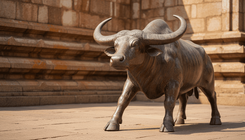
The mahishasura legend is one of the most celebrated stories in Hindu mythology, told and retold during Navratri, the nine-day festival dedicated to Durga, the supreme feminine power. The story is not simply a tale of good defeating evil—it is a meditation on courage, sacrifice and the triumph of dharma, right order, over adharma, chaos and unrighteousness.



The Demon's Rise to Power
Mahishasura was a powerful asura, a being of immense strength and cunning, born from the union of a demon and a buffalo. From his buffalo father he inherited a form that could shift between that of a buffalo and that of a man, making him nearly impossible to defeat in battle. For ages he performed tapasya, rigorous spiritual practice, to win a boon from Brahma, the creator god.
When Brahma finally appeared, satisfied by Mahishasura's devotion, the demon asked for a boon that he believed would make him invulnerable: that no man or god could kill him. Brahma granted it. Armed with this protection and his own formidable power, Mahishasura began to terrorise the worlds. He invaded heaven itself, defeated the gods in battle, and drove them from their home. The devas—the celestial beings—were forced to flee, and Mahishasura claimed dominion over all three realms: earth, sky and the underworld.
The Gods Call Upon Durga
Desperate and defeated, the gods gathered together. Vishnu, Shiva, Brahma and all the other deities combined their energies and consciousness into a single, radiant form. From this divine union emerged Durga, the invincible goddess, fierce and luminous. She was not born as a child but appeared fully armed and ready for battle, embodying all the shakti, the creative and destructive power, of the divine.
The gods gave Durga their own weapons as offerings. Shiva gave her his trident. Vishnu gave her his discus. Indra, lord of storms, gave her his thunderbolt. Each deity contributed their power to her. Equipped with these weapons and filled with divine purpose, Durga rode to meet Mahishasura on a lion, her vahana, or divine vehicle.
The Battle Unfolds
What followed was a fierce, prolonged battle that lasted nine days and nights. Mahishasura used every weapon and trick at his command. He shifted between his buffalo form and his human form, growing larger and more terrifying with each transformation. He summoned demons to fight alongside him. Durga matched him in combat with skill, courage and unshakable resolve.
In his buffalo form, Mahishasura would shake the earth with his charge. When Durga drove him back, he would shift to his human form and attack from a new angle. This transformation became his strategy for survival: by constantly changing shape, he hoped to confuse the goddess and escape the terms of his boon, which specified that no man or god could kill him. A buffalo, he reasoned, was neither man nor god.
But Durga saw through his deception. She recognised that his power lay not in any single form but in his refusal to submit to dharma. On the ninth day of battle, as Mahishasura charged at her in his true buffalo form, Durga drew her bow and released an arrow that pierced his heart. In his final moments, Mahishasura could no longer hold his form. He reverted to his demon self and fell.
Why This Story Matters Now
The mahishasura legend is more than ancient history. It speaks to something timeless in human experience: the struggle between forces that protect and forces that destroy, between those who submit to the natural order and those who seek to dominate it through deception and force.
Mahishasura's boon—his belief that no man or god could harm him—represents a kind of spiritual arrogance. He thought he had found a loophole in the cosmos, a way to be safe from consequence. What he did not understand was that power without wisdom becomes tyranny, and that the universe itself will eventually restore balance. Durga represents the intelligence and justice that maintain that balance.
This is why the story is central to Navratri, which is observed during the month of Chaitra (March-April) or Ashwin (September-October), depending on the regional tradition. During these nine days, devotees celebrate Durga's victory by worshipping her in her many forms. They fast, perform rituals, sing songs of her glory, and make offerings at temples. In doing so, they are not just remembering a victory that happened long ago—they are invoking that same divine strength within themselves, calling upon their own capacity to face what is difficult and refuse what is wrong.
The Eternal Cycle
The mahishasura legend also teaches that this victory is not a one-time event but part of a cycle. In some tellings of Hindu mythology, Mahishasura is said to be reborn again and again, representing the eternal return of chaos and disorder. Durga too returns, fighting the same battle in each age. This is not a pessimistic view but a realistic one: the work of protecting dharma is never finished. It requires constant vigilance, constant courage, and a willingness to face what threatens the good again and again.
For this reason, the story remains alive in devotional practice across India. It is told in homes, sung in temples, and enacted in dramatic performances called ramlila. Every Navratri, it is remembered and celebrated anew, keeping alive the understanding that the sacred and the good are not passive or distant, but active and present, ready to defend what is right.
Common questions
Is the mahishasura story told the same way in every region of India?
The core story remains consistent across India, but regional traditions and scriptures emphasise different details. The Devi Mahatmya, a Sanskrit text, is the most widely known source, but local versions may highlight different aspects of Durga's victory or Mahishasura's character.
Why did the gods not defeat Mahishasura themselves before creating Durga?
Mahishasura's boon protected him specifically from any man or god. Since he was already powerful enough to defeat all the gods individually, only a goddess—who is neither man nor god but pure shakti—could overcome him. This is why the gods had to combine their power into Durga's form.
How long does Navratri last and when should I observe it?
Navratri lasts nine days and is observed twice a year: Chaitra Navratri in March-April and Ashwin Navratri in September-October. Ashwin Navratri is more widely celebrated. The exact dates follow the lunar calendar, so they shift each year. Check your regional calendar or temple for the specific dates in your area.

Related Articles


