
The Kumbh Mela: What the Legend of the Nectar Pot Means
When the ocean churned, divinity spilled earthward

Abhilash Ramakrishna
10 Nov 2026 • 7min
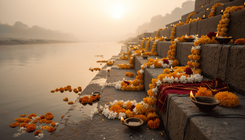
The Kumbh Mela is the world's largest pilgrimage, yet most people who hear of it know only the spectacle: the photographs of millions bathing in sacred rivers, the vast temporary cities, the ashes of sadhus. But the Kumbh Mela's true meaning lies in its mythology. The festival commemorates a moment when the divine became accessible to all, and it is celebrated in response to an old cosmic story about creation, sacrifice and the recovery of something sacred that was almost lost.
The meaning of Kumbh Mela rests on a single act from ancient mythology. According to the Bhagavata Purana and other sacred texts, the gods and demons once churned the cosmic ocean together to recover amrit, the nectar of immortality. As they pulled and pushed, friction created a great pot—the kumbh—and it was from this pot that amrit emerged. During the churning, drops of this immortal nectar fell to earth at four sacred locations: Haridwar on the Ganga, Ujjain on the Shipra, Prayagraj on the confluence of the Ganga and Yamuna, and Nasik on the Godavari. The Kumbh Mela is held in rotation at each of these four places, spaced several years apart, to mark the spots where divinity touched the earth.



The Four Places and the Cosmic Story
Each of the four Kumbh sites traces its sanctity to that mythological moment. Haridwar—the gateway to the gods—sits where the Ganga descends from the Himalayas and reaches the plains. Ujjain holds the memory of a battle between gods and demons over the kumbh itself. Prayagraj, the place of union, is where three rivers meet (the Yamuna joins the Ganga and the invisible Saraswati flows below). Nasik guards the riverbank where legend says Lakshmi herself bathed in the Godavari's waters.
What ties these places together is the thread of that single moment of cosmic abundance. The amrit that fell at each location was not separate drops but echoes of the same event, the same blessing. In this sense, the Kumbh Mela is not four festivals but one festival repeated, each iteration a return to the original act of the gods' recovery and a remembrance that what was lost can be found again.
The mythology also explains why so many gather. If divinity was poured out at these four spots, then coming to bathe at those times means swimming in grace that has already been placed there. The water itself is understood as carrying something sacred—not metaphorically, but as a real inheritance from that mythological past. This is why the bathing at the Kumbh Mela is not simply ritualistic or cultural but soteriological: it is meant to transform, to heal, to grant liberation.
When the Kumbh Melas Occur
The Kumbh Melas are timed by astrology and the lunar calendar. The Maha Kumbh (the great Kumbh) comes to each of the four places once every 144 years. More frequently, an Ardh Kumbh (half-Kumbh) is held at Haridwar and Prayagraj every 6 years, and a Kumbh Mela proper occurs at each site roughly every 12 years, though the exact intervals vary by location. The timing depends on the positions of the sun, moon and Jupiter in relation to the nakshatras (lunar mansions), calculated according to Jyotisha, the Vedic science of time.
The specific dates shift each year because they follow the lunar calendar rather than the solar one used in the wider world. So the Kumbh dates are announced in advance but tied always to astrological conditions rather to fixed numbers on a calendar. Millions of pilgrims coordinate their journeys around these astronomical moments, treating the turning of the heavens as a call to gather.
The Bathing and What It Means
The centerpiece of the Kumbh Mela is the ritual bathing, or snan. This is not a casual dip but a deliberate immersion, usually timed to specific auspicious hours. Many pilgrims come from great distances and wait for the exact moment when the astral conditions are deemed most favorable—these moments are among the busiest, which is why the Kumbh is known for the massive gatherings and the occasional tragedies that have marked crowded bathing.
Bathing at the Kumbh is understood as moksha—liberation—or at least as a crucial step toward it. The sacred geography matters: you are not simply bathing in any river but in a river at the exact spot where amrit fell. Time matters too: you are bathing when the cosmos is aligned in a particular way, when celestial bodies have returned to an auspicious configuration. The tradition holds that the combination of place and time creates a window of grace through which purification and spiritual transformation become possible.
Different segments of the pilgrimage communities bathe on different days, and this too is part of the meaning. Monks and ascetics often bathe first, followed by the brahmin priests and scholars, then householders and the wider public. The order reflects not hierarchy but the idea of collective purification: the spiritual energy of those furthest along the path is believed to sanctify the waters for all who follow. In this way, the Kumbh Mela is structured as a ritual of transmission, where the accumulated spiritual practice of renunciates and priests blesses and enables the spiritual life of ordinary practitioners.
The Festival as Sacred Time and Sacred Geography
The Kumbh Mela works on two registers simultaneously. It is an outer, historical event: a vast pilgrimage where devotees travel, bathe, eat prasad, camp in temporary settlements, and return home changed. But it is also an inner, mythological event: a return to the moment when the gods recovered what was lost. Every ritual action at the Kumbh points beyond itself to that cosmological story.
This is why the Kumbh Mela has not faded as Indian society has modernized. It is not a museum piece or a tradition maintained only because it is old. It remains alive because the mythology still explains why one would go, and why one would go at this particular time and place rather than another. The Kumbh Mela is meaning crystallized into geography and calendar, a way for pilgrims to step out of ordinary time and into mythic time, to bathe not only in water but in significance.
For those who cannot attend in person, the deeper meaning lies in the principle itself: that grace is accessible, that what was lost can be recovered, and that gathering with others in faith amplifies that recovery. The Kumbh Mela is both a literal pilgrimage and a model for spiritual practice itself.
Common questions
Why are there four different Kumbh Melas at four different places?
According to mythology, drops of amrit fell at four locations when the gods and demons churned the cosmic ocean. Each place—Haridwar, Ujjain, Prayagraj and Nasik—received these divine drops, so each is held sacred. The Kumbh Melas rotate among all four sites rather than always gathering in one place.
How often is each Kumbh Mela held?
The Maha Kumbh (great Kumbh) comes to each location once every 144 years. More frequently, a Kumbh Mela occurs at each site roughly every 12 years. Additionally, an Ardh Kumbh (half-Kumbh) is held at Haridwar and Prayagraj every 6 years. The exact timing depends on Jupiter's position in the zodiac, calculated according to Jyotisha.
What is the spiritual significance of bathing at the Kumbh Mela?
Bathing at the Kumbh is believed to offer moksha (liberation) or bring the pilgrim closer to it. The meaning comes from bathing at a place where amrit fell, at a time when the cosmos is astrologically aligned in a particular way. This combination is said to create a window of spiritual grace through which purification and transformation become possible.

Related Articles


