
The Kumbh Mela: The Legend of the Nectar Pot
Divine Nectar Spilled Across India's Holiest Shores

Aditya Pandey
09 Nov 2026 • 7min
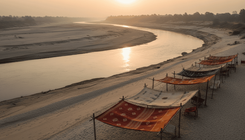
The Kumbh Mela is the world's largest gathering of pilgrims, held every twelve years at one of four sacred riverbank sites in India. Its meaning rests on one of Hinduism's most recognisable stories: the kumbh, or pot, that spilled nectar of immortality across the earth. To understand what draws millions to these sites is to know where the kumbh came from and why those particular four rivers matter.
According to Hindu scripture, the gods and demons once worked together to churn the ocean of milk, called samudra manthan. They sought amrita, the nectar of immortality that lay at the bottom of the cosmic ocean. Using Mount Mandara as a churn and the serpent Vasuki as a rope, they churned for a thousand years. When the nectar finally emerged, the gods fled with the pot to keep it from the demons, and during their escape, drops of amrita fell to earth at four sacred locations.
These four places became the sites of the Kumbh Mela: the Ganges at Haridwar in Uttarakhand, the Yamuna at Allahabad in Uttar Pradesh, the Shipra at Ujjain in Madhya Pradesh, and the Narmada at Nashik in Maharashtra. Each location is believed to hold the spiritual essence of the original nectar. The vast gatherings that happen there, lasting weeks or months, are rooted in the belief that bathing in these waters at the right cosmic moment brings spiritual purification and closer union with the divine.



The Story Behind the Pot
The kumbh story appears in several texts, most notably the Bhagavata Purana and the Mahabharata. In these tellings, the struggle for amrita represents the eternal tension between divine forces of preservation and forces of chaos. Neither side acts alone or with pure motives; both gods and demons desire the nectar, and the outcome matters not just for immortality but for the cosmic balance itself. This is why the story remains so central to Hindu understanding of dharma, the principle of righteous order that governs the universe.
The four locations where drops fell are themselves sacred independently of the Kumbh Mela. Haridwar, situated where the Ganges emerges onto the plains, is already considered a place where the river's purifying power is most concentrated. Ujjain holds temples to Shiva that predate the Kumbh tradition by centuries. Yet it is the combined belief that amrita fell at all four sites, and the cyclical return of the pilgrimage calendar, that weaves them into a single spiritual event.
Why It Happens Every Twelve Years
The interval between Kumbh Melas at each site follows an astrological calculation based on the movement of Jupiter through the zodiac. In Vedic astrology, or jyotisha, Jupiter's twelve-year orbit marks a complete cycle through the zodiacal houses. The Kumbh is held when Jupiter reaches a specific position relative to the sun and moon at each of the four rivers. This is not a human choice but a celestial alignment that repeats in a predictable pattern.
Because Jupiter takes twelve years to complete its cycle, each of the four sites hosts the Kumbh once every twelve years. The full pattern therefore completes every forty-eight years, with each river receiving pilgrims on its own twelve-year schedule. Within this larger cycle, some sites also hold smaller gatherings known as Ardh Kumbh, or half Kumbh, at intervals when Jupiter reaches an intermediate position. Understanding the Kumbh's timing is to understand that the pilgrim's calendar, like much in Hindu practice, is written in the movements of the heavens.
The Gathering and What It Means
When a Kumbh Mela is announced, pilgrims begin their journey months in advance. The riverbank transforms into a temporary city of millions. Sadhus, or renunciate monks, camp beside families. Vendors sell offerings and necessities. The rhythm of the gathering follows ritual and devotion: sacred baths are taken at auspicious moments determined by jyotisha, processions move through the crowds, temples are erected and dismantled.
For those who attend, the Kumbh holds multiple meanings. Some come for the promise of spiritual merit that the gathering is believed to carry. Others come to witness the scale of faith itself, to see how millions of strangers share a single belief and move toward a single river in unison. Still others seek the company of spiritual teachers and seekers who also attend. The festival is at once an individual act of pilgrimage and a communal celebration of belonging to a living tradition.
The conditions are often harsh: crowding, heat, inadequate sanitation. Yet this difficulty is not separate from the Kumbh's spiritual significance; many pilgrims understand sacrifice and endurance as part of their offering. The very vastness and inconvenience of the gathering become part of its meaning.
The Four Sites and Their Individual Character
Each Kumbh location carries its own spiritual history and character. Haridwar, where the Ganges flows most powerfully at the start of its descent to the plains, is associated with the goddess Ganga herself. The bathing ghat at Haridwar's Har-ki-Pauri, believed to be where the goddess's feet touched earth, draws pilgrims year-round. Ujjain, in central India, is traditionally linked to the sun god Surya and to Lord Shiva, whose temple Mahakaleshwar is one of the twelve sacred Jyotirlingas. Allahabad, where the Ganges meets the Yamuna, and where pilgrims believe an underground river called the Saraswati also joins, is the point of greatest convergence. Nashik, on the Godavari in Maharashtra, represents the Kumbh tradition as it is observed in southern India, with its own distinct rituals and lineages.
The Kumbh Mela is not a single experience but four parallel observances, each deeply rooted in its landscape and local practice. What unites them is the shared mythology of the spilled nectar and the shared astrological calendar. A pilgrim may attend Kumbhs at different sites across their lifetime and encounter the same essential story told in different regional voices.
To attend a Kumbh Mela, or simply to understand its place in Hindu practice, is to recognise that the tradition sees the sacred not as confined to temples alone but as present in natural landscapes, in water, in time itself. The mela teaches that pilgrimage is not peripheral to spiritual life but a core expression of it: a willingness to journey toward holiness, to join with strangers in shared devotion, and to seek transformation through the act of gathering together.
Common questions
Which Kumbh Mela happens first after the forty-eight-year cycle begins?
The Kumbh Mela does not have a fixed starting point across all four sites. Each site follows its own twelve-year schedule based on Jupiter's movement. At Haridwar, Kumbh Melas typically occur in years when Jupiter is in Aries; at Ujjain when Jupiter is in Leo; at Prayagraj (Allahabad) when Jupiter is in Sagittarius; and at Nashik when Jupiter is in Cancer or Leo, depending on local tradition.
How many people attend a Kumbh Mela?
Attendance varies greatly by site and year, but the largest Kumbh Melas attract tens of millions of pilgrims over their duration. The 2019 Kumbh Mela at Prayagraj drew an estimated 150 million people across several months, making it one of the largest human gatherings on record.
Can I attend a Kumbh Mela even if I'm not Hindu, or not from India?
Most Kumbh Melas are open to all, regardless of faith or origin, though crowds are often very large and conditions can be challenging. If you plan to attend, check current travel advisories and local guidelines, and consider visiting at a less busy period of the festival rather than at peak bathing dates.

Related Articles


