
The Kaliya Mardan Story: Why Krishna Danced on the Serpent's Hood
A child god, a poisoned river, and a lesson in dharma

Kushal K
30 Oct 2026 • 7min
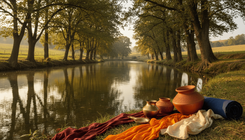
The kaliya mardan story tells of the day Krishna, as a young boy, subdued the serpent king Kaliya who was poisoning the waters of the Yamuna river near Mathura. Krishna danced on Kaliya's many hoods until the great serpent submitted to him, and the waters became pure again. The story is one of the most beloved Krishna leelas, or divine plays, because it shows both the gentleness and the terrifying power of the divine in a single act—and it happens when Krishna is young enough to climb a tree on a whim.
The event is set during Krishna's childhood in Vrindavan, the pastoral region where he was raised by the cowherd Nanda and his wife Yashoda. The Yamuna, the river that ran through this landscape, was essential to the life of the village and the cattle herds. One day, the waters became so toxic that even the touch of them proved fatal. The cows and animals that drank from the Yamuna fell ill or died. The people of Vrindavan were desperate: their river, their lifeline, had become a source of death.
The cause was Kaliya, a many-hooded serpent of immense power. Kaliya had been driven from his home in the ocean by Garuda, the divine eagle, and had taken refuge in the Yamuna. There, safe from Garuda, Kaliya released his venom into the water and made the river his domain. He did not see this as cruelty so much as survival: he was protecting himself in the only way he knew. Yet the cost to the world around him was severe.



How the Confrontation Began
Krishna heard of the poisoning and walked to the river. When he arrived, he climbed a tall kadamba tree on the riverbank and began to sing and play his flute. The music drew Kaliya's attention. The great serpent, accustomed to being feared, rose from the water in fury at the intrusion. His many hoods unfurled like the branches of a dark tree, towering over the land. The serpent's venom dripped from his fangs, and the very ground where his poison fell turned barren and cracked.
But instead of fleeing, Krishna leapt down and landed on Kaliya's central hood. What happened next is described in the Bhagavata Purana and retold across the devotional literature of North India: Krishna began to dance. His feet moved in rhythmic steps, each one pressing down onto the serpent's hood. The dance was not violent in appearance—it had the flow and grace of a ritual or a play—but the weight and power behind it was immense. Kaliya, for all his size and venom, could not throw Krishna off.
The Surrender of Kaliya
As Krishna danced, Kaliya's many hoods began to bleed. The great serpent, who had never been subdued, found himself unable to escape or overcome this small boy. But something more important than physical defeat was happening. The presence of Krishna, the divine power made manifest, began to awaken something in Kaliya. The serpent started to understand that he was in the presence of God.
Kaliya's consorts, the serpent's wives, emerged from the water. They had never seen their lord so humbled. They approached Krishna and knelt, begging him to spare Kaliya's life. They sang his praises and offered him worship, and in that moment of recognition—of the divine being acknowledged as such—something shifted. Kaliya's rage and fear gave way to understanding. The serpent's pride broke, not from the dance itself, but from the realization of what he was facing.
Krishna then asked Kaliya to leave the Yamuna. The serpent agreed and pledged that he would return to the ocean and trouble the waters no more. But he asked Krishna for protection on his journey, for Garuda, the divine eagle who had originally driven him away, might still seek vengeance. Krishna granted this, placing his footprints on Kaliya's hood as a sign of his blessing and protection. With that mark, Kaliya descended into the depths and left the river.
What the Story Teaches
The kaliya mardan is often understood as a tale of good overcoming evil, but the teaching runs deeper. Kaliya was not evil in the way a demon might be. He was a creature defending himself, trying to survive, but in doing so he was poisoning the world around him. His actions—necessary for his survival in his understanding—were still causing suffering to others.
Krishna does not destroy Kaliya. He subdues him, yes, but only to open a path toward understanding. The dancing on the serpent's hoods symbolises the way the divine principle brings order not through annihilation but through the weight of truth and presence. Kaliya's wives worship Krishna not out of fear alone but out of a genuine recognition. They see the divine made visible, and that sight changes them.
The story also reflects Krishna's role as a protector. The cowherd community of Vrindavan is safe because he acts. The river becomes pure again. But the protection Krishna offers is not a sign of dominance to be feared—it is a form of grace. He even blesses Kaliya with protection so that the serpent can continue to live elsewhere. The divine principle, in this reading, is not simply about winning but about restoring balance and allowing all creatures to find their rightful place.
Why This Story Remains Central to Krishna Devotion
The kaliya mardan has been painted, sung, danced and retold for centuries. You will see it in the artwork of temples, in the movements of Kathak dancers, and in the stories still told to children in villages across North India. Its power lies partly in the image itself—the child dancing on the serpent is striking and vivid—but also in what it communicates about dharma, or righteous duty.
Krishna's action in the kaliya mardan is not primarily about strength. It is about responsibility toward those who depend on you. The Yamuna cannot defend itself. The cattle cannot restore their own water source. The cowherd community cannot approach a serpent king and ask for mercy. Only Krishna, with his unique power, can act. The story suggests that the presence of the divine in the world is not distant or abstract—it is engaged, active and ready to address the suffering it encounters.
This is also why the story belongs to Krishna's childhood rather than his later life as a warrior. The kaliya mardan shows the divine not as a king fighting enemies or a warrior in battle, but as a young child willing to leap into danger and dance on a serpent's hood because the river must be clean and the cattle must drink. That image—of playfulness, courage and responsibility combined—remains one of the most recognisable symbols of Krishna across Hindu devotion.
Common questions
What made the Yamuna river poisonous in the kaliya mardan story?
Kaliya, a great serpent driven from the ocean by Garuda the eagle, took refuge in the Yamuna and released his venom into the water. The poison made the river toxic and killed the cattle and animals that drank from it, threatening the survival of the Vrindavan cowherd community.
Is kaliya mardan celebrated as a festival?
Kaliya Jayanti, marking the anniversary of Krishna's victory over Kaliya, is observed in many temples and devotional communities, though the date and manner of celebration vary by region and sampradaya. It is not observed with the same widespread fasting or calendar rituals as other major Krishna festivals.
Does Krishna kill Kaliya in the story?
No. Krishna subdues Kaliya and compels him to leave the Yamuna, but he does not kill the serpent. Krishna even blesses Kaliya with his footprints as protection so that the serpent can travel safely to the ocean and live elsewhere without fear of Garuda.

Related Articles


