
The Holika and Prahlada Story: Why We Celebrate Holi
Fire, devotion, and the triumph of truth

Sunil Chaurasia
08 Nov 2026 • 6min
The holika and prahlada story lies at the heart of Holi, the festival of colour and light celebrated across India and beyond. Before the colours and bonfires, before the sweets and water play, there is a tale of extraordinary faith: a young boy whose devotion to Krishna saved him from his own father's wrath and turned a demon to ash. This story, told in the Bhagavata Purana, explains not only why we light Holika Dahan fires each spring, but what Holi truly means.



The King Who Tried to Kill His Own Son
Hiranyakashyap was a powerful demon king who had won a boon making him nearly impossible to kill. No weapon forged by god or man could harm him, and he had asked for protection from death in every conceivable way. Drunk on this power, he declared himself the supreme being and demanded that everyone in his kingdom worship him alone. But his own son, Prahlada, refused.
Prahlada had become a devoted follower of Krishna from childhood. While other princes were trained in warfare and statecraft, Prahlada spent his time in prayer, chanting mantras and meditating on Krishna's name. To Hiranyakashyap, this was unbearable. A son who rejected his father's authority, who spoke of Krishna instead of bowing to the king—this was intolerable defiance.
Hiranyakashyap tried everything to break his son's faith. He locked Prahlada in a pit of snakes. He poisoned him. He threw him from a cliff. He had him trampled by elephants. Nothing worked. Each time, Prahlada's faith kept him safe. Each torture only strengthened his devotion.
The Test of Fire
Holika was Hiranyakashyap's sister, a demoness with her own fearsome powers. She had received a boon that fire could not burn her. When Hiranyakashyap's other methods failed, he devised a final plan: he asked Holika to take Prahlada into a roaring fire. Surely, he thought, the boy would burn.
Holika agreed. She carried Prahlada into the flames and sat in the heart of the inferno. But as the fire raged around them, something extraordinary happened. The flames leapt and danced, but they did not touch Prahlada. His faith was unshakeable, and Krishna's protection was absolute. Prahlada sat in the fire unharmed, singing hymns to Krishna, while Holika—despite her boon—was consumed by the flames. Her boon protected only her; it could not shelter her from the consequences of trying to harm a devotee.
When Holika was reduced to ash, the fire itself stopped burning. Prahlada emerged without a mark, his faith vindicated. The people of the kingdom, who had watched in terror, now saw the truth before their eyes: devotion to Krishna was more powerful than any demon's magic, and truth would always triumph over tyranny.
What the Story Teaches
The holika and prahlada story is not simply a tale of good versus evil. It teaches that unwavering devotion can withstand any trial. Prahlada did not fight his father with weapons or cunning. He did not run away or hide. He stood firm in his faith, and that faith became his armour. When the world tells you to abandon what you believe in, the story says, hold faster.
The story also shows what happens when someone uses their power to harm others. Hiranyakashyap had been granted extraordinary strength, but he used it to torment his own child. Holika had received protection from fire, but she used it to serve cruelty. Their power became their downfall, not because the gods punished them arbitrarily, but because they acted against dharma—against what is right and true.
For this reason, the holika and prahlada story is inseparable from the meaning of Holi itself. The festival is not simply a celebration of spring or the wheat harvest, though it falls at that time of year. It is a celebration of the victory of dharma over adharma, of truth over falsehood, of devotion over arrogance.
How the Story Shapes the Festival
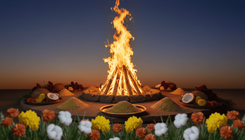
When families gather to light Holika Dahan fires on the night before Holi, they are enacting this ancient triumph. The bonfire represents the fire that could not touch Prahlada. As the fire burns, people offer grain, coconut and other foods, giving thanks for the harvest and asking for blessings. Some families walk around the fire, and in some regions, people pass through the embers as a symbolic act of purification and faith.
The next morning, when children and adults play with coloured powder and water, there is another layer to the joy. The colours represent the colours that Krishna, the central figure of Prahlada's faith, loved. The playfulness and forgiveness that come with Holi—the way old grudges are set aside, the way strangers become friends through play—echo the fundamental truth of the story: that goodness, joy and connection are more powerful than anger and separation.
Even the timing of Holi follows the rhythm of Prahlada's story. The festival falls in the month of Phalguna, at the moment when spring arrives and the world comes back to life. Prahlada's survival of the fire is also a kind of rebirth, a moment when the old order dies and a new truth emerges. This is why Holi, more than any other festival, feels like a genuine new beginning.
Why This Story Still Matters
The holika and prahlada story has been told in Indian homes for thousands of years, and it continues to resonate because it speaks to something universal: the human struggle to hold onto what we believe when the world pressures us to let go. Prahlada's father had wealth, power and authority. Prahlada had only faith. And in the end, faith won.
Today, when we celebrate Holi, we are doing more than lighting a fire or throwing colours. We are remembering that truth cannot be burned away. We are acknowledging that devotion is stronger than force. We are declaring, as Prahlada did, that some things are worth holding onto no matter what the cost.
Common questions
Is Holika Dahan the same as Holi?
No. Holika Dahan is the bonfire lit on the evening before Holi, the main festival day. Holi itself is celebrated the next morning with colours and celebration. Together they make up the festival season, but they are distinct observances.
What does Prahlada's name mean?
Prahlada means 'one who is delighted' or 'one who is gladdened'. The name reflects his nature as a joyful devotee, always singing and meditating on Krishna regardless of his suffering.
Did Hiranyakashyap die in the story?
The holika and prahlada story focuses on Holika's death in the fire. Later, Hiranyakashyap meets his end in a different encounter—when Vishnu appears as Narasimha, the man-lion avatar, to destroy the demon. But the climactic moment of the Holika Dahan story is Holika's burning.

Related Articles


