
The Govardhan Puja Story: Krishna Lifts the Mountain
When Krishna Held Up a Mountain

Kushal K
10 Nov 2026 • 5min
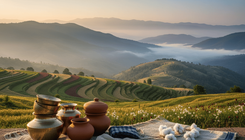
The govardhan puja story tells of Krishna, as a young cowherd boy, performing an extraordinary act of protection. When the people of Braj faced destruction from a deluge of rain sent by Indra, the rain god, Krishna raised the Govardhan Hill on his little finger and held it aloft for seven days to shelter everyone below. This act became the heart of a festival celebrated across India, where people honour Krishna's strength, his care for those who depend on him, and the sacred landscape he saved.



Why Krishna Lifted the Mountain
The story begins with a ritual. The people of Braj, led by Krishna's father Nanda, prepared to conduct a yagna, a sacred fire ceremony, to appease Indra and ensure good rains for their cattle and crops. When young Krishna learned of the plan, he questioned it. Why, he asked, should they worship a distant deity when they should first honour the land they lived on—the forests, the cows, the mountain itself that sustained them?
Krishna persuaded the villagers to perform a ritual instead at Govardhan Hill, the mountain that gave them shelter and pasture. They made offerings of food, milk, ghee and grains directly to the mountain. This act of devotion to the local landscape, and the implicit rejection of Indra's supremacy, angered the rain god. Indra sent a torrent—not gentle rain but a furious deluge meant to destroy Braj.
The Mountain as Shelter
As the catastrophic rains fell, Krishna took action. He lifted Govardhan Hill with one hand, raising it high enough that all the people of Braj, their cattle and their possessions could crowd beneath it. For seven days and nights, Krishna held the mountain while the rain fell ceaselessly. The people sheltered below, protected from the storm.
The story carries a deeper meaning beyond its dramatic surface. The mountain becomes a symbol of Krishna's maya, his divine power to sustain and protect. It shows his capacity to absorb the forces that would harm those devoted to him. In some tellings, Krishna does not merely protect through physical strength; he shelters everyone through his presence, absorbing their fear and transforming the catastrophe into an occasion of grace.
Indra's Submission and Blessing
When the seven-day downpour ceased, Indra himself descended from the heavens to witness what had occurred. Seeing Krishna standing unmoved, the mountain held aloft on his finger, Indra understood the truth of what had unfolded. The boy cowherd was no ordinary child but a divine being. Indra bowed, acknowledged Krishna's superiority, and withdrew his wrath.
In his submission, Indra blessed Krishna and the people of Braj. The rain, which had threatened destruction, now became blessing. The land was watered, the cattle safe, and the people's faith in Krishna had grown immeasurably. What began as a challenge to established authority ended with that authority itself recognising a greater power.
Annakut: The Festival of Food Offerings
Govardhan Puja is also known as Annakut, which means "mountain of food". On this day, people prepare an enormous variety of vegetarian dishes—cooked grains, vegetables, sweets, dairy preparations and fruits—and arrange them in pyramid or mountain-shaped stacks as offerings. The idea is to recreate the abundance of nourishment that Krishna provided to all the people and cattle of Braj during those seven days of shelter.
In temples and homes, the Annakut offering becomes an act of thanks and remembrance. The quantity of food prepared is deliberately lavish; the more varieties offered, the more the devotion is expressed. After the offering is made to Krishna, the food becomes prasad, blessed food, and is shared among all present. This transforms the offering into a communal meal that mirrors the shared protection Krishna once provided.
How the Festival is Observed
Govardhan Puja falls on the day after Diwali in the lunar calendar, part of the Kartik month. People begin by preparing the Annakut offerings early in the morning. Some walk in procession around a hill or even a representation of a hill if a natural one is not nearby. In Mathura and the region of Braj where the story originates, devotees circumambulate the actual Govardhan Hill, a journey that is said to be approximately 21 kilometres long.
Prayers are offered with gratitude for sustenance and protection. Cows are bathed and decorated, as cows hold a sacred place in the Krishna story and in Hindu practice more broadly. Gifts are exchanged, and homes are cleaned and decorated. The mood is one of celebration and thanksgiving, not for deliverance from a specific threat but for the continuous protection and abundance that Krishna is believed to provide.
The festival reflects a particular devotional understanding: that the divine is not distant or abstract but present in the natural world, responsive to sincere worship, and moved by the faith of ordinary people. Krishna's act in lifting the mountain was not performed to gain glory or dominion; it was done because the people needed shelter, and their need called forth his compassion.
Common questions
When is Govardhan Puja celebrated each year?
Govardhan Puja falls on the day after Diwali, during the month of Kartik in the lunar calendar. The date shifts every year according to the Hindu lunar calendar, not the Gregorian one.
What is the difference between Govardhan Puja and Annakut?
Govardhan Puja is the festival that honours Krishna's act of lifting the mountain, while Annakut (mountain of food) is the specific offering of many varieties of prepared dishes that forms the centrepiece of the celebration. Annakut is the food ritual within Govardhan Puja.
How long did Krishna hold the mountain?
According to the traditional story, Krishna held Govardhan Hill for seven days and seven nights while the rain fell without stopping. During this time, all the people and cattle of Braj remained safely sheltered beneath the mountain.

Related Articles


