The Four Vedas in Hinduism: The Foundation of Knowledge
Ancient wisdom that shapes practice and belief

Aditya Pandey
12 Oct 2026 • 6min
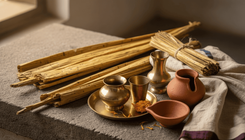
The four vedas in Hinduism are the oldest and most authoritative texts in the Hindu tradition. They are Rigveda, Yajurveda, Samaveda and Atharvaveda. Together they form what is called the Shruti, or "what is heard"—the eternal knowledge that is believed to have been revealed to the ancient rishis (sages) rather than composed by human authors. For thousands of years, these texts have guided ritual practice, philosophy and spiritual understanding across the Hindu world.



The Rigveda: Hymns of Praise and Knowledge
The Rigveda is the oldest of the four vedas. It is a collection of 1,028 hymns, mostly in praise of the devas and the natural forces they represent. These hymns were composed in Vedic Sanskrit, an earlier form of Sanskrit, and were originally transmitted orally from teacher to student, a practice that continues to this day in certain communities.
The Rigveda addresses deities like Agni (fire), Indra (associated with storms), Soma (the sacred drink), and Ushas (the dawn). Through these hymns, the Rigveda explores fundamental questions about existence, the nature of reality and humanity's relationship with the divine. Many of its verses describe rituals and sacrifices that form the basis of Vedic practice. The Rigveda is also valued as a historical and linguistic resource, offering insight into the life and beliefs of ancient peoples in the Indian subcontinent.
The Yajurveda: The Knowledge of Sacrifice
The Yajurveda is the veda of ritual action and sacrifice. The word "yajur" refers to the sacrificial formula or incantation. Unlike the Rigveda, which focuses on hymns of praise, the Yajurveda is a practical manual: it contains the words and instructions for performing yajnas (ritual sacrifices). These rituals were understood to maintain cosmic order and bring material prosperity.
The Yajurveda exists in two main recensions, or versions: the Shukla Yajurveda (the "white" or clear recension) and the Krishna Yajurveda (the "dark" or complex recension). The difference between them lies chiefly in how the sacrificial material is organized. Some sections of the Yajurveda also contain philosophical passages, including parts that reappear in later Upanishads, the texts that form the philosophical heart of Vedic teaching. This connection shows how ritual and philosophy were woven together in ancient Hindu thought.
The Samaveda: The Veda of Melodies
The Samaveda is the veda of melodies and chanting. The word "sama" means song or melody. The Samaveda consists largely of hymns taken from the Rigveda and rearranged so that they can be sung during rituals, particularly during the soma ritual (a ceremony involving the pressing and offering of soma, the sacred drink).
The Samaveda is the shortest of the four vedas, but its significance lies in its musical dimension. The melodies and chanting patterns of the Samaveda are believed to have powerful effects: they are thought to align the performer and listener with cosmic harmony. Even today, trained Samavedi priests preserve these chanting patterns with great precision, and the melodic recitation of Samaveda hymns remains part of many Hindu rituals. The Samaveda also illustrates how sound and vibration are understood as carriers of spiritual truth in Hindu philosophy.
The Atharvaveda: Prayers, Charms and Knowledge
The Atharvaveda is the fourth and final veda. It is named after Atharva, one of the early rishis to whom it is attributed. Unlike the other three vedas, which focus primarily on sacrifice and praise, the Atharvaveda contains a wider range of material: hymns, prayers, charms (called upacharas), and philosophical verses.
The Atharvaveda addresses practical concerns of daily life-healing, protection, prosperity and longevity-alongside deeper spiritual questions. Its charms invoke remedies for illness, blessings for safe travel, and protection from harm. This practical character made the Atharvaveda valuable to many people whose lives did not center on ritual sacrifice. The Atharvaveda also contains important philosophical sections, and some of its verses are quoted in the Upanishads. Because of its broad scope, the Atharvaveda was sometimes recognized separately or even excluded in ancient times, but it is now universally accepted as the fourth veda.
How the Vedas Shape Hindu Practice Today
The four vedas are not scriptures that most Hindus read directly in their daily lives. The language is ancient, the worldview is distant, and the ritual context is often unfamiliar. Yet the vedas remain foundational to Hindu thought and practice in several ways.
The authority of the vedas underpins Vedantic philosophy and the teachings found in texts like the Upanishads and the Brahma Sutras. Many ritual practices, from daily household worship to temple ceremonies draw on Vedic precedent and meaning. When priests perform rituals, they often recite Vedic mantras, invoking that ancient authority. The vedas also supply the conceptual framework through which many Hindus understand dharma (duty and righteous living), the nature of the divine, and the purpose of human life. Even those who have never read them are shaped by a civilization shaped by their teachings.
Study of the Vedas remains a living tradition in certain communities. Vedic schools, called gurukuls, teach young students the ancient texts using traditional methods of memorization and recitation. These students learn to chant the vedas with precise pronunciation and intonation, preserving a tradition of transmission that goes back thousands of years. This dedication reflects the belief that the vedas are not merely historical documents but living knowledge whose proper recitation carries spiritual power.
Common questions
Are the four vedas different from the Upanishads?
Yes. The vedas are the oldest layer of revealed knowledge; the Upanishads are philosophical texts that appear within or are derived from the vedas. The vedas focus on ritual and cosmic order, while the Upanishads explore the nature of Brahman (ultimate reality) and the self. Together they form the foundation of Hindu philosophy.
Do I need to read the vedas to be a Hindu?
No. The vedas are ancient texts that guide practice and provide authority for ritual and teaching, but they are not widely read by most Hindus today. Their influence reaches people through ritual, philosophy, teaching and cultural tradition, rather than through direct study of the Sanskrit texts.

Related Articles