
The Four Ashramas: Stages of Life in Hindu Thought
Living wisely through each season of life

Sunil Chaurasia
12 Nov 2026 • 6min
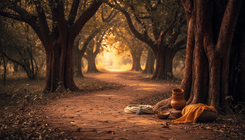
In Hindu philosophy, life is understood not as a single unbroken stretch but as four distinct stages, each with its own purpose, duties and spiritual focus. These four ashramas—brahmacharya, grihastha, vanaprastha and sannyasa—offer a framework for living in harmony with both your nature and the world around you. This stagewise approach teaches that fulfillment comes not from doing the same thing at every age, but from understanding what your time of life calls for and responding to it fully.



Brahmacharya: The Student Stage
Brahmacharya is the first ashrama, often lasting from childhood until the late teens or early twenties. During this stage, the focus is on learning, self-discipline and building the foundation for adult life. A brahmacharya is understood to live under a teacher's guidance, studying not only formal subjects but also the values, skills and self-restraint that will shape their character.
This is the time to develop concentration, respect for knowledge and a willingness to follow guidance. The brahmacharya typically practices celibacy and follows a simple, disciplined routine. While formal schooling may look different today, the underlying principle remains: this stage values growth through learning and the development of inner strength through restraint and dedication. It is a time to ask questions, absorb wisdom and prepare yourself for the responsibilities that lie ahead.
Grihastha: The Householder Stage
Grihastha, the householder stage, typically begins in early adulthood and extends through the active, productive years of life. This is the time to marry, raise a family, pursue a livelihood and engage fully in the world. Where brahmacharya emphasizes restraint, grihastha emphasizes fulfilling your duties—to your spouse, children, parents and community.
This stage is considered the backbone of society. The grihastha earns, provides, makes decisions and takes responsibility. They engage in artha (material well-being), kama (pleasure and relationships) and dharma (righteousness). The householder is not asked to withdraw from life but to live it with integrity and purpose. Supporting others, building something that lasts and contributing to the world around you are the dharmas of this stage. For many people, this is where the deepest learning happens: through the constraints and joys of caring for others, you discover your own capacity for sacrifice and love.
Vanaprastha: The Forest Dweller Stage
Vanaprastha, the forest dweller or retirement stage, traditionally begins as children grow into independence and the active phase of earning and raising a family winds down. This stage is marked by a gradual shift away from worldly engagement toward reflection and spiritual practice. The term vanaprastha recalls the ancient practice of moving to the forest, though in modern life this usually means a shift in focus and energy rather than a literal change of place.
During vanaprastha, the drive to accumulate or control begins to ease. Instead, there is time for pilgrimage, study of scripture, deepening spiritual practice and mentoring younger generations. Relationships with a spouse, adult children and community continue but with a different character—less driven by duty and productivity, more informed by wisdom and a broadening perspective. The vanaprastha is encouraged to loosen attachment to outcome and status, preparing the mind and heart for the final stage.
Sannyasa: The Renunciate Stage
Sannyasa is the final ashrama, a stage of complete renunciation and dedication to spiritual realization. A sannyasi—someone who has entered sannyasa—formally releases all worldly ties, possessions and social roles. They wear simple ochre or white robes, often wander from place to place, and devote themselves entirely to meditation, study and service.
Sannyasa has historically been a monastic path, and many sannyasis live in ashrams or as wandering monks. However, the principle of sannyasa extends beyond monasticism. Even those who do not take formal vows may embody its spirit in their final years—living simply, turning inward, and focusing on spiritual liberation. The sannyasi is freed from social obligation and worldly ambition. Their only duty is to their own spiritual evolution and to serving others from that place of inner freedom.
The Purpose Behind the Stages
The four ashramas are not meant to be rigid boxes but guides reflecting how human capacity and dharma naturally shift across a lifetime. A young person's strength lies in learning and idealism; a middle-aged person's in building and maintaining; an older person's in wisdom and letting go. By honoring each stage as complete in itself, rather than seeing all of life as one continuous pursuit, Hindu philosophy acknowledges that what matters most changes with time.
These stages also reflect the belief that no single way of living is right for an entire life. The restraint of brahmacharya would exhaust a grihastha; the worldly engagement of grihastha would distract a sannyasi. By naming and honoring these shifts, the ashrama system invites you to ask: What is being asked of me now? What does my age and circumstance call for? What becomes possible when I accept where I am rather than clinging to where I was?
This framework offers permission to change, to release what no longer serves you, and to deepen what does. Whether you live all four stages or find yourself in one particular season, the ashramas remind you that every season of life has its gift to give.
Common questions
Can you skip a stage or choose not to follow the ashramas?
The ashramas are presented as an ideal framework, not a law everyone must follow. Life circumstances, health, calling and personal choice all shape whether and how someone moves through them. Many people spend their entire life in one or two stages, and that is acknowledged within Hindu philosophy as valid.
How old are you supposed to be for each ashrama?
The texts do not specify exact ages; instead they describe natural transitions marked by life events like beginning education, marrying, children becoming independent, and aging. Modern life creates different timelines than ancient life, so the principle matters more than a fixed age.
Do only men follow the ashramas?
Historically the ashrama system was primarily framed for men, though women followed their own patterns of duty and spiritual practice shaped by family roles. Contemporary understanding recognizes that both men and women move through seasons of learning, householding, and inner focus across their lives.

Related Articles


