
Sthira Sukham Asanam: What Patanjali Says About Posture
Steady comfort, not Instagram perfection

Aditya Pandey
12 Nov 2026 • 6min
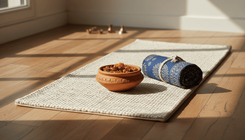
Patanjali defines asana in the Yoga Sutras with a single verse: sthira sukham asanam. Translated simply, it means a posture should be steady and comfortable. This is the foundation of how yoga thinks about the body—not about how your pose looks to someone else, but about how it feels to you.



The verse and its context
The sutra appears in chapter 2, verse 46 of the Yoga Sutras of Patanjali. In that chapter, Patanjali sets out the eight limbs of yoga, the Ashtanga. Asana is the third limb, and sthira sukham asanam is his only direct instruction about it. He does not describe postures. He does not list them. He gives one principle: steady and comfortable.
The word sthira means stable, firm, or rooted. Sukham means at ease, pleasant, comfortable, or joyful. Asanam is a posture or seat. Together, they suggest that your pose should carry two qualities at once: you should be rooted and unmoved, but also relaxed and unstraining. This balance is what Patanjali values, not the shape of the body.
Steady (Sthira)
Sthira refers to the quality of being grounded. When you practise asana, your body is the anchor. The steadiness is not about rigidity—it is not about tensing your muscles and locking into place. It is the kind of steadiness that comes from alignment and awareness. When you sit or stand with sthira, you are present in your body. You do not wobble. Your attention is gathered there.
In the context of the eight limbs, asana prepares the body to sit for meditation. Meditation is a practice of the mind, but the mind will not settle if the body is fidgeting or unstable. Sthira speaks to this need. A steady seat is one that does not demand your attention. It holds you without effort becoming the point.
Comfortable (Sukham)
Sukham is ease, and it is just as important as sthira. A comfortable posture is one you can hold without strain. If you are forcing yourself into a shape, if you are suffering, you are working against the principle. Patanjali does not tell you to push past pain. He tells you to find ease.
This can feel like a revolutionary thought in modern yoga practice, where advanced postures and visible flexibility are often celebrated. But Patanjali was addressing meditation, not acrobatics. He wanted practitioners to be able to sit for a long time without pain becoming a distraction. Sukham is the permission to honour what your body needs today. Some days you sit in a full lotus. Other days you sit in a simple cross-legged pose. Both are asana if both carry sukham.
The balance between the two
The artistry of asana lies in holding sthira and sukham together. They are not opposed, though they can seem that way. If you lean entirely toward sthira, you become rigid and tense. If you lean toward sukham, you collapse into shapelessness. The practice is finding the middle ground where you are both rooted and at ease.
This balance shifts from pose to pose and from day to day. In a standing pose like Tadasana (mountain pose), sthira might be drawing your weight evenly through your feet and lengthening your spine, while sukham is the softness in your belly and the ease in your shoulders. In a seated forward bend, sthira is the length along your spine, and sukham is the permission to bend only as far as your hamstrings allow without rounding painfully.
Teachers in different lineages interpret and emphasize these qualities differently. Some traditions stress the stabilizing actions within each pose. Others place more weight on listening to your body's comfort. Neither is wrong; each is working within Patanjali's principle.
Asana as a gateway to meditation
Patanjali included asana in the eight limbs because the body and mind are not separate. When you settle into a steady, comfortable posture, your nervous system settles too. Your breath becomes easier. Your mind becomes less likely to wander to physical discomfort. The pose becomes almost invisible—not because you are thinking deeply about the shape, but because there is nothing demanding your attention.
This is asana's real purpose. It is not a goal in itself. It is a preparation for pranayama (breath control), meditation, and the deeper practices that follow. Sthira sukham asanam is Patanjali's way of saying: find a seat that lets you go further. The posture should not be the destination.
Reading Patanjali now
The Yoga Sutras were written to address practitioners in a specific time and culture. Patanjali assumed you already knew what asana was—seated postures were the norm. His instruction was about the quality to bring to your practice, not about position-by-position technique.
In modern yoga studios, asana has become elaborate and varied. We stretch in directions. We balance upside down. We chase flexibility and strength. None of this is wrong, but it is not what Patanjali was describing. When you read sthira sukham asanam, you are reading a teacher who wanted you to be stable in your seat, comfortable in your body, and ready to look inward. If that sounds simple, it is. And like many simple things, it takes a lifetime of practice to understand.
Common questions
Where exactly does Patanjali describe sthira sukham asanam?
Sthira sukham asanam appears in the Yoga Sutras, chapter 2, verse 46. This is the only verse where Patanjali directly addresses what an asana should be.
Does sthira sukham asanam mean you should not challenge yourself in yoga?
Not at all. Challenge and growth have their place. But Patanjali is not describing athletic progress or flexibility work; he is defining asana as a meditation tool. The principle means you should not hurt yourself, and you should be able to hold a pose without pain dominating your attention.
Is sthira sukham asanam the reason yoga traditions vary so much?
Different lineages interpret how to embody sthira and sukham in practice, and that variation is part of yoga's strength. One lineage might emphasize alignment actions; another might emphasize listening to the body. Both are working within Patanjali's principle.

Related Articles


