
Spices for the Ayurvedic Kitchen
Healing warmth in everyday cooking

Kushal K
07 Nov 2026 • 7min
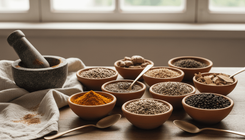
In Ayurveda, the spices you cook with are medicine. The everyday ayurvedic kitchen spices are not garnish or afterthought, but the foundation of how food works in your body. They kindle your digestive fire, move stagnation, warm cold tissues, and cool excess heat. Because Ayurveda sees each person as a unique blend of three doshas—Vata, Pitta and Kapha—the spices you reach for most often depend on your own constitution and what the season calls for. This is not a list of exotic compounds to hunt down. These are the spices you likely already have, used now with intention.



Turmeric and the digestive powerhouse
Turmeric is where most Ayurvedic cooking begins. This golden root is warming and slightly bitter, which means it stokes your digestive fire (agni) and moves toxins out of your tissues. It carries anti-inflammatory action so gentle and broad that it works for all three doshas, though it is especially balancing for Kapha. In the kitchen, a pinch of turmeric in most foods—dals, vegetables, rice—becomes a daily reset. It does not need to be flashy. A small amount in warm milk or ghee before bed is enough.
The reason turmeric works so thoroughly is that it touches both digestion and circulation. Ayurveda teaches that poor digestion is the root of most imbalance, because food that does not digest becomes toxins (ama) that settle in the tissues. Turmeric breaks that cycle by making your digestion stronger and more efficient. This is why it appears in almost every traditional Ayurvedic formulation.
Turmeric works best when absorbed with fat (ghee or oil) and black pepper. The pepper contains piperine, a compound that helps your body absorb turmeric's active principle (curcumin). This is not mystical; it is chemistry that Ayurveda understood long before modern science named the mechanism.
Cumin, coriander and fennel: the trio
These three seeds are the workhorses of Ayurvedic cooking, and they often work best together. Cumin is warming and sharp; it drives digestion and clears gas. Coriander is cooling and slightly sweet; it soothes inflammation and gently detoxifies. Fennel is warming and sweet, with a special affinity for the stomach and lower digestion. Together, they balance each other. Cumin and coriander-fennel teas are served in clinics and homes across India not as luxury but as everyday recovery for sluggish or overeager digestion.
You might have encountered the simple three-seed tea: equal parts cumin, coriander and fennel seeds, simmered in water for five or ten minutes. This is the baseline. No added sweetener needed. The water picks up a gentle, warm flavor that soothes the gut without forcing it. You can sip it through the day, before meals, or after heavy food.
Each seed also works alone. Cumin Rice is a staple: ghee, cumin seeds, rice, and water, cooked together. The cumin infuses the rice as it cooks, warming it without harshness. Coriander is lighter and is often used in fresh chutneys to cool a meal. Fennel seeds might be chewed after dinner to close the meal and settle the belly.
These three are foundational because they do not ask for special conditions. They work for most people in most seasons. Unlike some warming spices that can intensify Pitta (heat-type) imbalance in summer, cumin, coriander and fennel stay gentle and adaptive.
Ginger and black pepper for cold and stagnation
Fresh and dried ginger are both warming, but in different ways. Fresh ginger ignites your appetite and clears congestion; it is what you reach for when food feels stuck or the belly is bloated. Dried ginger is more penetrating and is used in many Ayurvedic formulas to drive warmth into the tissues and strengthen digestion. Both are particularly balancing for Vata and Kapha, though they sharpen Pitta in excess.
Black pepper is sometimes overlooked as a spice in its own right. It is warming, pungent, and carries a unique quality: it reaches tissues that other spices cannot easily reach. In Ayurveda, pepper is used not just for flavor but to carry other medicines deeper into the body. A few black peppercorns ground fresh into warm milk or stirred into soup will sharpen your digestive power and help move stagnant energy. Like ginger, it is Vata and Kapha-friendly and should be used with awareness in Pitta types.
Ginger and pepper together are more powerful than either alone. This pairing appears in many traditional remedies and in everyday cooking wherever digestion needs support.
Asafoetida and the last resort
Asafoetida (hing) is pungent, warming and deeply clearing. A tiny pinch—truly, the size of a grain of rice—goes into dals and vegetables, especially those that are hard to digest like beans or cabbage. Asafoetida cuts through gas and bloating with an almost miraculous speed. It smells sharp and slightly sulfurous in the jar, but it cooks into nothing but gentle help.
The reason to save asafoetida for difficult foods is that a little goes far. You do not need much, and more is not better. It is the spice you use when a meal sits heavy or when someone's digestion is already fragile. In that precision lies its power: Ayurveda does not use a sledgehammer when a nudge will work.
Building your kitchen with seasons and constitution
Choosing which spices to buy and keep depends first on who you are—your constitution—and second on the season. A Pitta person (prone to heat, sharpness and intensity) would reach less often for ginger and pepper in summer, and more for cooling coriander and fennel. A Vata person (prone to dryness, coldness and scattered energy) benefits from the warmth of ginger, cumin and black pepper year-round, with coriander to keep that warmth from becoming drying.
The seasons also call. Warming spices like ginger, cumin and asafoetida belong more in your cooking during Vata season (late autumn and early winter, when the air is dry and cold) and early Kapha season (winter and spring, when heaviness and sluggishness build). In Pitta season (summer and early autumn, when heat peaks) you might shift toward more cooling coriander and fennel, especially if the weather is intense.
This is not dogma. You are learning to listen to what your body needs and to use spices as a real tool. If you feel scattered and cold, warming spices settle you. If you feel overheated and inflamed, cooling spices bring balance. The spices themselves are the medicine; the kitchen is where prevention happens.
Common questions
Should I use fresh or dried spices for Ayurvedic cooking?
Both have their place. Fresh ginger is better for clearing congestion and poor appetite, while dried ginger penetrates deeper into tissues and is used in more formulas. Similarly, fresh spices have lighter action and dried spices are more concentrated. Use fresh herbs and ginger when your digestion is sluggish or blocked, and dried spices for building warmth over time or in formulations.
Can I take the same spices if I do not know my dosha type?
Yes. Turmeric, cumin, coriander and fennel work gently for all constitutions and seasons because they balance rather than push in one direction. If you feel scattered and cold, add warming spices like ginger and black pepper. If you feel overheated or inflamed, use more coriander and fennel. Listen to your body and adjust.
How much turmeric is a safe daily amount?
In cooking, a pinch or one-quarter teaspoon in each meal is a normal intake and carries no risk. If you are taking turmeric supplements or medicinal formulas, follow the directions on the package or the guidance of an Ayurvedic practitioner, as the dose changes depending on the form and your condition.

Related Articles


